Online Rishta in Pakistan 2026: A Family's Step-by-Step Verification Guide
Find out how Pakistani families can safely search for an online rishta in 2026, verify proposals, avoid scams, and choose the right channel for their city.
Online Rishta in Pakistan 2026: A Family's Step-by-Step Verification Guide
Introduction
The tea has gone cold on the table in Okara. A printed biodata sits beside the cups, its margins full of handwritten notes, and every adult in the room is scrolling through profile screenshots on a different phone. This is what a rishta search looks like in 2026: one family, two channels, and no clear process for either.
More than 80% of Pakistani marriages are arranged, and the traditional matchmaker who once brokered those introductions now charges anywhere from PKR 50,000 to PKR 1.5 million depending on the prospect's city, country, and profession. What that fee buys, in most cases, is an introduction and nothing more. No obligation to verify the biodata. No check on the employment claim. No confirmation that the family is who they say they are.
That introduction-only model is exactly where I changed my own approach. The matchmaker in Multan took PKR 75,000 and handed my family a biodata with an employment entry that turned out to be wrong, and that afternoon I stopped paying for introductions and started paying for verification.
A verified platform changes the math, but only within limits. It widens the pool far beyond what any single matchmaker or biradari network can offer, and it screens out the most obvious fraud: fake photos, fabricated biodata, profiles with no verifiable identity.
What it cannot do is decide for the family. The platform is a filter, not a matchmaker. The deciding still happens over tea, with elders asking hard questions and a CNIC check before the first meeting.
That is the promise of this guide. By the end, you will know how to run an online rishta search as a structured process: define your criteria before you browse, verify every candidate before the first meeting, and pick the right channel for your city, whether that is Okara, Multan, Haripur, or anywhere in between.
The Rishta Search Has Moved Online: What Changed by 2026
The shift that made this guide necessary is bigger than any one family's search. It is a structural change in how Pakistani marriages are arranged.
The search that once happened over tea in a living room now starts in a family WhatsApp group. A biodata and two photos circulate before anyone has met. The phone has replaced the living-room introduction, and most families still treat the group as a supplement rather than a replacement. That is the first mistake.
A modern Pakistani rishta platform offers something the WhatsApp group cannot: filters. City, age, sect, caste, profession. A platform like Weddme's rishta search lets a family narrow a pool of thousands to a shortlist of twenty in an afternoon. Useful. It is also where most families over-engineer.
The platform is a filter, not a matchmaker. Weddme states plainly that it does not verify every user identity. Families must verify identity, family background, and proposal details themselves before any meeting or commitment.
That statement is the proof point: the platform widens the pool, the family does the deciding.
Overseas Pakistanis use these same platforms to search back home. A son in Manchester can shortlist a rishta in Faisalabad without booking a flight. That raises a cross-border verification question no one has fully answered. A CNIC check in Lahore is straightforward; a work visa and rental history in Toronto is not. The diaspora effect is real, but it is a question to answer, not a settled fact.
The shift online is not automatically safer. Academic research on Pakistani Facebook matrimony group users documents significant security and privacy concerns. These groups operate under little oversight and are heavily monitored by scammers. Weddme's own statement that it does not verify every user identity is not a fine-print caveat; it is the design. The platform filters, it does not vouch.
I watched a neighbor in Multan join a WhatsApp rishta group for her son. Within days, a profile with a borrowed photo and a too-good-to-be-true government job appeared next to a genuine biodata from a family she knew. The group admin had approved both. She assumed admin review meant verified. It did not.
That assumption cost her three weeks of calls before a relative recognized the photo from a cousin's wedding album. That is why the first rule of online rishta is verify before you meet.
Knowing the shift happened is not enough. The next section turns the search into a repeatable, seven-step family process.
How Online Rishta Actually Works: A Step-by-Step Family Process
Knowing the shift happened is not enough. The search needs a repeatable, seven-step family process. Each step pairs one instruction that matters with one mistake I see families make repeatedly.
1. Define your criteria as a family before browsing. Sit down together and write out the non-negotiables: sect, city, education level, whatever the elders will not bend on. The common mistake is browsing first and letting a polished profile override a core requirement. A well-written biodata can make you forget you needed a doctor from Lahore, not a banker from Karachi.
1. Create a profile with controlled photo privacy. Set photo visibility to approved matches only from day one. The common mistake is uploading identifiable family photos before any vetting. That puts your daughter's picture in front of strangers you have not checked.
1. Filter by the details families discuss first. Use the platform's filters for city, age, sect, caste, profession, and education before you read a single profile in full. The common mistake is skipping filters and scrolling. You waste evenings on proposals that fail on the first phone call.
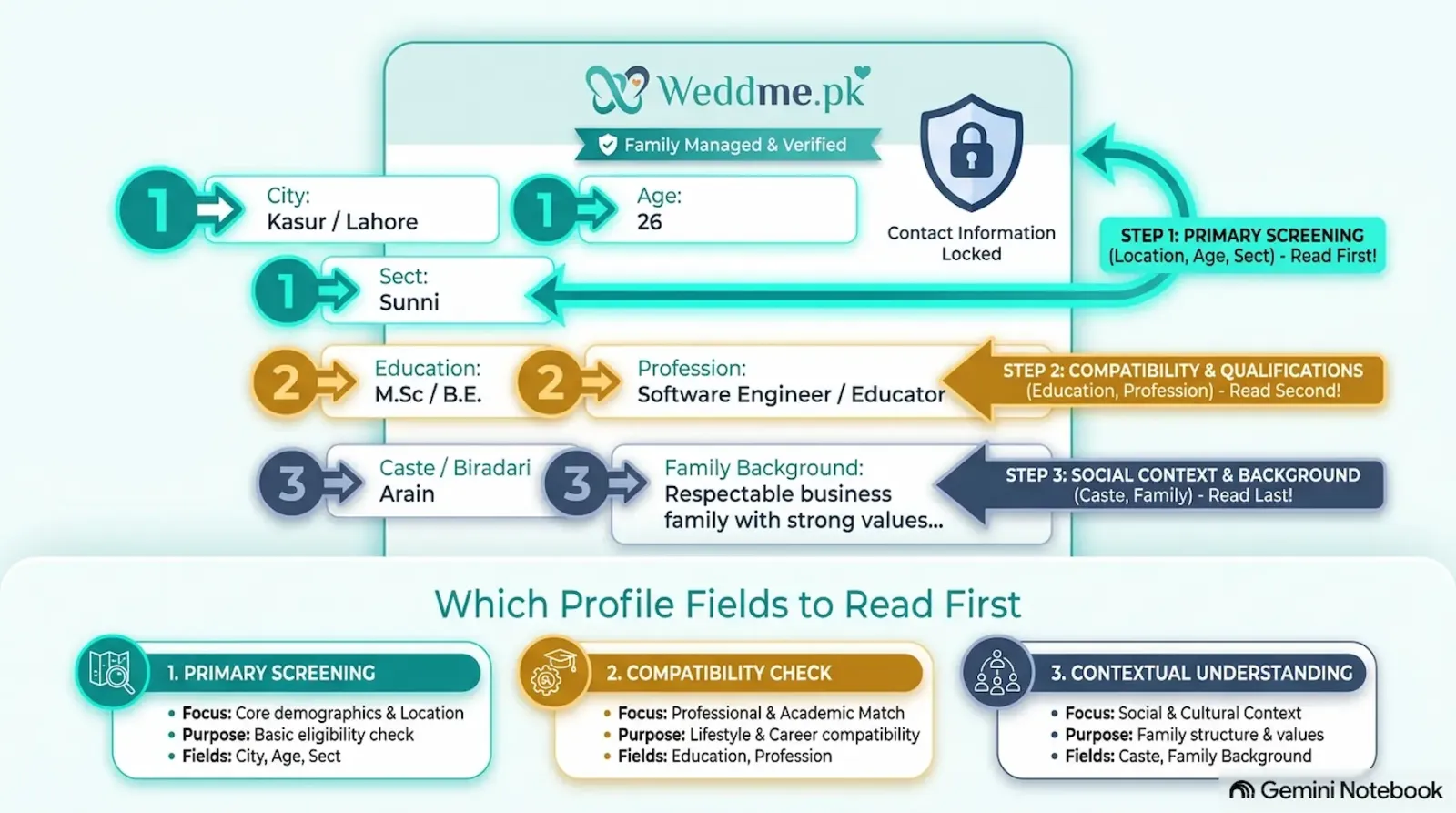
1. Shortlist and exchange biodatas. Move from profile to biodata exchange before any personal chat. The common mistake is treating the platform like a chat app and spending weeks in casual conversation before asking for the biodata. That delays the real screening.
1. Run verification checks. Treat verification as the family's job, not the platform's. The platform does not verify every user, so check identity, family background, and proposal details before any meeting. The common mistake is assuming a "verified" badge means the platform did the checking for you.
Why do families still get burned on a platform that advertises verification? I have watched the same pattern repeat in Okara and Multan. A family reads "verified profiles" on the landing page, assumes the platform checked the person behind the biodata, and walks into a first meeting with zero independent checks. Then a CNIC number does not match, or the "engineer" turns out to be something else entirely. Weddme itself states plainly that it does not verify every user identity, so the family has to check identity, family background, and proposal details before any meeting. The families who treat verification as their own step, not the platform's promise, are the ones who close without a story to regret.
1. Arrange the first family meeting on neutral ground. Meet at a family home, a restaurant, or a neutral venue with elders present, never alone. The common mistake is letting the two young people meet privately first. That skips the family screening the whole process exists to do.
1. Proceed to nikah only after both families are satisfied. Move toward the nikah only when both sides have met, verified, and agreed on the terms. The common mistake is rushing to nikah on profile chemistry alone, before the families have actually sat together and asked the hard questions.
The process only works if the family picks the right channel to run it through, which is the next decision.
Choosing Your Channel: Platform, Rishta Aunty, or Marriage Bureau
The seven-step process only works if the family picks the right channel to run it through. That choice shapes how many profiles you see, how fast you move, and who else sits in the room when decisions get made. Treat it as a decision with real trade-offs, not a loyalty contest.
Three channels sit in front of most Pakistani families. An online platform like Weddme gives you volume, filters, and privacy controls, but the family does its own shortlisting. A rishta aunty brings elder-to-elder credibility and local knowledge, but her network is small and slow. A marriage bureau is a paid human matchmaker, but its register is small, its profiles go stale, and the fees come in stages.
| Factor | Online Platform (e.g., Weddme) | Rishta Aunty | Marriage Bureau |
| Pool size | Large, searchable database | Small personal network | Small paid register |
| Cost | No per-introduction fee | Gift or token, informal | PKR 4,000 to 25,000+ per tier |
| Verification | Family does its own | Elder vouches informally | Claims to screen, rarely verifies |
| Speed | Fast, self-serve browsing | Slow, depends on her calls | Moderate, depends on register |
| Privacy control | High, family controls photos | Low, word spreads | Moderate, bureau holds biodata |
| Human judgment | None built in | Strong, knows families | Moderate, but sales-driven |
| Best for | Volume and filtering | High-credibility introductions | Families who want a paid service |
The costs are real, and they are not small. Bureau registration commonly starts around PKR 4,000 and climbs to PKR 25,000 depending on the package tier, with premium services charging more. Traditional matchmakers charge anywhere from PKR 50,000 to PKR 1.5 million depending on the prospect's area, city, or country of residence and profession. For most of that money, you get little more than an introduction, with no obligation on the matchmaker to verify what they share.
PKR 8,000 in bureau fees bought a register where half the biodatas were two years old, and the switch to platform volume showed me the unmarketed edge: the family could reject thirty profiles in private before a single matchmaker ever heard a name.
That private rejection is the platform's quiet advantage. A rishta aunty takes every "no" personally, and a bureau wants to justify its fee by pushing profiles you have already ruled out.
On a platform, the family filters by the details it discusses first, such as education, city, and sect, and shortlists without anyone's feelings in the way.
That is exactly the trade-off families weigh when comparing platforms and rishta aunties: the aunty vouches for character, but the platform lets you screen fifty profiles before the aunty has made three calls.
City matters here. In Sheikhupura, where bureaus still line the main bazaar, the platform-versus-bureau decision is live for every family choosing a channel in Sheikhupura.
A bureau's register may hold a few hundred biodatas, but many will be stale, and the fee structure means you pay again at each stage.
Move north to Haripur and the same decision shifts: a smaller KP city means fewer bureaus worth trusting, so Haripur's rishta options tilt harder toward platform volume plus one well-connected aunty.
Here is the point every family needs to hear before paying anyone: no channel verifies for you. Weddme explicitly states it does not verify every user identity. The rishta aunty vouches on reputation, not documentation. The bureau sells access, not guarantees. Whichever channel you pick, the family must verify identity, family background, and proposal details itself before the first meeting or any commitment.
So the recommendation lands where the trade-offs meet. Most families close fastest using a platform for volume and one trusted human channel for a few high-credibility introductions. The platform widens the pool and screens out obvious fraud; the aunty or a careful bureau contact brings the introductions that carry elder-to-elder weight. Run both, and let each do what it does best.
Verification and Safety: The Non-Negotiable Layer
Whichever channel a family picks, the next layer is non-negotiable: verification and safety.
Anyone can create a profile in minutes. That is the uncomfortable starting point. A platform's verification badge does not mean the person is safe or genuine. It means a CNIC was submitted. A verification badge on the first profile I shortlisted looked like a green light, and I nearly moved straight to the family meeting.
Then I read the platform's own wording: it does not verify every user identity. The badge confirmed a CNIC had been submitted. It said nothing about the person's intentions, their marital status, or whether their overseas job actually existed. That gap reshaped my whole approach.
I stopped treating the platform as a safety net and started treating it as a filter that widened the pool while my family ran every check ourselves.
Scammers target families showing active interest. The most common scams are fake overseas proposals, fabricated qualifications and income, and fake bureaus that charge fees running from tens of thousands of rupees up to PKR 100,000 for introductions without any verification. A family that responds quickly to a promising profile is exactly the family a scammer wants. The scammer's profile looks complete: a verified badge, a good job abroad, a degree from a reputable institution. None of it is real.
The solution is a six-point checklist the family runs before the first meeting:
1. CNIC check. Confirm the identity document is real and matches the person. A photocopy is not enough; ask to see the original on a video call.
2. Employment verification through the employer's official channel. Call the company's listed number, not a number the prospect gives you. Ask for HR and confirm the person actually works there.
3. Education verification through the institution. Contact the university or college directly. Degrees are easy to fabricate on paper.
4. Marital-status confirmation. This is harder than it sounds. Ask direct questions and cross-check with family contacts.
5. Family background through mutual contacts. Local knowledge still matters. Verifying proposals in Kasur follows its own norms, and what a family in Multan accepts as proof may not satisfy a family in Haripur.
6. A video call before any in-person meeting. If someone refuses a video call, there is a reason.
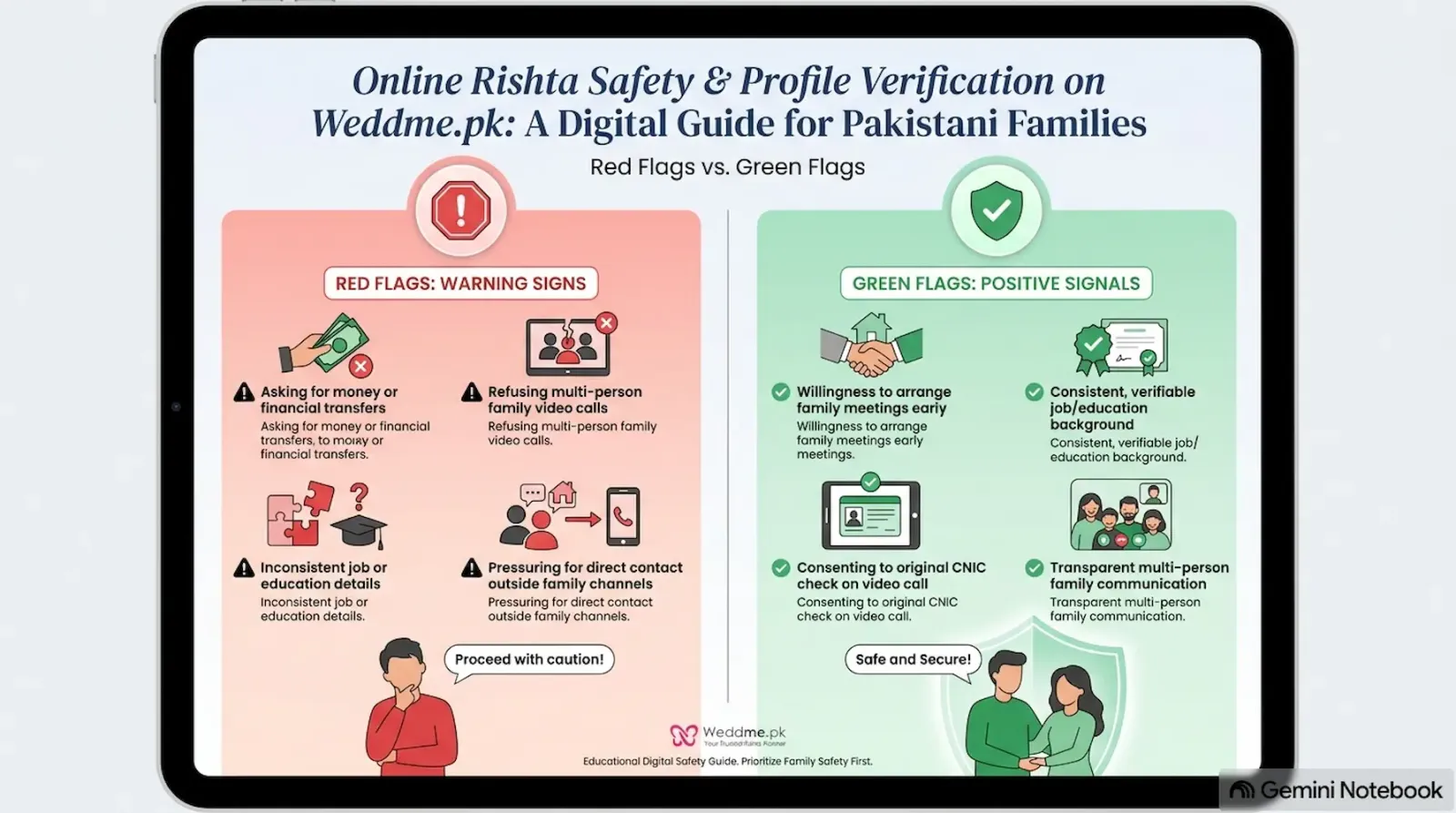
Cut contact at the first red flag. No second chances. The red flags are specific: asks for money before meeting, refuses video call, job details inconsistent across platforms, or pressures for a quick commitment.
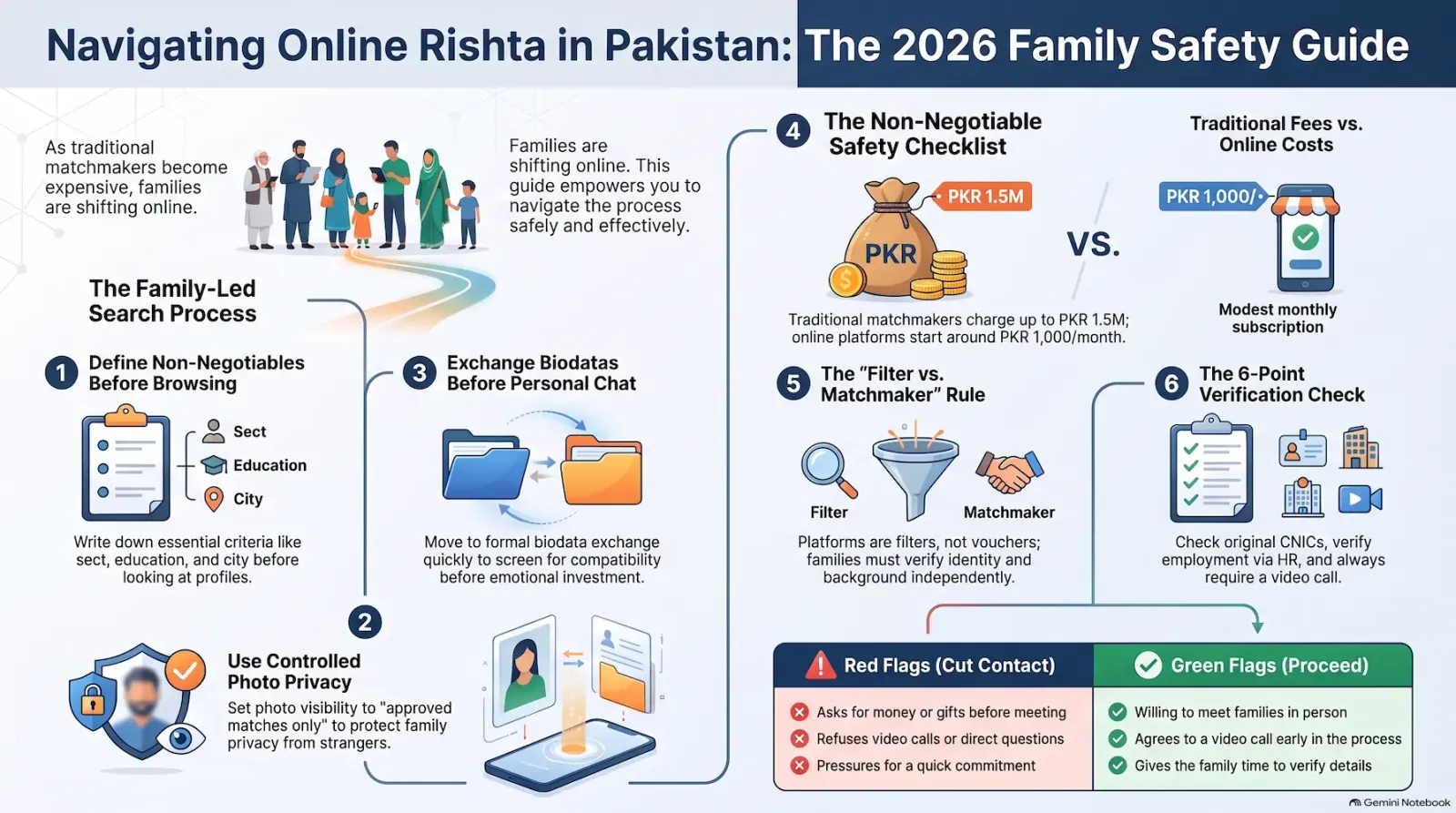
| Red FlagsGreen Flags | |
| Asks for money before meeting | Willing to meet families in person |
| Refuses video call | Agrees to a video call early |
| Job details inconsistent across platforms | Details consistent across platforms |
| Pressures for a quick commitment | Gives families time to verify |
Verification protects the family from fraud. Cultural fit determines whether the match will actually work, which is the next section.
Cultural Fit: What Pakistani Families Actually Discuss First
Verification protects the family from fraud. Cultural fit determines whether the match will actually work. Both matter, but they answer different questions. Verification asks, "Is this person real?" Cultural fit asks, "Will this person fit into our home, our biradari, our Friday gatherings?" The second question is harder, and in practice it comes first.
When a Pakistani family opens a rishta profile, they do not start with personality. They start with a checklist: city, age, marital status, sect, caste or tribe, community, profession, education, family values. On paper these items sound cold.
They are proxies, the shorthand families use to predict social acceptance before investing a single evening in a meeting.
A family in Sargodha knows its own rishta culture and safety norms better than any platform algorithm, and that local knowledge shapes the checklist before the first message is sent.
Through the Multan summer, a family I had been advising for months skipped the sect question on the first pass. The groom's biodata looked strong on paper, right city, solid profession, good education. They agreed to a first meeting without confirming the sect, assuming it would sort itself out. It did not. The father asked about the family's masjid within the first ten minutes, and the conversation never recovered. The checklist item they dismissed as a formality turned out to be the one that mattered most to the elders in the room. That meeting cost them an evening and a lot of goodwill; a five-minute question beforehand would have saved both.
The checklist is a filter. It screens out obvious mismatches so the family does not waste a meeting on a match that will never survive the first family dinner. Most families stop there, and that is too early. The checklist tells you who someone is on paper.
It says nothing about character, deen, and family reputation, and those are the things that decide whether a marriage actually holds. No platform filter can measure how a person prays, how a family makes decisions, or how they handle disagreement.
That work belongs to the family, and it starts in the first meeting.
Ask these questions in the first family meeting, not over chat. How does the family practice deen day to day, not just on Eid? Who makes the big decisions in the household, and does the prospective bride or groom get a voice?
What does the family expect from the wife's role after marriage, and is that expectation spoken or assumed? How did the family handle its last real disagreement, and who did the resolving? The answers reveal more than any biodata ever will.
Second Marriage: Legal and Islamic Rules
One cultural-fit variable deserves its own careful treatment because it carries legal and religious weight: second marriage.
In Islam, a second marriage is a fully valid, ordinary marriage, not a diminished one. The permission comes with a real condition: justice between wives. A man who cannot treat both wives fairly should not take the second step. That religious frame is exactly why the legal process in Pakistan asks about the existing wife's position before anything else.
Under Section 6 of the Muslim Family Laws Ordinance 1961, a man who wants to contract a second marriage while his first wife is still married to him must get written permission from the local Arbitration Council.
The application states the reasons for the proposed marriage and whether the existing wife's consent has been obtained. The Council's permission is a legal requirement, not a formality. For the family, the practical step is to put the reasons in writing and to know the first wife's position before approaching the Council.
The second nikah is then registered with that permission attached, not as a separate lesser process.
"We have already spoken to her," a father in Multan told me, "now we need the Council's paper." That line repeats in almost every second-marriage search I handle: the family settles the existing wife's consent before the first meeting, then treats the Arbitration Council as paperwork, not permission.
Divorced and widowed candidates increasingly set marital-status filters directly on the platform before they browse. This is one area where an online platform clearly outperforms a small bureau with a limited register: a platform can show every profile that already states "divorced" or "widowed," while a bureau can only offer the handful of names in its own file.
second marriage rules covers this in more depth.
The City-by-City Landscape: Where You Search Changes How You Search
Everything so far has been about process and principle. This section grounds it in geography, because where a family searches changes how they search. Pool size, online adoption, bureau presence, and cultural expectations differ sharply from one city to the next. A family in Multan can start with platform browsing and get useful results in days. A family in Okara who does the same will likely drown in mismatched proposals. The starting channel matters.
The table below is directional, not a ranking. Use it to pick a starting channel, then adapt to your family's biradari and criteria.
| City | Online adoption | Bureau presence | Cultural notes | Best starting channel |
| Okara | Moderate | Low | Strong biradari networks, family referrals carry weight | Platform to widen pool, then elders screen |
| Bahawalpur | Growing | Moderate | Emphasis on verified proposals, southern Punjab norms | Platform with verification-first approach |
| Sargodha | Moderate | Moderate | Family-centric, biradari still important | Mix of bureau and platform |
| Multan | High | Moderate | Family-centric search culture, many active profiles | Platform first, bureau second |
| Kasur | Low | Low | Traditional, biradari-heavy | Family referrals plus platform to widen |
| Sheikhupura | Moderate | Low | Close to Lahore, some spillover | Platform with family involvement |
| Haripur | Moderate | Low | Smaller city, strong community ties | Platform to widen beyond immediate network |
Okara
Okara runs on biradari. The pool of eligible matches is moderate, but the real filter is the extended family network. A rishta aunty who knows three generations of both sides still carries more weight than a hundred platform profiles. Treat that as your starting point, not an obstacle.
During a consultation with a family in Okara last winter, I made a mistake that cost them three weeks. I told them to skip the elders and go straight to platform matches. Within two weeks they had a dozen proposals, none of which fit their biradari expectations, and the elders felt sidelined. The fix was simple: route every lead back through the elders for a first-pass biradari check before any serious conversation. The platform widened the pool, but the family did the deciding.
The platform's role here is to widen the pool beyond the immediate network without bypassing family involvement. Use it to surface candidates from nearby towns and other biradaris, then hand each one to the elders for a compatibility screen. The full walkthrough of finding proposals in Okara covers the exact sequence, including how to present platform leads to skeptical relatives.
Bahawalpur
Bahawalpur families want proof before the meeting. Southern Punjab norms put a premium on verified proposals, and that changes the order of operations. In Multan you might browse first and verify later. In Bahawalpur you verify first, then agree to meet. The verification checklist from earlier applies here with extra weight. Check the CNIC, confirm the biodata details, and ask for the nikah registration if there is a prior marriage. Do it before the first family meeting, not after.
The city-specific deep dive on verified proposals in Bahawalpur shows how to apply that checklist without making the other family feel interrogated. The tone matters. A firm but respectful request for documents is normal here. A family that refuses to share basic verification is a red flag, not a negotiation point.
Multan
Multan is the high-adoption, high-pool example. Many active profiles, a family-centric search culture, and a case where a platform first, bureau second strategy works best. Start with the platform because the volume is there and the filters let you narrow by biradari, education, and city in minutes. Only after you have a shortlist do you bring in a bureau or a rishta aunty for the human checks that platforms cannot do.
The worked example of finding proposals in Multan shows a large-pool search done right: define criteria before browsing, use marital-status filters if relevant, and keep the family in the loop at every step. The risk in a high-pool city is decision fatigue, not scarcity. A family that browses without criteria will waste weeks on profiles that look fine but do not fit.
The city landscape raises the questions families ask most often, answered directly in the FAQ.
finding proposals in Okara covers this in more depth. verified proposals in Bahawalpur covers this in more depth. finding proposals in Multan covers this in more depth.
FAQ
City by city, the search changes. But five questions come up in every family meeting I sit through, from Okara to Haripur. Here are the direct answers.
Is online rishta safe?
As safe as your own verification. Weddme states plainly that it does not verify every user identity, so treat every profile as unverified until you check it. Ask for the CNIC, confirm family background through biradari or mutual contacts, and check proposal details against the biodata before any meeting or commitment.
How do I verify a proposal before families meet?
Start with the CNIC. Then confirm the family through biradari or mutual contacts. Finally, check every claim in the biodata against what the family says. A mismatch on any of these is a red flag. Stop and investigate.
What are the most common scams?
Three patterns repeat. Fake profiles with stolen photos. Requests for money or gifts before any meeting. Men hiding an existing first marriage. If a profile asks for money early, walk away. If a photo looks too polished, reverse-check it. If a man avoids questions about his marital history, dig deeper.
Platform or marriage bureau?
A platform is a filter. It widens the pool and screens obvious fraud, but it does not matchmake. A marriage bureau charges anywhere from PKR 50,000 to PKR 1.5 million for an introduction, depending on the prospect's area, city, or profession, with no obligation to verify what it shares. For most families, the platform plus your own verification does more for less.
How do I find a second marriage proposal online?
A man seeking a second marriage must obtain written permission from the local Arbitration Council under Section 6 of the Muslim Family Laws Ordinance 1961. The application states the reasons for the proposed marriage and whether the first wife consents. No permission, no valid second nikah.
Conclusion
Start with the family's criteria. Then browse with intention.
Most families begin the way their parents did. A relative mentions a suitable boy or girl. A printed biodata passes through two or three hands, and the family waits for word of mouth to deliver. That process works, but it is slow and narrow, and it leaves you dependent on whoever happens to know someone.
The families who close fastest work differently. They choose one verified platform, settle the channel question early, and run the same verification checklist before every first meeting. The search becomes a structured project instead of a scattered hope.
A neighbor's daughter was engaged within six weeks, and the only difference from the families I've watched stall for a year was that her parents wrote their non-negotiables on paper before opening a single profile.
The platform widens the pool and screens out the obvious fraud. The family does the deciding, and that deciding starts before the first profile is opened.
A closing 'First Week Checklist' gives the family an immediate next step: Day 1 agree on non-negotiable criteria, Day 2 create the profile with controlled photos, Day 3 shortlist ten candidates, Day 4 verify the top three, Day 5 arrange the first family meeting.
So begin there. Sit down as a family and write your non-negotiable criteria. Then create the profile and browse with intention, not casually. The platform is a filter, not a matchmaker. Your family is the one who decides.
Compare profiles when your family is ready.
Use Weddme search filters to review profiles with clearer context before starting a serious conversation.