Sargodha Rishta Guide: Population, Culture, Education & Marriage Trends
Sargodha families no longer have to depend entirely on brokers, repeated bureau fees and incomplete profiles. This guide explains the city’s rishta culture, biradari preferences, education landscape and current marriage-safety requirements. It also shows families how to search, shortlist and verify proposals through Weddme’s direct, no-commission model.
The Sargodha Family’s Matchmaking Dilemma
If you have ever paid a marriage bureau thousands in registration fees or commission, only to receive a few incomplete profiles and no proper follow-up, you already understand the frustration. Brokers often make strong promises before payment. Afterwards, calls go unanswered, suitable proposals stop arriving, and basic details turn out to be inaccurate.
Picture a father in Sargodha spending several weeks visiting marriage bureaus and speaking with different intermediaries. He explains the family’s biradari preference, education expectations, religious values and acceptable location. Yet he repeatedly receives profiles that do not meet those requirements or discovers that important information was never verified.
For overseas Pakistanis, the difficulty can be even greater. A family living in the UK or UAE may want a match with roots in Sargodha, but without a reliable local relative, it is difficult to know which profiles are genuine. Distance makes family verification, neighbourhood inquiries and direct communication harder.
The problem is not a shortage of rishtas.
It is the lack of accurate information, responsible communication and direct family involvement.
Why a City-Specific Rishta Guide Matters
A generic national matchmaking website cannot fully explain how rishta decisions are made in Sargodha. Local families consider more than age, occupation and appearance. Biradari, family reputation, education, religious practice, neighbourhood, village connections and plans for living in Pakistan or abroad may all influence the decision.
A family seeking an Awan or Rajput rishta in Sargodha faces a different social landscape from a family searching in Karachi or Lahore. Even within Sargodha District, expectations can vary between city-based households, agricultural families and people living in surrounding towns and villages.
This guide brings that local context into the search. It combines demographic and education data with practical instructions for finding, assessing and verifying a proposal through Weddme’s direct, family-to-family model.
By the end, you will know how to narrow your search, create a useful profile, control your privacy and evaluate a rishta before either family becomes deeply involved.
What This Guide Will Help You Do
You will gain:
- An understanding of Sargodha’s population, education landscape and cultural factors that influence rishta decisions.
- A clear explanation of how Weddme’s direct, no-commission model differs from a traditional marriage bureau.
- Step-by-step guidance for creating a profile, searching for suitable matches and managing privacy settings.
- A practical checklist for checking the identity, education, employment and family details connected to a proposal.
- An understanding of the applicable legal marriage age and the risks of child marriage, so your family can make a lawful and responsible decision.
Last reviewed: September 2026
Population, literacy and marriage-related statistics in this guide are presented with their relevant source year and geographic coverage.
Bookmark this guide and share it with the parents, siblings and guardians involved in your rishta search. When your family is ready, visit Weddme.pk to begin a direct, family-to-family search with no commission.
Sargodha’s Matchmaking Landscape: Why Local Context Matters
Understanding Sargodha as a Marriage Market
Sargodha’s rishta culture is shaped by three forces: agricultural roots, strong biradari networks and a growing educated professional class.
Landholding and extended-family connections still carry weight, particularly outside the main city. Families often know one another through a village, common relatives or long-standing community relationships. This can make the first introduction easier, but it does not automatically make a proposal suitable.
Awan and Rajput families form an important part of Sargodha’s social landscape, and some households prefer a match within their own biradari. Others are more flexible but still ask about family background early. These preferences are not identical across every household. Education, profession, religious practice and the character of the prospective bride or groom increasingly influence the final decision.
Families are therefore looking for a careful balance. They want someone who understands their roots without being restricted by outdated expectations. A degree, stable profession and compatible plans for married life may matter just as much as biradari.
Education deserves particular attention. Sargodha’s literacy figures show continued progress, but the difference between male and female literacy remains visible. This makes a genuinely educated and professionally settled match highly valued and makes it important to verify qualifications rather than relying on a broker’s description.
The same local connection matters to overseas families. Parents living in the UK, UAE, Saudi Arabia or elsewhere may still want a rishta connected to Sargodha. They may prefer someone who understands the family’s language, customs and community relationships, even if the couple will live abroad after the nikah.
Without a dependable contact in Sargodha, however, these families can struggle to confirm what they are being told.
Key takeaways
- Biradari remains relevant, particularly among Awan and Rajput families, but preferences vary from one household to another.
- Education and professional stability increasingly influence which proposals families consider seriously.
- The literacy gender gap makes verified education details especially important during a rishta search.
- Overseas families often seek Sargodha roots while planning married life in another country.
- Traditional bureaus frequently fail to filter proposals according to a family’s full requirements.
The Problem with Traditional Marriage Bureaus in Sargodha
The main problem is not simply the fee. It is paying without knowing what service the fee actually covers.
Some marriage bureaus charge an initial registration amount and then request more money for introductions, profile access or “priority” proposals. The family may never receive a written fee structure. If a proposal fails at the first conversation, there is often no refund and no guarantee that another suitable profile will follow.
Verification is another weak point. A profile may list a university degree, government job, overseas residence or specific family background without showing how any of it was checked. Photographs may be old. Employment details may be incomplete. In serious cases, the identity behind the profile may not be genuine.
Then there is poor matching. A broker may send an Awan family Rajput profiles after being told that the biradari preference is firm or reject a suitable proposal because the family’s requirements were never recorded properly. Education, age range, sect, location and plans for living abroad are treated as casual notes instead of essential search criteria.
This wastes more than money. It creates repeated discussions inside the home, raises expectations and exposes private family information to people who may have no serious interest in the proposal.
A direct model changes who controls the process. Families create their requirements, review profiles and decide when communication should move forward. There is no broker being paid to keep the introduction alive.
Sargodha Rishta Data Snapshot
| Indicator | Available figure | Why it matters |
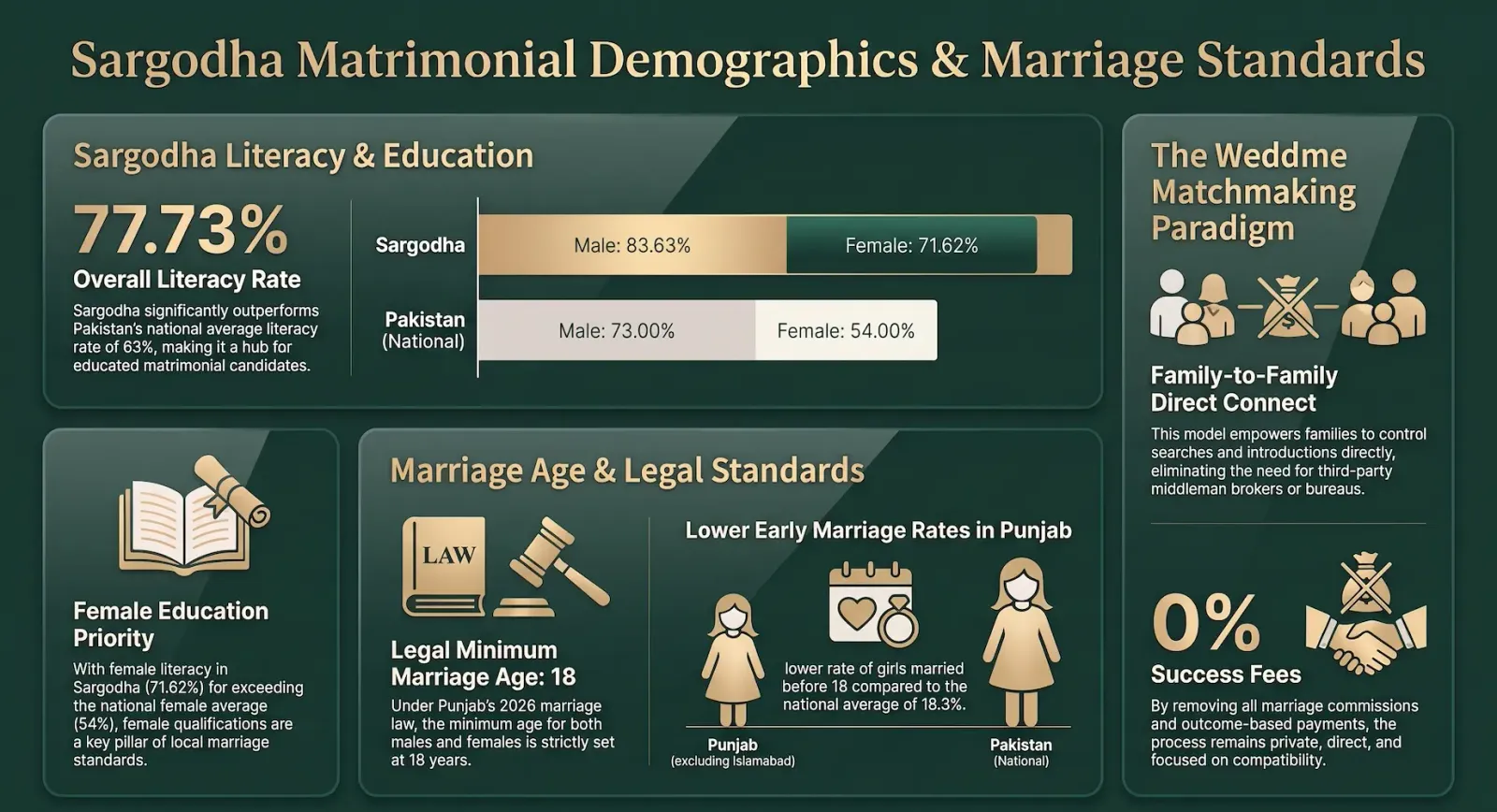
| Sargodha literacy rate | 66.73% overall | Education is becoming a stronger rishta consideration |
| Male literacy in Sargodha | 73.63% | Shows the continuing gender difference |
| Female literacy in Sargodha | 59.62% | Qualifications should be stated and checked clearly |
| Pakistan literacy rate, age 10+ | 63% overall; 73% male and 54% female | Provides a national comparison |
| Minimum marriage age in Punjab | 18 for both females and males | Applies to Sargodha under Punjab’s 2026 law |
| Girls married before 18 in Pakistan | 18.3% | National estimate from the 2017–18 PDHS |
| Girls married before 18 in Punjab, excluding Islamabad | 14.8% | Regional estimate reported for 2018 |
| Weddme model | Direct, family-to-family and no commission | Families control the search and introductions |
Data note: Literacy percentages must be published with their geographic definition and source year because “Sargodha city” and “Sargodha district” are not interchangeable. Pakistan’s 63% literacy figure applies to people aged 10 and above in the 2024–25 HIES. The child-marriage estimates describe women aged 20–24 who were first married before age 18; they do not mean 18% of all girls are currently married. Punjab now sets 18 as the minimum marriage age for both sexes. Pakistan Bureau of Statistics, Pakistan Demographic and Health Survey 2017–18, Punjab Child Marriage Restraint Act 2026, UNFPA Pakistan.
Sargodha Population and Demographics Overview
Why Demographics Shape Your Rishta Search
Start with the size of the actual profile pool, not the population headline.
Sargodha District recorded 4,334,448 residents in the 2023 census, including 2,194,156 males and 2,139,911 females. Around 37% of the district’s population lived in urban areas. These are district figures, so they include Sargodha city and the surrounding tehsils, towns and villages. Pakistan Bureau of Statistics, 2023 Census
That does not mean four million possible matches. The useful pool becomes smaller after a family applies age, marital status, sect, biradari, education, profession and location preferences. It narrows again when both sides’ expectations must align.
Community connections also overlap. Two families may discover common relatives, neighbours, school connections or links to the same village. Reputation can travel quickly, which helps with verification but also makes privacy important. Do not circulate a profile throughout the biradari before the other family has agreed to proceed.
The male-to-female difference in the district population is modest. A stronger imbalance may appear on an individual rishta platform because some families are more willing to publish a groom’s profile than a bride’s. That platform imbalance should not be presented as a demographic fact.
Check the current profile count before fixing your requirements too tightly.
Key takeaways
- Census population does not equal the number of available or compatible rishtas.
- The ratio of bride and groom profiles can differ considerably from Sargodha’s general population ratio.
- A narrow combination of biradari, age, education and profession will produce a smaller pool.
- If results are limited, widen one preference at a time instead of abandoning every family requirement.
- If privacy is the concern, adjust visibility before expanding the search.
Verifying the Population Figure
Use the Pakistan Bureau of Statistics 2023 Digital Census as the primary source.
The confirmed population of Sargodha District is 4,334,448. Do not label this as the population of Sargodha city. The district includes several tehsils and a substantial rural population.
If the article requires a city-only figure, state exactly which boundary is being measured such as Sargodha Municipal Corporation, Sargodha Cantonment or a combined urban area. Do not substitute a commercial “metro population” estimate for an official census count.
Source note: Population figures in this guide refer to Sargodha District unless a table specifically states otherwise. The figures come from Pakistan’s 2023 Population and Housing Census and should be rechecked against the official PBS census report whenever this guide is updated.
Culture and Biradari in Sargodha Matchmaking
The Role of Biradari and Caste in Rishta Decisions
In many Sargodha households, biradari is an early screening question.
Awan and Rajput communities are prominent in the region, although Sargodha includes many other castes, tribes and family backgrounds. Some parents consider only proposals from their own biradari. Others will consider a wider community if education, deen, profession and family values are compatible.
Even when the biradari name matches, families usually ask more questions. They may want to know the sub-clan, ancestral village, known relatives and the family’s local reputation. A shared label alone does not establish that two households will be comfortable with each other.
The usual shortlist therefore develops in stages. A family checks biradari or community first, followed by sect, age and marital status. It then considers education, employment, family circumstances and plans after marriage.
Overseas families can be more particular about these roots. A household settled in the UK or UAE may use biradari and ancestral location to maintain its relationship with Sargodha. That preference is understandable, but it should not replace proper compatibility and background checks.
Key takeaways
- Awan and Rajput are among Sargodha’s prominent biradari communities, but they are not the only ones.
- Some families use biradari as their first filter; others treat it as one factor among several.
- A matching biradari name does not confirm compatible values or a good family reputation.
- Sub-clan, village connections and known relatives may influence the family’s review.
- Diaspora families may give additional weight to Sargodha roots.
Balancing Tradition with Modern Search Methods
Using an online platform does not require a family to abandon its traditions.
The search method changes. The family’s standards do not.
Some parents worry that a national platform will show hundreds of irrelevant profiles with no way to apply local preferences. Weddme allows families to begin with city, caste or tribe, community, sect, age, marital status, profession and education. Families can search within their preferred biradari and then compare the details that matter after the first filter. Weddme Rishta Search
This gives families more control than handing a list of requirements to a broker and waiting for whatever arrives. It also makes the trade-off visible. If a very narrow biradari search produces few profiles, the family can decide which single requirement location, age range or profession it is willing to broaden.
Weddme’s cultural specificity comes from searchable fields that Pakistani families already discuss. Avoid claiming that competitors lack equivalent filters unless those services have been reviewed on the same date using the same criteria.
Sargodha’s Cultural Norms Around Family Involvement
A Sargodha rishta is rarely evaluated by one person alone.
Parents may begin the search. Siblings review photographs and education details. An uncle, phuppo or trusted family friend may know the other household. The prospective bride or groom must then consider whether the person’s temperament, plans and expectations are compatible with their own.
This discussion often happens exactly where family decisions have always happened: around the dining table.
Weddme supports a family-led process by allowing a profile to identify whether it is managed by the candidate, a parent, a guardian or another family representative. Families can review profiles together and agree on a shortlist before making contact.
However, a shared multi-user family co-account with separate logins has not been publicly confirmed. Do not advertise that feature until it is available and tested.
Until then, use a simple family review process:
- Agree on the non-negotiable requirements.
- Let one responsible person manage the account.
- Review shortlisted profiles with the candidate and relevant family members.
- Record important questions before contacting the other family.
- Do not share account credentials or private profile information unnecessarily.
The platform can organise the search. The family must still provide judgment, respectful discussion and final consent.
Education and Literacy in Sargodha: What Families Should Know
Why Education Matters in Sargodha Rishta Decisions
Education is one of the first serious compatibility questions in many Sargodha rishta discussions.
Families are not only comparing degrees. They are trying to understand how the prospective bride or groom thinks, communicates and plans for married life. For a daughter with a university education or established career, her family may want someone who respects her qualifications and can discuss whether she will continue working. A family seeking a bride for an educated son may have similar expectations about education, communication and household decisions.
This becomes especially important for overseas families. A spouse moving to the UK, UAE or another country may need language skills, professional qualifications or the ability to adjust to a different education and employment system.
Education can support professional opportunities, but a degree does not prove good character, financial stability or shared family values. Check each matter separately.
Key takeaways
- Official 2023 census data show a clear literacy gap between men and women in Sargodha District.
- Educational expectations should be discussed before families become emotionally committed to a proposal.
- Ask for the complete qualification, institution, subject and completion year.
- Discuss plans for employment or further education after marriage.
- Do not use a degree as a substitute for checking character, conduct and family expectations.
Sargodha Literacy Comparison
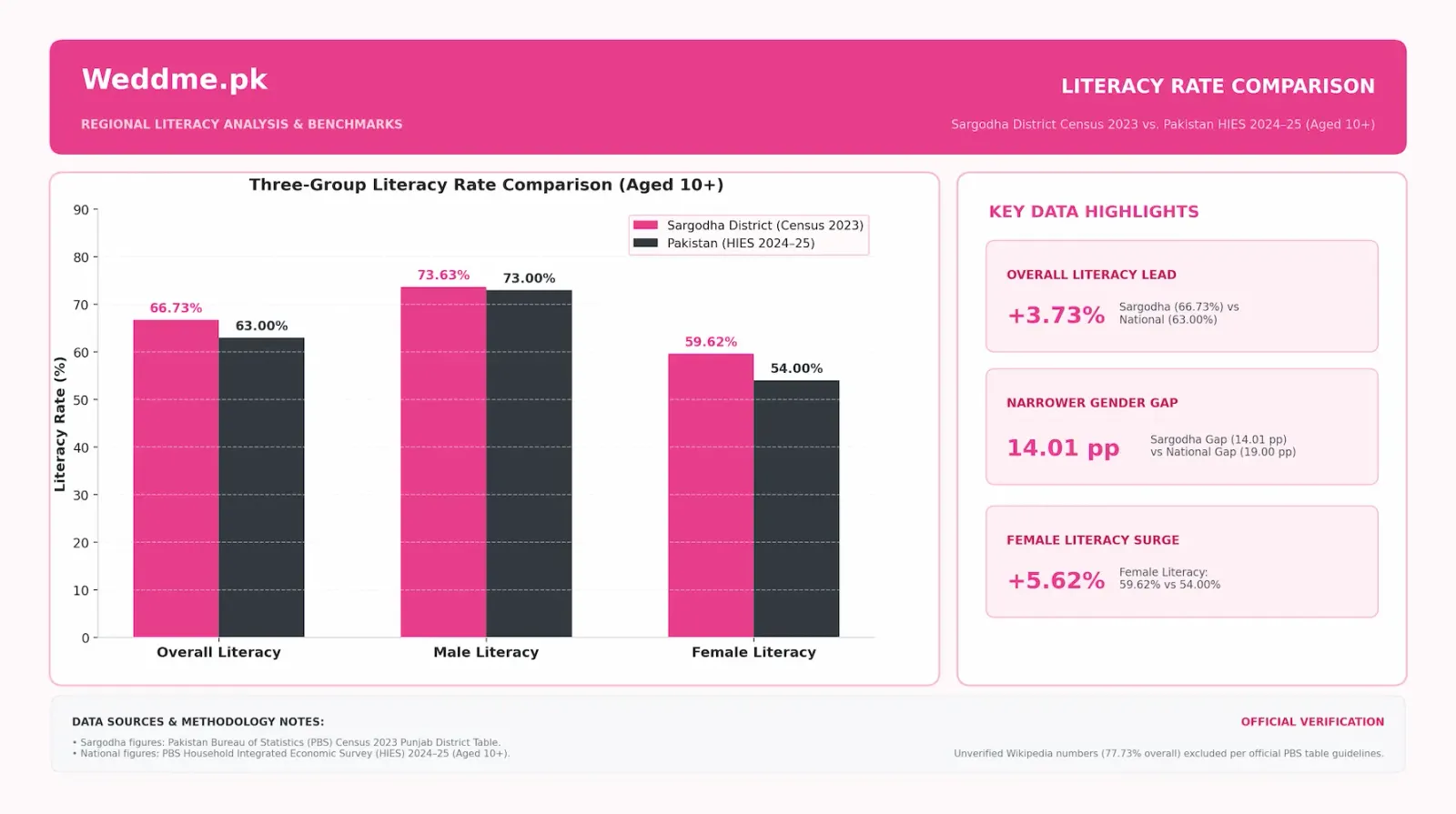
The latest official 2023 census figures show an overall literacy rate of 66.73% in Sargodha District, with male literacy at 73.63% and female literacy at 59.62%.
| Indicator | Sargodha District | Pakistan | Sargodha data year | Pakistan data year |
| Overall literacy rate | 66.73% | 63% | 2023 | 2024–25 |
| Male literacy rate | 73.63% | 73% | 2023 | 2024–25 |
| Female literacy rate | 59.62% | 54% | 2023 | 2024–25 |
| Male–female gap | 14.01 percentage points | 19 percentage points | 2023 | 2024–25 |
Source: Sargodha figures come from the Pakistan Bureau of Statistics’ Census 2023 Punjab district table. National figures come from the PBS Household Integrated Economic Survey 2024–25. Both sets report literacy for people aged 10 and above, but they come from different years and data exercises. PBS Census 2023 Punjab literacy table, PBS HIES 2024–25.
Do not restore the Wikipedia percentages unless their original survey, year, age definition and geographic boundary can be confirmed.
Using Literacy Data to Assess Educational Compatibility
The numbers provide context, not a rule for judging an individual.
Sargodha District’s female literacy rate of 59.62% is above the national female rate of 54%, based on the latest available figures used here. However, the comparison is not exact because the Sargodha number comes from the 2023 census and the national number comes from the 2024–25 HIES.
More importantly, “literate” does not mean “university educated.” Literacy measures the ability to read and understand simple text under the survey definition. It does not tell you how many available rishta candidates hold a bachelor’s degree, work in a particular profession or intend to continue studying.
Ask direct questions:
- What is the candidate’s complete qualification?
- Which institution awarded it?
- Was the programme completed, or is it still in progress?
- What is the candidate’s current profession?
- Does the bride intend to work or study after marriage?
- Is the prospective groom comfortable with that plan?
- If the couple will live abroad, will the qualification be recognised there?
Verify the answer when education is an important condition. Ask to see the degree or transcript respectfully, and allow the other family to request the same evidence from you.
Underage and Child Marriage: Legal Awareness for Families
The Legal Marriage Age in Sargodha
For families in Sargodha, the legal minimum marriage age is 18 for both females and males.
This requirement comes from the Punjab Child Marriage Restraint Act 2026, which applies across Punjab. It is more accurate to say “the legal marriage age in Punjab” than “the legal marriage age in Pakistan,” because marriage law can differ by province and territory. Punjab Child Marriage Restraint Act 2026
Any Sargodha proposal involving a person below 18 must be refused. Do not accept an assurance that the nikah can occur now and registration can happen later. Do not allow biradari pressure, a verbal engagement or an elder’s promise to override the law.
This is not only a legal boundary. It protects the young person’s education, health, safety and ability to give meaningful consent.
Key takeaways
- The minimum marriage age in Punjab is 18 for both sexes.
- The rule applies equally to proposals for daughters and sons.
- Check age through official documents before fixing a nikah.
- Treat inconsistent dates of birth as a serious warning.
- Refuse and report a suspected underage proposal.
Child Marriage in Punjab and Pakistan
The available data show why families must remain alert.
The 2017–18 Pakistan Demographic and Health Survey found that 18.3% of women aged 20–24 had married before turning 18. For Punjab excluding Islamabad, the corresponding 2018 estimate was 14.8%. These figures are commonly rounded to 18% nationally and 14.8% for Punjab. Pakistan Demographic and Health Survey 2017–18, Child Marriage Data Pakistan.
Read the statistic carefully. It does not mean that 18% of all girls in Pakistan are currently married. It measures the share of women aged 20–24 who were first married before age 18.
The figures are based on 2017–18 data and may not describe the exact position in 2026. Until a newer comparable survey is published, they remain useful as evidence that child marriage has affected a substantial number of Pakistani families.
For Sargodha parents, the lesson is simple: never assume age because someone looks mature, has completed matric or comes through a known biradari contact.
Verify it.
How to Protect Your Family From an Underage Proposal
- Ask for the full date of birth.
- Do this before arranging a formal meeting or discussing a nikah date.
- Check an official document.
- Review the candidate’s CNIC. If the person is still presented through a child-registration record, do not proceed with a marriage proposal.
- Compare every date provided.
- The age stated on the profile, CNIC and education documents should be consistent.
- Treat hesitation as a warning.
- If the family avoids showing documents, changes the date or asks you to “manage” the registration later, stop the discussion.
- Report the profile.
- Notify Weddme immediately if an account appears to involve a person below 18.
- Contact the proper authority when a child may be at risk.
- In Punjab, concerns can be reported to the Child Protection and Welfare Bureau through Child Helpline 1121. Contact local police when there is an immediate danger. Punjab Child Protection and Welfare Bureau
- Explain the law to younger relatives.
- Make sure they know that they can refuse an underage proposal and speak to a trusted adult.
How Weddme’s No-Commission, Family-to-Family Model Works
The Problem With Commission-Based Matchmaking
A traditional marriage bureau controls the introductions. That creates a financial incentive families cannot always see clearly.
Some bureaus charge a registration fee. Others request payment for each introduction, a larger amount after a successful match or additional charges for continued access. Families may only discover the complete cost after they have already shared private information or started discussing a proposal.
Do not assume that every Sargodha bureau charges a percentage of dowry or haq mehr. That practice should only be mentioned when supported by written evidence from a named bureau. The safer and more accurate point is that bureau pricing is often difficult to compare because charges, refund conditions and promised introductions may not be provided in writing.
The payment structure can also affect which profiles a broker presents. A broker who earns from introductions may benefit from arranging more conversations, even when the families’ education, biradari or location requirements do not align.
The family is then waiting for callbacks while someone else decides which profiles it may see.
Key takeaways
- Bureau charges may include registration, profile access, introductions or a success fee.
- Families are not always given the full fee structure and refund policy in writing.
- A broker’s financial incentive may favour more introductions rather than careful compatibility.
- Families lose visibility when a middleman controls the available profiles.
- Never pay a bureau until its services, charges and refund terms are documented.
Weddme’s Direct, Family-to-Family Approach
Weddme does not operate as a traditional marriage bureau.
Families create their own profiles, apply search filters and compare suitable rishta options directly. They decide which profiles to shortlist, when to send an interest and when a conversation should move beyond the platform.
There is no broker choosing proposals behind the scenes. Weddme provides the directory, filters, messaging tools and privacy settings. Your family remains responsible for the search and final evaluation.
The commercial model is also different. A family can create a free profile and then select a membership plan if it needs the features offered in that plan. Weddme states that it does not charge a marriage commission, success fee or percentage after a match is found. There is also no separate per-introduction charge beyond the access included in the selected plan.
Check the Weddme pricing page before subscribing. Prices, billing cycles and included features can change.
How the process works
- Create the profile.
- Enter accurate information about age, city, marital status, education, profession, sect, caste or tribe, family background and partner preferences.
- Set your privacy choices.
- Decide what information and photographs should be visible before the profile becomes active.
- Search directly.
- Use filters such as city, age, education, profession, sect, marital status, caste and community.
- Review the full profile.
- Do not shortlist from a photograph alone. Compare the family’s stated background and expectations.
- Begin inside the platform.
- Use the available interest or messaging tools before sharing a private number.
- Move forward when both sides are comfortable.
- Arrange a family video call, complete independent checks and then consider an in-person meeting.
- Pay no success commission.
- If a rishta succeeds, Weddme does not take a percentage or post-marriage payment.
Membership note: Weddme uses transparent membership plans, not a traditional commission structure. Families pay the displayed platform price for the selected plan. There is no per-rishta success fee or post-marriage commission.
What a Verified Profile Means
Treat verification as a signal, not proof of every claim.
Weddme records phone and email verification information and provides structured profile fields. It also offers reporting tools for suspicious activity. However, Weddme’s own public guidance states that it does not verify every user’s identity.
A verification indicator must not be interpreted as confirmation of the person’s:
- CNIC or legal identity
- Education
- Employment or income
- Marital history
- Family background
- Biradari or sect
- Overseas immigration status
Verify important claims independently before arranging a serious meeting or making a commitment. Ask for documents respectfully and give the other family the same opportunity to verify you.
Privacy Controls That Keep Families in Charge
Set privacy before you begin sending interests.
Weddme allows members to manage profile, photo and contact visibility. A photograph may be displayed publicly or kept private, depending on the selected setting. Private-photo access can be handled through an access request where that option is available.
Contact information is not shown on Weddme’s public search pages. Inside the platform, however, the Weddme terms state that phone numbers or email addresses may be visible to other users unless the appropriate privacy restriction has been enabled.
For that reason, do not claim that contact details are automatically revealed only after mutual interest unless the live account confirms that exact rule.
Use this safer process:
- Keep personal contact details restricted at the beginning.
- Use in-platform messaging for the first conversation.
- Keep photographs private if public visibility makes the family uncomfortable.
- Review every photo-access request before granting it.
- Share a phone number only after both families have expressed clear interest.
- Do not publish a home address, CNIC number, banking information or workplace routine.
- Block and report anyone who pressures the family for photographs or private details.
Remember that privacy controls reduce exposure; they cannot prevent screenshots or forwarding after access has been granted.
Step-by-Step Guide: Creating a Profile and Searching on Weddme
Step 1: Create a Complete and Honest Profile
Treat the profile as your family’s formal introduction.
It should contain enough information for another family to make a sensible first decision. It should not expose documents, contact details or private information before trust has been established.
- Visit Weddme.pk and select “Create Account.”
- Complete the registration process using an email address and phone number that you control.
- Enter accurate personal details.
- Provide the correct name, age, marital status, city, sect, education, profession, caste or tribe, and community. Check what part of the name will appear publicly before publishing.
- Upload a clear, recent photograph.
- Use a photograph that represents the candidate accurately. Avoid heavy filters, old pictures and group photographs. If the family prefers discretion, enable the private-photo setting before the profile becomes visible.
- Describe the family background.
- Briefly mention the parents’ professions, number of siblings, hometown, current residence and the values important to the household. Do not publish home addresses, CNIC details or another family member’s phone number.
- Explain what you are looking for.
- State the preferred age range, location, education, profession, sect and biradari where relevant. Separate genuine requirements from preferences on which the family can be flexible.
- Write a useful introduction.
- Mention personality, interests, religious outlook, career plans and expected living arrangements after marriage. Avoid vague lines such as “looking for a good family.”
- Review privacy settings.
- Choose the profile, photo and contact visibility settings before publishing. These are separate decisions on Weddme.
- Check the entire profile as a family.
- Ask the candidate and one responsible parent or guardian to review every field. Correct exaggerations, omissions and spelling mistakes before another family sees them.
An incomplete profile attracts mismatched conversations because other families must guess what matters. An exaggerated profile creates a worse problem. Once a qualification, salary, occupation or family circumstance proves inaccurate, trust is difficult to recover.
Be specific. Be respectful. Be truthful.
Step 2: Search for Matches in Sargodha
Start broad enough to see the real pool. Narrow it carefully.
- Select Sargodha as the city.
- Review the available bride or groom profiles connected to Sargodha. If relocation is acceptable, search relevant Pakistani or overseas locations separately.
- Set the essential filters first.
- Begin with age, marital status, sect and location. These usually remove clearly unsuitable profiles without making the pool unnecessarily small.
- Apply caste or biradari preferences.
- Search for Awan, Rajput or another community if it is important to the family. Confirm how the candidate describes the biradari rather than relying only on the selected label.
- Compare education and profession.
- Use the education and profession filters, then read the complete description. “Graduate” or “business” may cover very different qualifications and circumstances.
- Read the family background.
- Look for current residence, hometown, household structure, family values and plans after marriage.
- Review profile completeness.
- Give more attention to profiles that answer the important questions clearly. A contact-verification indicator does not confirm identity, education, income or family history.
- Create a short family shortlist.
- Select a manageable number of profiles and discuss them with the candidate and relevant family members.
- Send a respectful expression of interest.
- Introduce your family briefly and mention the specific details that appear compatible. Do not begin by demanding photographs, salary evidence or a phone number.
Weddme currently supports browsing by city, gender, age, marital status, sect, caste or tribe, community, profession and education. Weddme Rishta Search
Filters work best when the family knows which requirements are fixed and which are flexible. Searching for one sub-clan, one profession, a very small age range and one neighbourhood may leave almost no profiles. Removing every filter creates the opposite problem.
Broaden one requirement at a time. You will then know which preference is restricting the search.
Step 3: Manage Profile, Photo and Contact Visibility
Profile visibility and contact visibility do different jobs.
Profile visibility controls who can discover or review the profile. Contact visibility controls who can see a phone number or other direct-contact information. Weddme recommends treating them as separate decisions. Weddme visibility guide
- Choose the initial profile visibility.
- Weddme’s public guidance refers to public, members-only and private approaches. Start with a restricted setting if privacy matters more than broad discovery.
- Review every visible field.
- Check the name, location, education, profession, family description and photographs as they appear to another user.
- Configure photo privacy.
- Enable the private-photo setting if the family does not want photographs shown widely. Where an access-request option is available, approve requests individually.
- Restrict contact visibility.
- Keep the phone number and email private during early profile review. Confirm the saved setting from the account rather than assuming contact details are hidden automatically.
- Use platform communication first.
- Exchange initial messages before moving to WhatsApp or a phone call.
- Review incoming requests carefully.
- Read the requesting profile in full. Decline access when the account is incomplete, inconsistent, disrespectful or suspicious.
- Share direct contact only after clear interest.
- Both families should understand who will call, why they are continuing and which family members are involved.
- Revisit the settings as the search changes.
- A family may begin privately, move to members-only visibility and later make the profile public. Tighten the settings again when pausing the search.
- Remember the limit of every privacy control.
- A person who receives access may still save or screenshot information. Never upload material that would place the candidate or family at risk if copied.
How to Evaluate and Verify a Proposal: A Family Checklist
From First Contact to the Family Meeting
A rishta should be evaluated in stages.
One pleasant phone call proves very little. A complete profile, clear documents, consistent answers, family references and an in-person meeting each answer different questions. Do not combine them into one rushed decision.
The purpose is not to investigate the other family secretly. It is to verify important claims openly and give both prospective spouses enough reliable information to decide freely.
Stage 1: Review the profile
Compare the stated age, city, marital status, education, profession, biradari, family background and expectations after marriage.
Look for missing or contradictory details. A polished photograph should not distract you from an incomplete family description.
Stage 2: Begin contact inside Weddme
Send a short family introduction through the platform. Confirm who manages the profile and whether the prospective bride or groom knows about the conversation.
Discuss the basic requirements first. Do not request CNIC copies, salary slips or private photographs in the opening message.
Stage 3: Confirm identity and documents
Once both sides have shown genuine interest, ask how important claims can be checked.
View the original CNIC during a video call or family meeting. Confirm the name and date of birth without keeping or circulating an unredacted copy. Where appropriate, use a consent-based verification method.
Ask to see original education documents or an HEC-attested record when the qualification is important. Pakistan’s Higher Education Commission provides an official degree attestation and verification system.
Employment can be checked through an appointment letter, employee card, official professional profile, business registration or a reference agreed upon by both sides. Income is sensitive. Discuss the form of evidence instead of demanding bank statements during an early conversation.
Stage 4: Hold a family-to-family video call
Include a parent, guardian or responsible family member from each side.
The call confirms that the person resembles the profile photographs and allows both families to assess whether the conversation is consistent and respectful. It does not prove education, employment or character by itself.
Allow the prospective bride and groom to speak. They are the people considering marriage.
Stage 5: Check references openly
Ask whether there are mutual relatives, neighbours, colleagues or community contacts who may be approached.
Tell the other family before making inquiries. Use references to confirm specific facts not to collect gossip about private disputes or repeat unverified allegations.
Stage 6: Meet in person
Arrange the first meeting in a safe, neutral and family-friendly place. Both sides should know who will attend.
Do not meet alone. Do not agree to a private residence if either family feels uncomfortable.
Stage 7: Discuss the findings
After the meeting, separate facts from impressions.
Review what has been verified, what remains unclear and whether any answers changed. Give the prospective bride and groom time to express their views without pressure from relatives.
No commitment should be made until both individuals consent freely.
Family Decision Checklist
Print or copy this checklist for each serious proposal.
Identity and age
- Full name matches the identity document
- Date of birth has been checked
- Candidate is at least 18 years old
- Profile photographs match the person on the video call
- Marital status has been discussed and checked where necessary
Education and employment
- Highest qualification has been stated clearly
- Institution and completion year have been confirmed
- Original degree, transcript or HEC record has been reviewed where relevant
- Current job title and employer have been confirmed
- Business ownership or professional registration has been checked where claimed
- Financial expectations have been discussed respectfully
Family and compatibility
- Biradari or community details have been confirmed if relevant
- Family background has been discussed with the other household
- References were contacted with the family’s knowledge
- Living arrangements after marriage are clear
- Education and employment plans after marriage have been discussed
- Religious, family and lifestyle expectations have been discussed
- The prospective bride and groom have both participated in the decision
Communication and safety
- A family-to-family video call has taken place
- Private-photo access was requested and granted respectfully
- No one has demanded money, banking details or urgent financial help
- No one has pressured the family to leave the platform immediately
- The first meeting is in a safe, family-accompanied setting
- Important answers and agreed expectations have been recorded
- Both families are comfortable with the pace
- No commitment is being demanded before verification
Warning signs
Pause the proposal if:
- The date of birth changes between conversations.
- The person refuses a live video call without a reasonable explanation.
- Education or employment details remain vague.
- The family demands secrecy from parents or guardians.
- Someone requests money, travel expenses, visa fees or an emergency loan.
- The profile photographs appear copied or do not match the person.
- The family creates urgency around engagement or nikah before basic checks.
- The prospective bride or groom appears unaware, unwilling or unable to speak freely.
Privacy and Safety Best Practices for Sargodha Families
Protecting Your Family’s Information Online
Privacy matters more in a close community.
Sargodha families often worry that a daughter’s photograph will be downloaded, a parent’s number will enter unknown WhatsApp groups or private family details will reach people who were never part of the rishta discussion. These concerns are reasonable.
Weddme provides separate controls for profile, photo and contact visibility. Use them carefully. They reduce unnecessary exposure, but they cannot prevent someone from taking a screenshot or forwarding information after access has been granted.
Share in stages.
Keep enough information visible for a serious family to evaluate basic compatibility. Hold back anything that could expose the candidate, household or daily routine.
Protect these details
- Keep photographs private until the requesting profile has been reviewed.
- Never place a WhatsApp number, phone number or email address in the profile description.
- Use Weddme’s messaging system for early conversations.
- Do not publish a home address, CNIC number, passport details or workplace schedule.
- Avoid photographs showing house numbers, vehicle registration plates, office identity cards or school details.
- Do not send financial records, bank information or verification codes.
- Be cautious when someone demands private contact immediately.
- Block and report profiles that become threatening, sexual, dishonest or financially demanding.
Mutual interest does not remove every risk. Before granting photo access or sharing a number, read the complete profile, exchange a few messages and confirm that the candidate and family know about the conversation.
Privacy rule: If information is not necessary for the current stage, do not share it yet.
Safe Meeting Practices
The first meeting should be planned, family-accompanied and easy to leave.
A public restaurant with a family section or another neutral, well-used venue is usually the safest choice. A community hall can also work when the meeting is part of a properly arranged family event. A private home should not be the first option unless identities have already been checked, several responsible relatives are present and both families are genuinely comfortable.
Before the meeting
- Confirm who will attend.
- Both sides should know the names and relationships of the expected family members.
- Choose a neutral location.
- Select a place with other people present, reliable transport and a clear meeting time.
- Share the plan at home.
- Tell another relative the location, start time and expected return time.
- Arrange separate transport.
- Do not depend on the other family for collection or return travel.
- Confirm the candidate will attend.
- A family meeting without the prospective bride or groom cannot establish personal compatibility.
- Prepare verification carefully.
- Bring an original document only when there is a clear, agreed reason. Show it; do not hand over an unredacted copy to be kept or photographed.
During and after the meeting
- Keep the first meeting focused on family introductions and major expectations.
- Allow the prospective bride and groom an appropriate opportunity to speak.
- Do not agree to an engagement, nikah date or payment under pressure.
- Record important answers immediately afterwards, not private gossip or insulting observations.
- Discuss the meeting with the candidate and relevant family members.
- Respond only after everyone has had time to think.
No family should demand an immediate answer from the drawing room or restaurant table.
Diaspora-Specific Safety Guidance
Distance changes the verification process. It does not remove it.
A Sargodha family living in the UK, UAE, Saudi Arabia or another country may be unable to visit each household personally. This makes staged video calls, document checks and trusted local references more important.
Begin with a video call that includes family members from both sides. Confirm that the person matches the profile and can discuss their own education, work, family circumstances and plans after marriage.
Verify overseas claims separately. A foreign phone number, workplace photograph or social-media location does not prove residence, immigration status or employment. Ask for an appropriate method of confirmation when those claims materially affect the proposal.
If you have a trusted relative in Sargodha, ask them to help with an in-person family introduction or agreed reference check. Tell the other family who will make contact and why. Do not send relatives to investigate secretly or collect neighbourhood gossip.
For overseas searches:
- Confirm the candidate’s current country and city.
- Discuss whether relocation is expected and who will relocate.
- Verify employment or study claims through an agreed source.
- Discuss visa status without requesting passport scans too early.
- Arrange more than one family video call before booking travel.
- Never send money for tickets, visas, emergencies or document processing.
- Complete an in-person family meeting before making a final commitment.
Important Note About Family Account Access
Weddme supports profiles managed by a candidate, parent or guardian. However, a separate multi-user family co-account, allowing relatives in different countries to use individual logins for the same profile, has not been publicly confirmed.
Do not advertise this as a current Weddme feature.
Instead, nominate one account manager. The relative in Sargodha can send observations to the primary family through a private family group or scheduled call. Do not share the Weddme password across several households, especially when private photographs and contact details are accessible through the account.
Frequently Asked Questions About Finding a Rishta in Sargodha
How do I find Awan or Rajput matches specifically in Sargodha?
Weddme's search filters allow you to narrow by biradari/community and location. Select Sargodha as the location and your preferred biradari to see relevant profiles. You can also mention your biradari preference in your profile description to attract compatible families.
How are profiles verified on Weddme?
Weddme verifies contact details where available and provides safety and privacy tools, but verification should not be treated as proof of identity, education, employment or family background. Families should independently verify important claims through appropriate documents and references before proceeding with a serious proposal.
Can my family members access my account?
Weddme allows a profile to be managed by a candidate, parent or guardian. However, a separate multi-user family co-account with individual logins has not been publicly confirmed. For now, families should nominate one responsible account manager rather than sharing login credentials.
What is the legal marriage age, and how do I handle an underage proposal?
The legal marriage age in Pakistan is 18. Any proposal involving a person under 18 is illegal. Refuse the proposal immediately, report it to the platform, and if necessary, contact local authorities. Always verify age with a CNIC or B-form.
I live abroad, how can I find a Sargodha-rooted match?
Use Weddme's location filters to search for Sargodha-based profiles, conduct video calls for initial meetings, ask a trusted local relative to verify the family in person, and use document verification for education and profession claims. Use Weddme’s location filters to search for Sargodha-based profiles, conduct video calls for initial conversations, ask a trusted local relative to help with an in-person family introduction, and independently verify education and profession claims. If relatives are helping with the search, use a private family communication channel rather than sharing the Weddme account password.
Are there fewer female profiles than male profiles?
On many platforms, a gender imbalance exists with more grooms listed than brides. This makes it important for families with daughters to create thorough, verified profiles and for searching families to be patient and thorough in their evaluation.
How do I protect my family's photos and contact details?
Use Weddme's photo-view request controls, photos are hidden by default and only visible to families you approve. Set contact-visibility rules so your WhatsApp or phone number is shared only after mutual interest is confirmed. Never include contact details in your public profile description.
Compare profiles when your family is ready.
Use Weddme search filters to review profiles with clearer context before starting a serious conversation.