Bahawalpur Rishta Guide Culture, Population, Education & Marriage Proposals
Looking for a rishta in Bahawalpur? This 2026 guide explains Seraiki wedding traditions, population and education trends, marriage age considerations, urban-rural differences, profile verification, and practical ways to find compatible marriage proposals on WeddMe.pk.
The Search for a Verified Rishta in Bahawalpur
Finding a genuine rishta in Bahawalpur is harder than it should be. A profile may look suitable on paper, but families still need to consider caste, tribe, family background, education, location, and whether both sides can respect Seraiki customs.
Then there is the bigger concern: can you trust the profile at all?
Fake profiles, misleading information, and online scams have made many Bahawalpur families cautious about matrimonial websites. That caution is justified. Before you share a single family detail online, you should know who you are dealing with and how their information can be verified.
How do you find a rishta in Bahawalpur that respects your family's caste, understands Seraiki customs, and is actually genuine?
The answer is not simply to browse more profiles. Bahawalpur matchmaking has its own realities. Compatibility may involve Syed, Baloch, Arain, Rajput, or other caste and tribe preferences. Urban families may prioritise higher education and professional careers, while rural families may place greater importance on family reputation, land, traditions, and extended family relationships. Education gaps, dowry pressure, and the difficulty faced by divorced or widowed individuals can make the search even more complicated.
Most matrimonial platforms give families profiles but very little guidance. They rarely explain the local cultural context, population patterns, education landscape, or practical steps needed to verify a potential rishta safely.
This guide takes a different approach.
You will understand Bahawalpur's population and education landscape, see how Seraiki traditions can influence rishta decisions, and learn practical steps for finding and evaluating suitable marriage proposals online. We will also cover the legal marriage age, the role of education in rishta prospects, profile verification, privacy, and advice for different situations, including educated urban professionals, traditional rural families, and divorced or widowed individuals seeking remarriage.
The goal is simple: help you make better decisions before families invest time, emotions, and private information in a potential rishta.
Once you understand the local realities and know what to check, you can use platforms such as WeddMe.pk more carefully to search for profiles based on factors that genuinely matter to your family, including city, education, profession, caste, sect, and family preferences.
Start with the information in this guide. Then search with clearer expectations, ask better questions, and verify before moving a rishta forward.
Bahawalpur: A Princely State City with a Distinct Matchmaking Identity
The Historical and Cultural Significance of Bahawalpur
Bahawalpur is not culturally identical to Lahore, Faisalabad, or Islamabad. Its history as a princely state, established in 1748, and its strong Seraiki identity continue to shape family relationships, social expectations, and marriage customs.
That history matters when discussing rishtas.
In Bahawalpur, marriage decisions often involve more than two individuals. Family background, caste or tribe, social reputation, education, location, and the views of close and extended family can all influence whether a proposal moves forward. A generic rishta guide can easily miss these realities because it treats every Pakistani city as if families follow the same decision-making process.
Bahawalpur is also geographically significant. According to the Pakistan Bureau of Statistics (PBS), 2023 Digital Census, the district's demographic profile must be understood alongside its large geographical spread. Bahawalpur District covers approximately 24,830 square kilometres and is widely described as the largest district in Punjab by area. This scale creates a substantial urban-rural divide, with families in Bahawalpur city often having different education, employment, communication, and marriage expectations from families living in smaller towns and rural areas.
Source note: Population and demographic statistics in this guide are based on the Pakistan Bureau of Statistics (PBS) 2023 Digital Census, while cultural and academic context should be supported with relevant published research from The Islamia University of Bahawalpur. Where a statistic varies between official or academic sources, the source and publication year should be clearly stated before relying on it.
Why a Region-Specific Rishta Guide Is Necessary
A rishta search in Bahawalpur does not work exactly like one in Lahore, Karachi, or Islamabad, just as a The region's Seraiki cultural base, caste and tribal considerations, and wide urban-rural differences create a different set of expectations.
For some families, compatibility includes whether the other family belongs to a preferred community such as Syed, Baloch, Arain, Rajput, or another caste or tribe. For others, education, profession, sect, financial stability, or family values carry more weight. The important point is that preferences should be discussed honestly rather than hidden until both families have already invested time.
Communication habits are also local. Many families prefer direct contact through a mobile number or WhatsApp once they consider a profile serious. That can make the process faster, but it also creates a safety issue: direct contact should come after basic verification, not before it.
A generic platform can show profiles. It cannot automatically explain why one Bahawalpur family may prioritise family background while another focuses on education and professional compatibility. Nor can a generic guide fully address Seraiki wedding customs, caste considerations, or the demographic realities that influence the local rishta market.
That is why local context matters.
What This Guide Covers
This guide will help you understand:
- Seraiki culture and traditions that can influence rishta and marriage decisions.
- Bahawalpur's population and demographic landscape, using clearly attributed official data.
- Education and literacy patterns and how education can affect rishta expectations.
- Pakistan's legal marriage age framework and why families should understand the applicable law.
- Different rishta situations, including educated professionals, traditional rural families, and divorced or widowed individuals seeking remarriage.
- Step-by-step guidance for using WeddMe.pk to search for relevant marriage proposals.
- Practical verification and safety advice before sharing personal information or taking a proposal forward.
The rest of this guide focuses on one practical question: how can a Bahawalpur family use local understanding, reliable information, and careful verification to make better rishta decisions?
Bahawalpur Culture and Traditions: The Foundation of Matchmaking
The Seraiki Language and Cultural Identity
In Bahawalpur, language is more than a way of speaking. For many families, Seraiki is part of cultural identity, family connection, and shared values.
Urdu is widely used in education, business, and formal communication, while Punjabi may also be understood or spoken by some families. But Seraiki has deep emotional and cultural significance across the region. This matters during a rishta search because cultural compatibility is often judged through everyday understanding, not just a profile's education or profession.
A family may ask a simple question: Will this person understand our way of life?
That can include understanding the language spoken at home, respecting elders, knowing local family customs, and participating comfortably in traditional gatherings. This does not mean every successful rishta in Bahawalpur must be between two Seraiki-speaking families. Many marriages successfully cross linguistic, regional, and cultural boundaries. But families should discuss these differences early instead of treating them as unimportant.
Language compatibility can become especially relevant after marriage, when a person joins a household where Seraiki is the main language of daily conversation.
Seraiki wedding traditions also remain an important part of the region's cultural identity. Customs associated with Mayun and Mehndi, along with local folk expressions and wedding songs, can form part of pre-wedding celebrations. Traditional practices may vary between families, communities, and urban or rural areas. Some customs remain strong, while others are becoming less common as weddings change with education, migration, social media, and modern preferences.
The important point is not to assume every Bahawalpur wedding follows one fixed tradition.
A serious rishta discussion should leave room for families to talk openly about which customs matter to them and which do not.
Tribal and Caste Structures in Bahawalpur Matchmaking
Caste and tribe can still be an important compatibility filter in many Bahawalpur families. Commonly referenced groups include Syed, Baloch, Arain, Rajput, along with many other biradaris and tribal communities.
For traditional arranged marriages, some families prefer to begin their search within a particular caste, tribe, or biradari. Others are more flexible and prioritise education, profession, character, religious values, or family compatibility instead.
Both approaches exist.
What creates problems is hiding expectations.
If caste or tribe is a non-negotiable requirement for a family, it should be addressed early and respectfully. There is little sense in allowing two families to spend weeks discussing a proposal only to reject it later over information that could have been clarified at the beginning.
Family izzat, reputation, and background can also influence how carefully a proposal is examined. Families may ask about the other household, relatives, occupation, previous marriages, and community reputation before moving forward. This scrutiny is often rooted in the belief that marriage connects families, not only individuals.
But careful background checking should not become gossip or unsupported accusations.
Verify important claims through reliable references. Ask direct questions. Give the other family an opportunity to answer. Online information alone is not enough.
Academic ethnographic research on Seraiki-speaking Baloch tribal marriage customs in South Punjab, including traditions associated with Parh'na, also shows why a simple national-level explanation of Pakistani marriage customs can miss important local differences. Marriage practices can be shaped by tribal identity, kinship structures, family authority, and traditions that vary from one community to another.
This is exactly why a Bahawalpur rishta search requires more than selecting an age and education filter.
Cultural compatibility should be discussed clearly. Family background should be checked respectfully. And no family should assume that a caste or tribe label alone tells them everything about a potential spouse or household.
Seraiki Wedding Customs: Sehras, Mayun, Mehndi, and Parh'na
Understanding wedding customs before a rishta becomes serious can prevent unnecessary misunderstandings later.
In Bahawalpur and the wider Seraiki region, two families may agree on education, profession, and family background but still have different expectations about the wedding itself. One family may want to preserve traditional customs. Another may prefer a short, modern ceremony.
Neither approach is automatically right. The problem starts when expectations are never discussed.
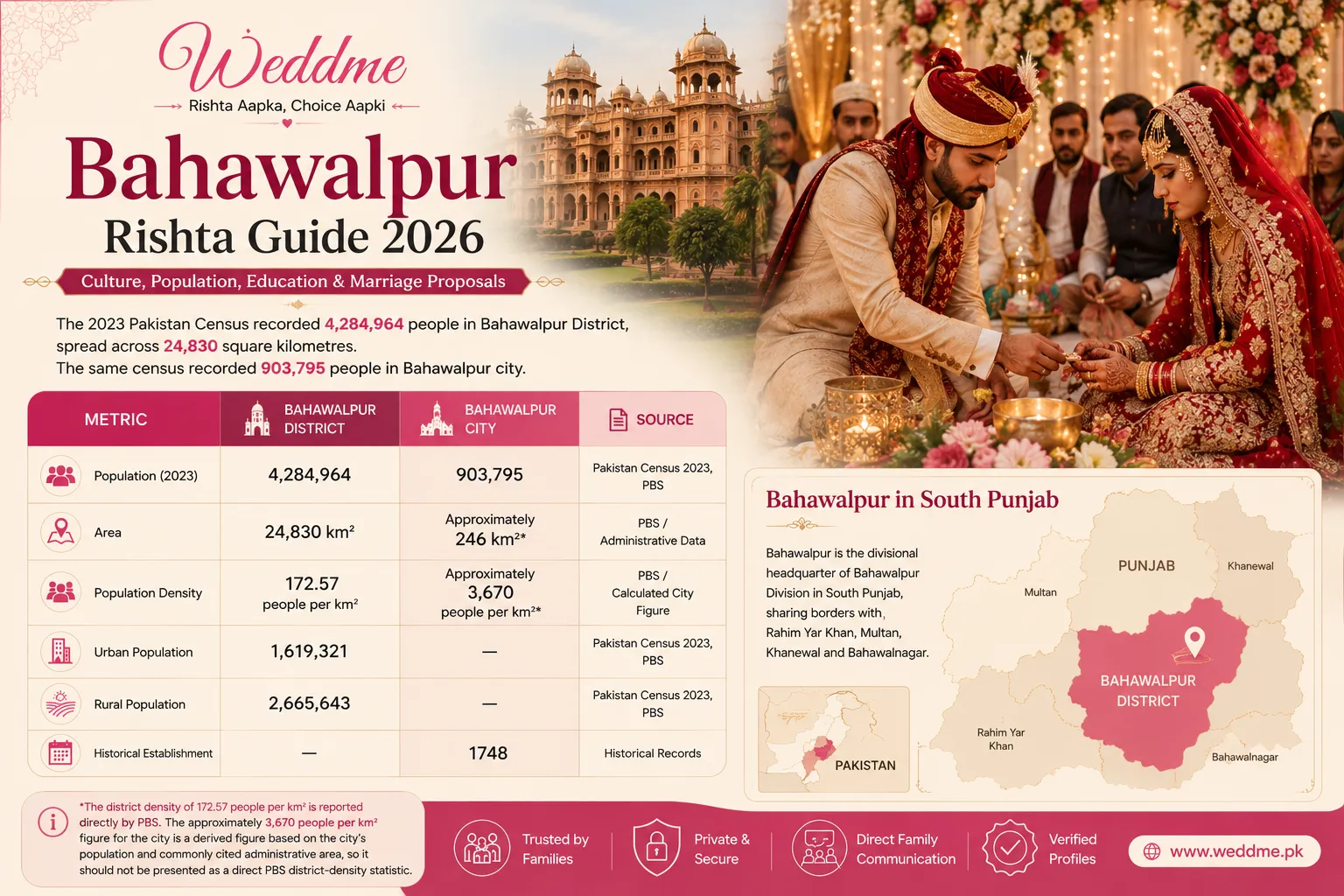
Sehras: Folk Songs That Carry Family Memory
Sehras are traditional folk wedding songs associated with the Seraiki region. They were historically sung mainly by women during wedding celebrations, often with the dhol, expressing joy, family bonds, and emotions surrounding the bride and groom.
This tradition is fading.
An APP report published by The Express Tribune in October 2024 documented concerns about the decline of Seraiki Sehra singing. The report noted that cultural observers see modern lifestyles, time constraints, and recorded music replacing longer traditional singing sessions.
For a family that values Sehras, this is not simply entertainment. It can be part of preserving cultural memory.
If such traditions matter to either side, discuss them before wedding planning begins.
Mayun: A Traditional Pre-Wedding Preparation
Mayun is a pre-wedding custom traditionally associated with preparations for the bride before the wedding. Its exact form varies between families and communities.
In many families, the bride spends this period with close family members and participates in traditional preparations before the wedding celebrations. Modern urban weddings may simplify the ritual, while other families continue to observe it in a more traditional form.
Do not assume both families define Mayun in exactly the same way.
A simple early discussion about which events the families expect to hold can avoid disputes over costs, timing, and participation later.
Mehndi: Tradition in an Evolving Form
Mehndi remains one of the most visible pre-wedding celebrations in South Punjab. Henna, music, family gatherings, and other forms of celebration may be part of the event, although the format differs widely from household to household.
Some Bahawalpur families organise a large function. Others keep it small and family-focused.
This is another example of why cultural compatibility is practical, not theoretical. Wedding expectations affect budgets, family involvement, and the overall relationship between both households.
Parh'na: A Tribal Marriage Tradition
Parh'na is a more specific marriage custom documented in ethnographic research on Seraiki-speaking Baloch communities in South Punjab.
A 2025 ethnographic study examined matrimonial traditions among a Seraiki-speaking Baloch community on the western outskirts of Rahim Yar Khan. The research used fieldwork and interviews to explore traditional wedding rituals, their meanings, and their role in identity and cultural preservation. Its findings provide useful context for understanding how tribal marriage customs in the wider South Punjab region can differ from generic descriptions of Pakistani weddings.
An important distinction is necessary here: this study focused on a specific Seraiki-speaking Baloch community, so its findings should not be presented as a universal custom followed by every family in Bahawalpur.
That would be inaccurate.
Instead, the research shows why families should ask about community-specific traditions rather than assuming every Seraiki or Baloch household follows identical customs.
Seraiki Wedding Traditions Spotlight
Sehras: A fading cultural tradition
Folk Sehras were once a central part of wedding celebrations across parts of the Seraiki region. An October 2024 report by APP, published in The Express Tribune, documented their decline and described how recorded music and changing lifestyles are replacing longer traditional singing sessions. Families who want to preserve this tradition should discuss it early rather than assuming it will automatically be part of the wedding.
Parh'na: Tribal customs need local context
A 2025 ethnographic study documents Parh'na and other matrimonial traditions within a specific Seraiki-speaking Baloch community in South Punjab. It highlights how marriage customs can preserve tribal identity and continue adapting to modern social change. These practices should be understood in their specific community context, not treated as universal across Bahawalpur.
Mayun and Mehndi: Still present, but changing
These pre-wedding rituals remain important for many families, but their format is evolving. Some urban households simplify the celebrations, while other families maintain more traditional arrangements. Research on marriage customs in South Punjab also documents the continuing importance and variation of Mehndi and other regional wedding practices.
How Tradition Shapes Modern Rishta Expectations
Online platforms have changed how families find a rishta, whether in Bahawalpur or exploring online rishta in Sheikhupura They have not removed the traditional values used to evaluate one.
A family may search online using filters such as education, profession, city, caste, or sect. But when a proposal becomes serious, questions about family background, cultural expectations, and wedding customs still come to the surface.
The modern process often looks like this: an initial profile is reviewed, basic information is verified, and contact may begin through a phone call or WhatsApp. If there is genuine interest, the process should move toward direct and respectful discussions between families and, where appropriate, an in-person family meeting.
Technology can speed up the search. It cannot replace due diligence or family-level clarity.
Before taking a serious Bahawalpur rishta forward, discuss the issues that commonly cause problems later:
- Which Seraiki or family traditions are important to each side?
- Do both families expect Mayun, Mehndi, or other separate functions?
- Is preserving traditions such as Sehra singing important?
- What level of family involvement is expected in wedding planning?
- Are there major differences in expectations about the scale and cost of celebrations?
Do not leave these questions until the engagement or final wedding planning stage.
For many Bahawalpur families, respecting Seraiki customs carries genuine emotional significance. A good rishta is not created by identical traditions. It is created when both sides know where they differ and deal with those differences honestly and respectfully.
That same principle applies to every other part of the search: understand the local context, verify the facts, and discuss expectations before commitment makes the conversation harder.
Population and Demographics Overview: Understanding the Rishta Pool
Bahawalpur District and City at a Glance
Population figures matter when you are trying to understand the size of the local rishta pool. Bahawalpur is not a small, tightly connected market where every family already knows every suitable household.
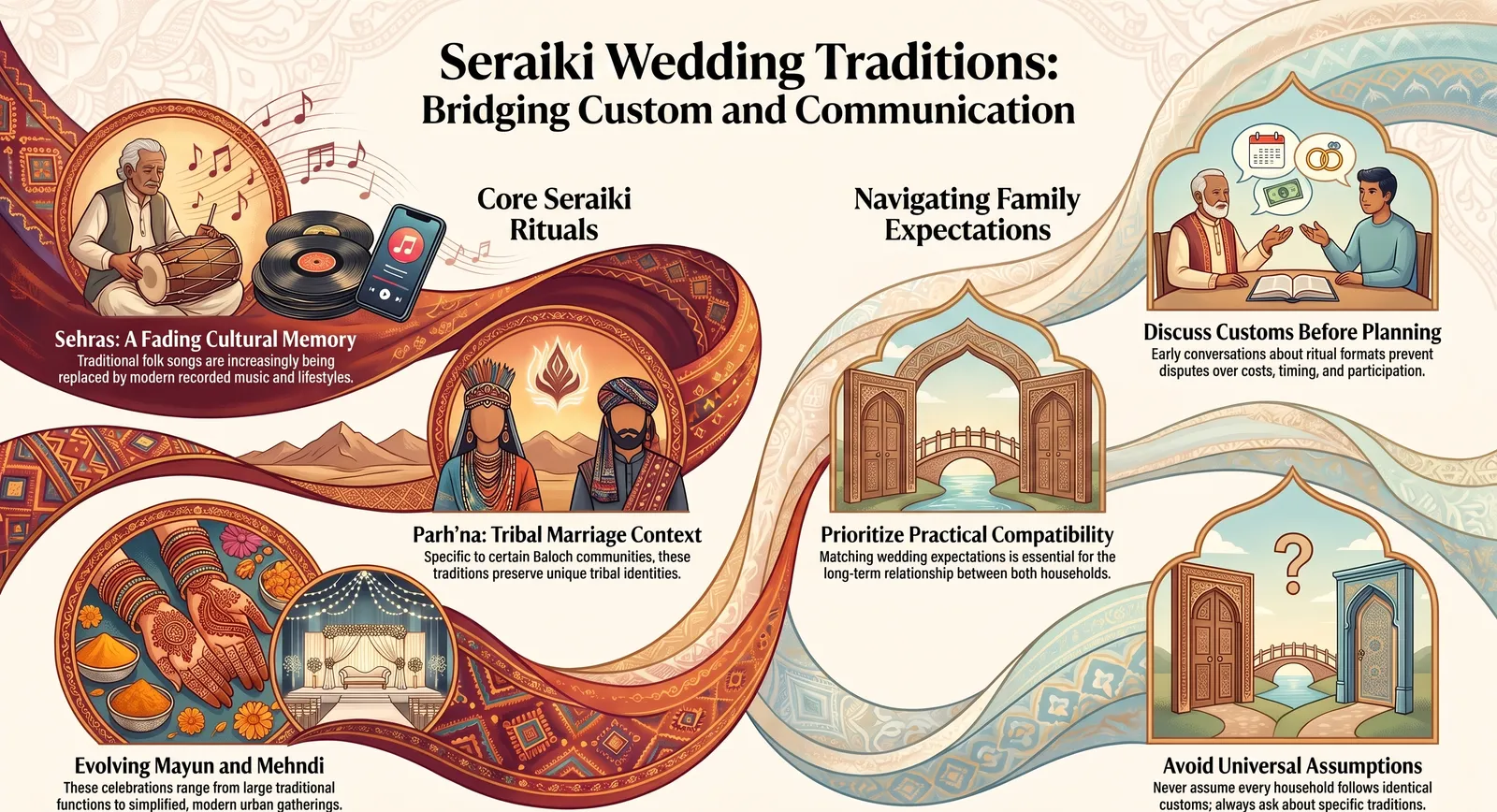
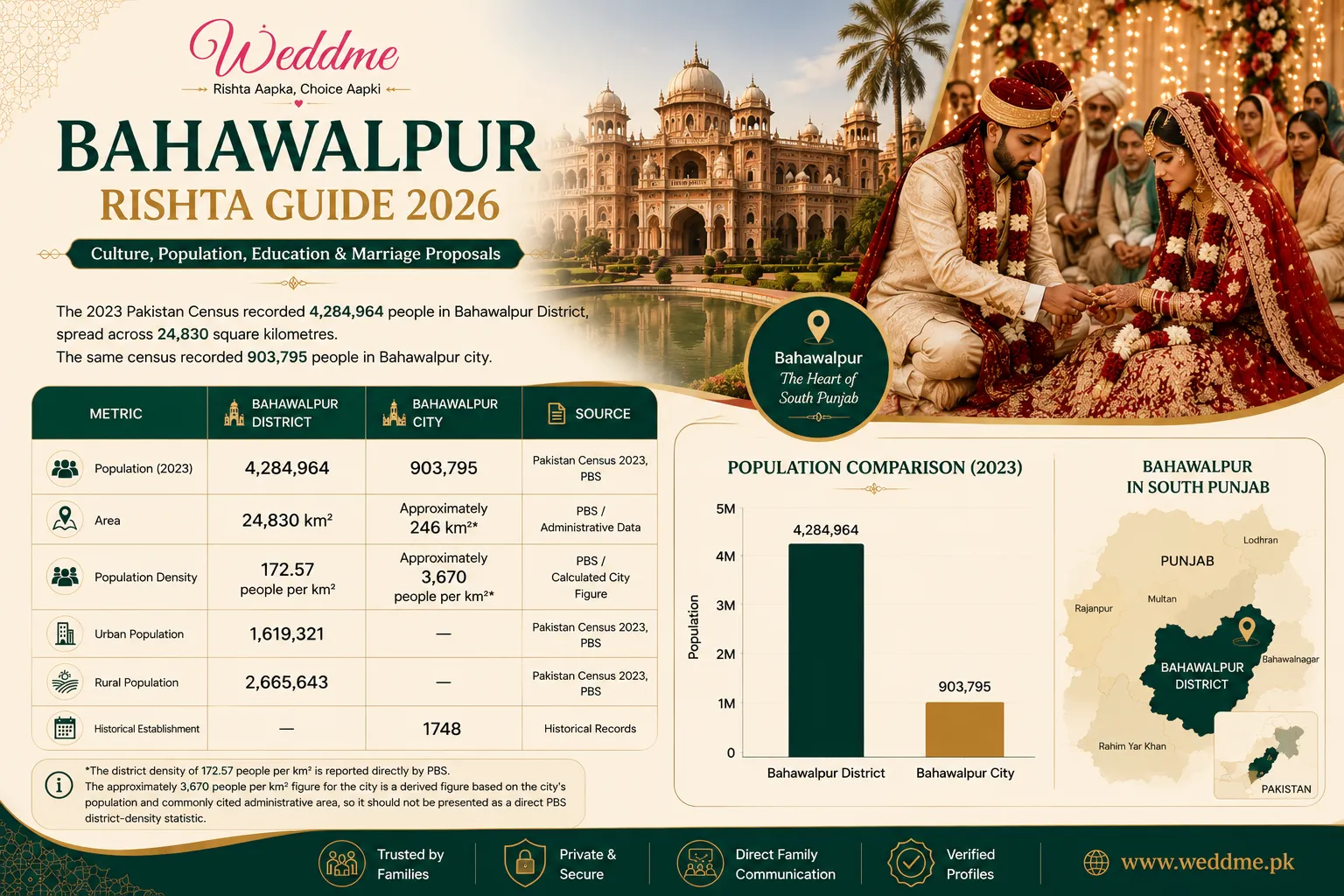
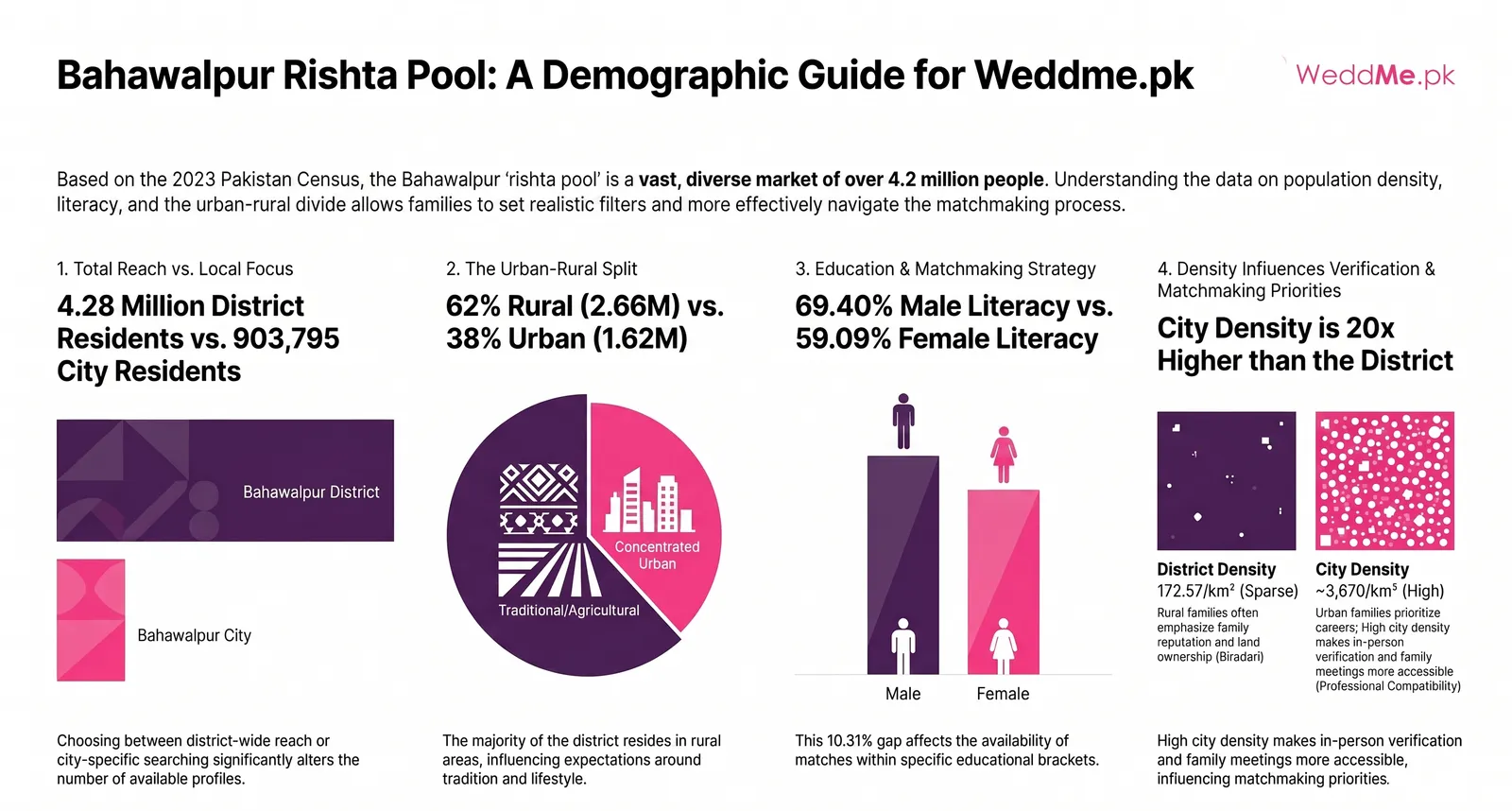
The 2023 Pakistan Census recorded 4,284,964 people in Bahawalpur District, spread across 24,830 square kilometres. The same census recorded 903,795 people in Bahawalpur city. The city figure is the official 2023 census figure and should be preferred over older estimates or third-party population projections.
For families searching for a rishta, the distinction between district and city is important. A profile from Bahawalpur city is not the same search pool as a family living in Hasilpur, Yazman, Ahmadpur East, Khairpur Tamewali, or a rural area of the district.
| Metric | Bahawalpur District | Bahawalpur City | Source |
| Population (2023) | 4,284,964 | 903,795 | Pakistan Census 2023, PBS |
| Area | 24,830 km² | Approximately 246 km²* | PBS / administrative data |
| Population density | 172.57/km² | Approximately 3,670/km²* | PBS / calculated city figure |
| Urban population | 1,619,321 | — | Pakistan Census 2023, PBS |
| Rural population | 2,665,643 | — | Pakistan Census 2023, PBS |
| Historical establishment | — | 1748 | Historical records |
The district density of 172.57 people per km² is reported directly by PBS. The approximately 3,670 people per km² figure for the city is a derived figure based on the city's population and commonly cited administrative area, so it should not be presented as a direct PBS district-density statistic.
The numbers also show why the phrase "Bahawalpur rishta pool" needs some qualification. The district had more than 4.28 million residents in 2023, but a large proportion lived outside the main urban centre. PBS recorded about 2.67 million rural residents compared with 1.62 million urban residents in the district.
So the best rishta search is not necessarily the one with the largest number of profiles. It is the one that reaches the right part of the population for your family's requirements.
Urban-Rural Split and Its Impact on the Rishta Pool
Bahawalpur's urban-rural divide can influence how families approach marriage.
Urban families in Bahawalpur city may place greater emphasis on university education, professional careers, salaried employment, and compatibility between two working or professionally educated individuals. They may also be more comfortable beginning a rishta search through online platforms.
Rural families can place stronger emphasis on biradari, caste or tribal background, family reputation, land or family occupation, proximity, and established family connections. But this should not be treated as a rigid rule. Many rural families actively seek educated professionals, while many urban families remain highly traditional in their marriage preferences.
In practice, you will find several combinations:
- An urban family looking specifically for a traditional rural household.
- A rural family seeking a university-educated son-in-law or daughter-in-law.
- A family that prioritises caste or tribe before education.
- A family that considers education, profession, and personality more important than biradari.
- Families willing to consider matches across Bahawalpur district, while others want the proposal to remain within a particular locality or community.
This is why location should be treated as a search filter, not a judgment about compatibility.
What Population Density Means for Matchmaking
Bahawalpur city has a much more concentrated population than the district as a whole. Using the 2023 city population of 903,795 and an area of roughly 246 km² produces a density of approximately 3,670 people per km². By comparison, PBS reports a district-wide density of 172.57 people per km² because the district covers a much larger 24,830 km² area.
That difference has a practical effect.
A family searching within Bahawalpur city has a concentrated local population and may find it easier to arrange introductions, family meetings, and verification visits. A family searching across the entire district has a much larger geographic area to cover. A potentially suitable profile may be in another tehsil or a rural locality several hours away.
This is one reason traditional family networks have remained important in rural matchmaking. Relatives and community contacts can already provide information about a household before the two families formally meet.
Online search changes that equation.
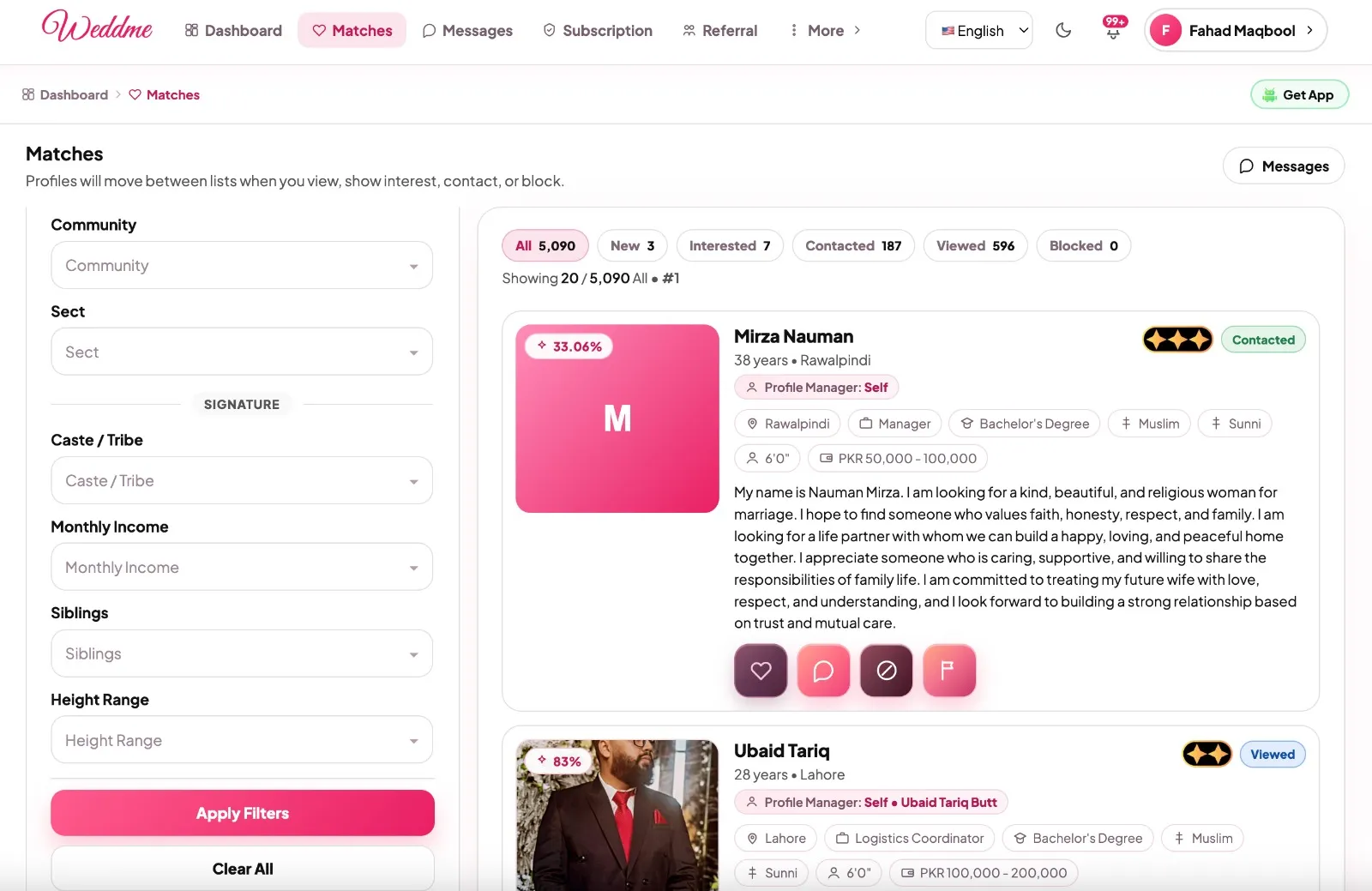
With WeddMe.pk, families can narrow the search using relevant profile information instead of relying entirely on who happens to be known through relatives. Depending on the family's requirements, filters such as city, caste, sect, education, and profession can help reduce an otherwise broad search to profiles that are more relevant.
But filtering is only the first step.
A matching location, education level, or caste does not prove that a person or family is suitable. Treat the profile as a starting point for questions and verification, not as proof of compatibility.
For Bahawalpur families, the real advantage of understanding the demographic picture is simple: you can decide how wide your search should be before you start it. If your family wants a strictly local urban match, search accordingly. If you are open to rural families, other tehsils, or a wider part of the district, say so from the beginning.
A larger rishta pool gives you more options. It does not automatically give you better options.
Education Landscape: Educated vs. Less-Educated Segments
Literacy Rates in Bahawalpur
Education is an important rishta filter in Bahawalpur, but families do not all use it in the same way.
Available research reports Bahawalpur's overall literacy rate at 64.35%, with male literacy at 69.40% and female literacy at 59.09%. That creates a 10.31 percentage-point gender gap.
The gap matters when families are comparing potential matches. It can affect the number of men and women available within a particular education bracket, especially when a family wants both partners to have similar academic or professional backgrounds.
However, one assumption needs to be avoided: a higher male literacy rate does not automatically mean that every educated groom will struggle to find an equally educated bride. Literacy is not the same thing as university education, professional qualification, or participation in the formal workforce. Families should use these figures as demographic context, not as a prediction of an individual rishta search.
| Education Level | Male Literacy % | Female Literacy % | Typical Rishta Preferences |
| Overall literacy | 69.40% | 59.09% | Education is increasingly valued; many families want basic literacy and compatibility in both partners. |
| Below primary / non-literate | Not confirmed | Not confirmed | Some families may give greater weight to caste, family background, reputation, and traditional values. |
| Primary to secondary | Not confirmed | Not confirmed | Common in some rural communities; family background and shared values may carry significant weight. |
| Higher secondary / intermediate | Not confirmed | Not confirmed | Education matters, while caste, family reputation, and values may remain important filters. |
| Graduate / professional | Not confirmed | Not confirmed | Professionals often prefer partners with comparable education, career outlook, and communication style. |
Data caution: The male and female literacy figures above are the confirmed figures available for this guide. The education-level breakdown has not been established from the same source and should not be presented as official Bahawalpur statistics until verified through PBS or another authoritative Pakistan education dataset.
How Educated Professionals Approach Matchmaking
For an educated professional in Bahawalpur, a rishta search can involve a different set of priorities.
A graduate working in a bank, hospital, university, software company, government department, or private organisation may want a partner who understands professional life. Education level can become an initial filter. Career plans, communication skills, financial expectations, and willingness to live in an urban environment may matter just as much.
These families may also be more comfortable starting the search online. They can review profiles, communicate through WhatsApp or phone, and discuss basic compatibility before arranging a family meeting.
But education does not remove traditional expectations.
An educated man or woman may still face pressure from parents or relatives to prioritise caste, biradari, family reputation, or a particular community. That can create tension when the individual's preferred match is academically compatible but does not meet the family's traditional criteria.
The solution is not to hide either preference.
Discuss the priorities early. If education is essential, say so. If caste is equally important, say that too. A family should not discover a major non-negotiable requirement after weeks of communication.
The Islamia University of Bahawalpur is also an important part of the region's educated social and professional network. Graduates, academics, and professionals connected through universities can naturally become part of wider family and social networks where marriage proposals are discussed. But a university connection should be treated as a social connection, not evidence that a person or profile is automatically suitable.
How Less-Educated Traditional Families Approach Matchmaking
Formal education is not the only measure families use when evaluating a rishta.
In some less-educated or traditional households, particularly in rural communities, caste, biradari, family reputation, character, occupation, and traditional values may carry more weight than academic qualifications. Families may prefer a proposal from their own community or tribe because they already understand its customs and family structures.
These households may also depend more heavily on relatives, community contacts, and local marriage bureaus to identify proposals.
That does not make the approach outdated or inferior.
It simply means the family's definition of compatibility is different.
The real problem occurs when two families have fundamentally different expectations and fail to discuss them. For example, an educated professional may assume that a shared academic background is essential, while the other family may consider family background and caste far more important.
Be clear from the start.
Education level should be stated honestly in a profile and confirmed during early conversations. Do not exaggerate a qualification to make a profile appear more attractive. A mismatch discovered later can damage trust between both families.
Bridging the Education Gap in Rishta Conversations
Education differences do not automatically make a marriage unsuitable.
A university graduate and someone with less formal education can have a successful marriage if they share important values, communicate well, respect each other's expectations, and agree about practical issues such as work, residence, finances, and family involvement.
But pretending the difference does not matter is equally foolish.
Before taking a proposal seriously, discuss:
- Education: What is each person's actual qualification?
- Career: Will either spouse continue working or studying after marriage?
- Lifestyle: Are both families comfortable with differences in urban and rural living?
- Family expectations: How much involvement will parents and relatives have?
- Cultural values: Are caste, biradari, language, and traditions important to either side?
- Future plans: Where will the couple live, and what kind of household do they expect?
Look beyond certificates, but do not ignore them either.
For families using WeddMe.pk, education can be used as one of the search filters alongside other relevant preferences. This makes it easier to begin with a suitable education range while keeping enough flexibility to consider profiles that may be compatible in other important areas.
The objective is not to find a person with the same degree.
The objective is to find a person whose education, expectations, values, and family circumstances are compatible with yours.
Marriage Age Demographics and Legal Framework
The Legal Minimum Age for Marriage in Pakistan
Marriage age needs to be discussed carefully because legal requirements and social expectations are not the same thing.
The outline for this guide states that the minimum legal marriage age is 18 for both men and women. However, families in Bahawalpur should not rely on a generic national statement without checking the law currently applicable in Punjab at the time of marriage. Marriage-age legislation has changed over time and can differ by jurisdiction.
The practical rule is simple: never arrange or facilitate a marriage involving someone below the legally applicable minimum age.
Social expectations are a separate matter. In Bahawalpur, families may prefer men to marry after completing education and becoming financially established. Some families also prefer women to complete their education before marriage. These are family and social preferences, not substitutes for the law.
Social Norms Around Marriage Age in Bahawalpur
There is no single "correct" rishta age in Bahawalpur. Expectations can differ according to gender, education, family background, urban or rural setting, and whether the person is seeking a first marriage or remarriage.
| Age Category | Legal Status* | Social Expectations in Bahawalpur | Matchmaking Considerations |
| Under 18 | Below the stated minimum; verify applicable Punjab law | Generally regarded as too young for marriage | Families should prioritise education, personal development, and legal compliance. |
| 18–21 | Legal status depends on the applicable current law | Often considered young, particularly when education is incomplete | Legal eligibility does not necessarily mean families are ready for marriage. |
| 22–25 | Subject to applicable law | A common age range considered by many families, particularly for women | Education, family expectations, and early career plans may need discussion. |
| 26–30 | Subject to applicable law | Often viewed as an established marriage age, particularly for men | Career and financial stability may become important factors. |
| 31–40 | Subject to applicable law | Generally acceptable, although expectations can differ for men and women | May include first-marriage proposals as well as divorced or widowed individuals seeking remarriage. |
| 40+ | Subject to applicable law | Often approached through a remarriage or later-marriage context | Marital status, children, residence, finances, and family expectations should be discussed openly. |
Legal caution: The legal age must be verified against the law currently applicable in Punjab before publication. Do not publish an unconditional "18 for both men and women across Pakistan" statement unless the current legislation and jurisdiction have been checked.
A useful distinction is often missed in rishta discussions:
Being legally old enough to marry does not mean someone is necessarily ready for marriage.
Education, emotional maturity, financial circumstances, family responsibilities, and the person's own willingness all matter.
The Under-Marriage-Age Population Segment
Bahawalpur has a substantial young population, so naturally a significant share of residents are below the legal marriage age. But the existence of a large young population should never be interpreted as a larger pool of marriage prospects.
It is simply a demographic fact.
For this guide, a reliable Bahawalpur-specific under-18 population figure should be taken from the Pakistan Bureau of Statistics (PBS) 2023 Census age-distribution data before publication. If that figure is not available from a directly verifiable official table, it is better to say that the exact figure has not been confirmed than to use an estimate.
For families with younger sons or daughters, the priority should be clear: education, personal development, and preparation for adult responsibilities come before marriage.
Remarriage for Divorced and Widowed Individuals
Remarriage can be more difficult than a first marriage in conservative communities.
A divorced or widowed person may face questions that have little to do with their character or suitability as a spouse. Women can face particularly strong social pressure, while men may also encounter assumptions about previous marriage, children, or financial responsibilities.
That does not mean a second marriage is a lesser option.
It means the search needs greater honesty from the beginning.
If you are divorced or widowed and looking for a rishta in Bahawalpur, be straightforward about your marital history. Do not hide a previous marriage in the hope that the information will be accepted later. It is far better for an unsuitable family to decline early than to discover the information after trust has already developed.
Look for families who are explicitly comfortable with remarriage. On a platform such as WeddMe.pk, marital-status information and relevant profile preferences can help narrow the search to people whose circumstances are more compatible.
The same principle applies if there are children from a previous marriage. Discuss their living arrangements, financial responsibilities, custody circumstances where relevant, and expectations about the future household before the proposal becomes serious.
Supportive family members can also make the process easier. Choose relatives who will help you evaluate proposals fairly rather than relatives who turn every discussion into gossip or social judgment.
Attitudes are not identical across Bahawalpur. Educated urban families may be more open to remarriage, while some traditional households may still attach significant stigma to divorce or widowhood. You cannot control another family's attitude.
You can control how honestly you present your circumstances and how carefully you choose the family you approach.
A previous marriage does not determine the quality of a future marriage. Character, compatibility, honesty, and mutual respect still matter more than a label.
Bahawalpur Rishta Persona Profiles: Find Your Situation
Why Personas Help You Navigate the Search
Not every Bahawalpur family approaches a rishta in the same way.
A 28-year-old bank officer in the city may care about education and career compatibility. A rural family may place caste, family background, and traditional values first. A divorced professional may have completely different concerns from someone seeking a first marriage.
The following fictional personas represent realistic situations within the wider Bahawalpur rishta landscape. They are based on the demographic, educational, and cultural patterns discussed in this guide.
Your situation may not fit one persona exactly. That is fine. Use the closest example to identify which filters, questions, and verification steps matter most for your search.
Persona 1: Ahmed, 28 Educated Urban Professional
Background:
Ahmed is a 28-year-old MBA graduate working as a bank officer in Bahawalpur city. He comes from a Syed family with established urban roots.
What he is looking for:
He wants an educated bride, preferably with at least a bachelor's degree. Career compatibility matters to him. He also wants someone comfortable with both modern professional life and traditional family settings.
His key challenge:
Ahmed has two priorities that can compete with each other. He wants education and career compatibility, while his family places significant importance on caste and family background.
There is no reason to hide either preference.
Practical approach:
Ahmed can narrow his initial search using education and caste filters together. He should also state his career situation and expectations clearly rather than waiting until a proposal becomes serious.
Once he has screened profiles for basic compatibility, he can involve his family in the next stage. This prevents relatives from reviewing dozens of unsuitable profiles while still ensuring that family expectations are considered before serious communication begins.
Persona 2: Fatima's Family Rural Traditional Family Seeking a Bride
Background:
Fatima's family is an Arain household from a rural area of Bahawalpur District. They are looking for a bride for their 25-year-old son, who works in agriculture.
What they are looking for:
They prefer a bride from a compatible caste with strong traditional values. A rural or semi-rural background is preferred because they believe someone from a similar environment will adjust more easily to their household.
Their key challenges:
The family has limited exposure to online matchmaking and remains suspicious of profiles they cannot verify. They also traditionally depend on relatives and family contacts for rishtas.
Their concern about online profiles is reasonable.
Practical approach:
They can use caste and location filters to narrow the search, then treat the resulting profiles as leads rather than confirmed proposals. Before sharing sensitive information or arranging a serious meeting, they should verify the person's identity and family details through appropriate documentation and references.
They should also avoid assuming that an urban profile means a family has abandoned traditional values. Some city-based families strongly value Seraiki culture, family involvement, and traditional marriage expectations.
A wider search may produce better options.
Persona 3: Saima, 34 Divorced Professional Seeking Remarriage
Background:
Saima is a 34-year-old teacher with a master's degree. She lives in Bahawalpur city and is looking for a respectful and understanding partner after divorce.
What she is looking for:
She wants someone who accepts her marital history without treating it as a permanent judgment. Her profession matters to her, and she wants an equal partnership rather than a household where her education or career is viewed as a problem.
Her key challenges:
Divorce can still carry social stigma. She may also face pressure from relatives who believe she should accept almost any proposal simply because she has been married before.
That is the wrong approach.
Practical approach:
Saima should be honest about her marital status from the beginning. She can use marital-status preferences to focus her search on people who are open to remarriage and whose circumstances are compatible with hers.
She should also make her expectations clear. If continuing her teaching career is important, that should be discussed early.
She should not assume that every educated urban family will be accepting, either. Verify attitudes through actual conversation rather than relying on assumptions about someone's background.
Persona 4: Bilal's Parents Urban Middle-Class Family Seeking an Educated Bride
Background:
Bilal is a 30-year-old doctor living in Bahawalpur city. His parents come from a Rajput family and have strong professional and social networks.
What they are looking for:
They prefer an educated bride, ideally from medicine or an allied health profession. Compatible caste and good family reputation are also important.
Their key challenges:
Their criteria are demanding because they are combining several filters: education, profession, caste, and family background. They also need to discuss wedding expectations, including dowry, without allowing financial demands to damage the relationship between the families.
Practical approach:
They can begin with education and profession filters, then apply their preferred caste criteria. Once a profile appears suitable, verification should come before emotional or financial commitment.
CNIC verification, family references, and direct family communication can help establish whether the basic information is genuine.
Dowry expectations should also be discussed honestly. A family should not use vague language such as "whatever you can afford" if it actually has specific expectations. Clear and respectful communication is better than allowing assumptions to build.
How to Use These Personas
You do not need to fit perfectly into one category.
Your family may be an urban household with rural roots. You may value education but still prefer a particular caste. You may be open to divorced or widowed individuals but have specific expectations about children or residence.
Start by identifying your non-negotiables.
Then separate them from preferences.
For example:
- Non-negotiable: minimum education level.
- Strong preference: same caste or tribe.
- Flexible: city or rural background.
- Essential discussion: career after marriage.
- Verification requirement: identity and family references.
This makes the search more efficient and reduces unnecessary conversations.
On WeddMe.pk, create a profile that accurately reflects your situation rather than writing a generic description designed to attract everyone. State relevant education, profession, city, caste or community preference where appropriate, and marital status honestly.
A detailed profile does more than attract attention.
It helps the wrong families filter themselves out and gives compatible families a clearer reason to contact you.
How to Find a Rishta in Bahawalpur Using WeddMe.pk
Searching for a rishta online should not mean opening hundreds of random profiles and hoping one works.
Start with clear requirements. Then verify the people behind the profiles.
Step 1: Create a Detailed and Honest Profile
Your profile is the first screening tool.
If it only says "looking for a suitable match," you are making other families guess what suitable means. That wastes everyone's time and attracts proposals that may have little chance of working.
On WeddMe.pk, provide the information that genuinely affects compatibility, including:
- Age
- Education level
- Profession
- Caste or tribe, where relevant to your family's preferences
- Marital status
- City and location
- Urban or rural background
- Family background
- Relevant cultural preferences
- Basic expectations about marriage and family life
Be accurate.
Do not inflate your education, profession, income, family status, or other details to make the profile look stronger. A misleading profile may generate more initial interest, but it creates a serious problem when families begin verification.
A detailed profile does the opposite. It gives suitable families enough information to decide whether they should approach you.
For Bahawalpur families, cultural context can also matter. If your household strongly values Seraiki traditions, a particular caste or tribe, rural or urban compatibility, or continued family involvement in marriage decisions, make those expectations clear where appropriate.
Before you share a single family detail online, verify how the platform handles identity and profile information.
WeddMe.pk can be used as the primary search platform for families looking for Bahawalpur marriage proposals, while external checks such as NADRA identity verification and family references can provide additional confirmation when a proposal becomes serious. Demographic information from PBS can help you understand the wider population, but it cannot verify an individual profile.
And when both families have completed initial screening, WhatsApp or direct phone communication can make family-to-family discussion easier. Do not move immediately to sharing sensitive documents, financial information, passwords, or private family details simply because someone has contacted you.
Step 2: Search and Filter by Education, Age, and Caste
Once your profile is complete, stop browsing randomly.
Use filters to reduce the search to people who meet your basic requirements.
Education:
Decide what level actually matters. If a bachelor's degree is essential, use that as your starting point. If you are willing to consider intermediate or other qualifications, keep the filter broader.
Do not set an unnecessarily narrow education filter simply because a qualification sounds impressive. A degree does not guarantee character, compatibility, or a good family environment.
Age:
Set a realistic age range based on your circumstances and the applicable legal requirements discussed earlier. Do not treat 18 as an automatic recommendation simply because it is a legal threshold. Education, maturity, career plans, and personal readiness also matter.
Caste or tribe:
If caste compatibility is genuinely important to your family, use the relevant filter rather than hiding the preference until the final stage. If your family is flexible, do not make the filter unnecessarily restrictive.
Location:
Start with Bahawalpur city if proximity is important. But do not automatically exclude rural or semi-rural profiles.
A rural family may offer the traditional values another family is specifically looking for. Likewise, an urban family may have strong cultural and family-oriented values despite living in the city.
The right question is not "city or village?"
It is "does this family match the values and circumstances we are looking for?"
Use WeddMe.pk filters to create a manageable shortlist. Then review each profile carefully. Filtering identifies potential compatibility; it does not prove it.
The next stage is more important: verification and first contact.
Step 3: Verify Profiles Before Proceeding
A good-looking profile is not proof of a genuine person.
Before you become emotionally invested in a rishta, verify the basic facts. This is especially important when the first contact happens online and the families have no shared relative or community connection.
Verification Checklist
Before moving a proposal forward:
- Verify identity: Use appropriate CNIC verification channels and, where applicable, NADRA's available identity-verification services.
- Ask for family references: Request references from people who genuinely know the family. Contact them rather than accepting a name as proof.
- Check education: If someone claims a degree or professional qualification, ask reasonable questions and verify important claims when the proposal becomes serious.
- Check profession: Confirm that the stated job, business, or professional role is genuine.
- Compare information: Look for contradictions between the profile, WhatsApp conversations, family statements, and documents.
- Watch their behaviour: Be cautious if someone avoids straightforward questions, refuses reasonable family involvement, or pushes you toward a quick commitment.
Step 4: Initiate Contact and Transition to Family Meetings
Once a profile has passed your initial screening, make contact respectfully.
WhatsApp can be useful for the first conversation, particularly when both sides want to establish basic compatibility before involving the entire family. Keep the first exchange simple.
Introduce yourself. Explain who in your family is involved. State that your intention is to explore a serious marriage proposal.
For example:
"Assalam-o-Alaikum. I came across your profile and found the basic details relevant to what our family is looking for. We would like to discuss the proposal respectfully. If you are comfortable, we can involve our families after an initial conversation."
Do not begin with intrusive personal questions. Do not demand private photographs or documents unnecessarily. Give the other person reasonable space to respond.
If the conversation remains positive, move beyond messaging.
A serious Bahawalpur rishta should eventually involve real people, not remain a WhatsApp conversation indefinitely.
Arrange a family meeting through parents, elders, or another trusted family member. Face-to-face interaction allows both sides to assess communication, manners, family expectations, and overall compatibility in a way a profile cannot.
For families living in different cities or countries, a video call involving family members can be an intermediate step before an in-person meeting.
Step 5: Involve Elders and Respect Family Protocols
Bahawalpur remains a family-oriented society, and elders can play an important role in the rishta process.
Their value is practical.
An experienced elder may know the local community, understand family relationships, recognise important background information, and know which questions need to be asked before a proposal progresses.
That does not mean the person getting married should have no say.
The individual and the family need to work together.
Share the profile with the relevant elders. Explain what you are looking for and what your non-negotiables are. Ask them to assess the family background and participate in serious meetings.
At the same time, communicate your own preferences clearly.
A common mistake is allowing relatives to make every decision and then blaming them when the proposed match does not suit the individual. Another mistake is completely excluding the family until the relationship has become emotionally serious.
Neither approach is sensible.
Bring the right people into the process at the right time.
Tips for Successful Matchmaking in Bahawalpur
Family Involvement and Elder Wisdom
For many Bahawalpur families, family involvement is not a formality. It is part of how a rishta is evaluated.
Relatives and elders can help with background checks, references, community knowledge, and sensitive conversations about family expectations. Their involvement can also signal that both sides are treating the proposal seriously.
A practical approach is:
- Complete the initial online screening.
- Discuss the profile with trusted family members.
- Verify important background information.
- Arrange a family-level conversation.
- Allow the prospective bride and groom to discuss their own expectations.
- Make the final decision without coercion.
Respect elders, but do not confuse respect with surrendering personal choice.
Marriage affects the two people who will live together. Their consent, expectations, and compatibility must remain central.
Caste, Tribe, and Cultural Compatibility
Caste and tribe can be important considerations for Bahawalpur families. Some households strongly prefer a particular biradari. Others are willing to consider people from different backgrounds if family values, character, education, and circumstances are compatible.
There is no universal formula.
If caste is important to your family, state the preference honestly. If you are flexible, remain genuinely flexible instead of rejecting a suitable profile automatically because of a label.
And remember that cultural compatibility goes beyond caste.
Ask whether both families are comfortable with:
- Seraiki language and communication.
- Family involvement in marriage decisions.
- Wedding customs and celebrations.
- Urban or rural living arrangements.
- Expectations around parents and extended family.
- Religious and cultural practices.
- The role of the bride and groom after marriage.
A shared caste does not guarantee shared values.
Likewise, a different caste does not automatically mean incompatibility.
Dowry (Jahez) and Wedding Budget Discussions
Dowry and wedding expenses can become a major source of pressure between families.
The problem often begins when expectations remain vague.
One family may expect an elaborate wedding, while the other believes a modest ceremony is appropriate. Extended relatives may add demands that neither bride nor groom originally expected.
Discuss the financial side early enough to prevent surprises.
Set a realistic wedding budget. Decide which events are actually necessary. Consider the cost of traditional Seraiki celebrations alongside venue, clothing, food, photography, transport, and other modern expenses.
If jahez is expected, the families should discuss expectations openly and respectfully rather than allowing indirect demands to accumulate.
More importantly, neither family should measure the quality of a rishta by the size of a dowry.
Educated urban families may increasingly prefer simpler arrangements, but assumptions about changing attitudes are not enough. Ask. Clarify. Agree.
A financially realistic wedding is better than beginning married life under unnecessary debt or resentment.
Avoiding Scams and Fake Profiles
Online matchmaking requires a higher standard of caution because the first information you see may come from a profile rather than someone your family already knows.
Watch for warning signs:
- Requests for money.
- Emergency financial stories.
- Refusal to involve family.
- Contradictory information.
- Pressure to move conversations into secret channels.
- Requests for sensitive documents without a legitimate reason.
- Pressure to commit after only a few conversations.
- Reluctance to participate in reasonable identity or family verification.
Do not let emotional excitement override basic checks.
WeddMe.pk's profile-verification and review processes can provide an additional layer of screening, but families should still carry out their own reasonable due diligence before making a serious commitment. No online platform should be treated as a substitute for personal verification.
Urban vs. Rural Matchmaking Considerations
The urban-rural divide is important when searching for a Bahawalpur rishta, but it should not become a stereotype.
An urban family may place greater emphasis on university education, professional careers, and independent decision-making. A rural family may give greater importance to caste, biradari, family reputation, agriculture, and traditional household roles.
But there are plenty of exceptions.
A rural family may strongly value higher education. An urban household may follow very traditional marriage customs. What matters is the actual family in front of you.
If you are open to both urban and rural profiles, keep your location search broad enough to discover those options. WeddMe.pk's location filters can help families search across different areas instead of limiting themselves to a single neighbourhood or city setting.
Then ask the questions that matter.
Where will the couple live? Will the bride work? How involved will parents be? Which traditions are important? What are the expectations around household responsibilities?
Geography tells you where a family lives. Conversation tells you how that family actually lives.
Conclusion
- Culture matters: Seraiki language, family traditions, and customs such as Sehras, Mayun, and Mehndi can remain important parts of marriage expectations.
- The rishta pool is large: The 2023 census recorded more than 4.2 million people in Bahawalpur District and 903,795 in Bahawalpur city. But the district's large urban-rural spread means location can significantly affect the type of families you encounter.
- Education affects expectations: The reported literacy figures are 64.35% overall, 69.40% for males, and 59.09% for females, representing a 10.31 percentage-point gender gap. Literacy should be treated as demographic context, not as a measure of an individual's education or suitability.
- Marriage age needs care: Legal requirements must be followed, while social expectations vary according to gender, education, family circumstances, and location. Do not confuse a legal minimum with an ideal marriage age.
- Verification is essential: Check identity, important education or profession claims, and family references before treating an online profile as a serious proposal.
- Tradition and modern search can work together: You can use online filters to find relevant profiles while still involving parents and elders when a proposal becomes serious.
The goal is not to choose between tradition and technology.
Use technology to widen the search. Use family involvement and verification to make the decision wisely.
Start Your Search on WeddMe.pk
If you are looking for a Bahawalpur rishta, start by creating a profile that tells the truth about who you are and what your family genuinely expects.
On WeddMe.pk, you can search profiles using relevant criteria such as education, profession, caste, sect, marital status, and location. This can reduce the time spent reviewing proposals that were never likely to be compatible.
But do not treat filters as a guarantee.
A suitable rishta still requires conversation, family involvement, background checking, and eventually a face-to-face meeting.
Create a detailed profile. Search with realistic requirements. Shortlist carefully. Verify before committing.
Then involve the people whose judgment you trust.
Finding the right rishta may take time. That is not a problem. A rushed decision can create years of problems; a careful search can save you from them.
Bahawalpur families do not have to abandon their traditions to use modern matchmaking. They can use online tools to find more relevant proposals while keeping the respect, family involvement, cultural understanding, and due diligence that have long been part of serious rishta decisions.
Start your Bahawalpur rishta search on WeddMe.pk with clearer expectations, better verification, and a wider view of what compatibility really means.
Compare profiles when your family is ready.
Use Weddme search filters to review profiles with clearer context before starting a serious conversation.