How to Find Marriage Proposals in Okara: A Family Guide
Finding a suitable marriage proposal in Okara is not simply about meeting more people. For most families, the real challenge is knowing where to search, which details to discuss first and how to evaluate whether a proposal is genuinely suitable. Some families begin with relatives and trusted social connections, while others expand their search through online matrimonial platforms. This guide explains practical ways to find marriage proposals in Okara and make the search process more organized, informed and safe.
Every year, hundreds of families in Okara begin a rishta search with the same question: Where do we even start?
One relative suggests speaking to people within the biradari. Someone else recommends a local marriage bureau. Younger family members may prefer checking matrimonial websites or online matchmaking platforms. In some families, parents also ask trusted people at the local mosque or within their community.
Each option can work, including for families considering a second marriage in Pakistan The problem starts when everyone searches separately.
A promising proposal reaches one family member but never gets discussed properly. The same biodata gets shared in several WhatsApp groups. Important details are written down on scraps of paper or buried inside old messages. Sometimes families become interested before basic information has even been verified.
That makes an already sensitive decision more stressful than it needs to be.
The better approach is to use several trusted channels, but manage them through one family process.
Before you share a single biodata, sit down as a family and write down the three things that matter most: education, biradari, and how the young person feels about the match. Add other genuine priorities, such as age range, profession, religious values, family background, or whether the family prefers someone living in Okara or is open to another city.
Most importantly, involve the prospective bride or groom from the beginning. Parents and elders may lead the search, but the person considering marriage should have a clear voice in which proposals move forward.
What This Guide Will Help You Do
This guide gives Okara families a practical system for managing the entire rishta search.
You will learn where to look for marriage proposals in Okara and how to use online matchmaking platforms, local marriage bureaus, biradari connections, relatives, and mosque or community referrals without depending completely on any one source.
We will then move through the process in order: preparing a useful biodata, protecting personal information, comparing proposals, creating a manageable shortlist, verifying the proposal's background, and preparing for the first family meeting.
You will also learn what information to verify before emotions or expectations become too involved.
The goal is not to collect as many proposals as possible.
The goal is to find suitable proposals, keep the search organized, and give your family enough reliable information to make each next decision calmly.
By the end, you will have a step-by-step rishta workflow that the whole family can follow. You will also have a family rishta tracker for recording proposals and a channel decision flowchart for deciding where to search next.
Whether you are searching for a son or a daughter, keep two things at the center of the process: your family's values and the young person's comfort with the match.
Now we can start with the first practical decision: where should an Okara family actually look for suitable marriage proposals?
The Okara Rishta Landscape What Makes This Search Different
How Rishta-Finding Works in Okara
In Okara, the rishta search often starts with people the family already knows, much as families in other Punjab cities can use a guide to finding rishta in Bahawalpur for local advice.
A parent may call a trusted relative first. An aunt may speak to another family within the biradari. An elder may quietly ask whether a suitable proposal is available among Rajput, Arain, or other community connections. Only after those conversations slow down do many families begin looking at marriage bureaus or online matrimonial platforms.
That approach feels familiar, and families in other Punjab cities can take similar local steps, as a guide to finding rishta in Sargodha shows.But it can also make the search unnecessarily narrow.
From hands-on matchmaking experience with families in Punjab, one pattern appears repeatedly: the strongest searches rarely depend on a single source. A relative may know a family nearby that never created an online profile. A matrimonial website may introduce an educated family in another part of Okara that your relatives would never have reached. A bureau may have proposals from families who prefer not to publish their details online.
Each channel reaches a different group.
That is why an Okara family should think of rishta-finding as a multi-channel search, not a choice between traditional and online matchmaking.
1. Start With Your Biradari and Family Network
Use trusted family connections first, especially when biradari, family background, or a known reputation is important to you.
Extended family members, respected elders, family friends, and community contacts can often introduce proposals with some context already attached. You may already know where the family lives, what they do, who their relatives are, or how they are regarded locally.
This makes the first conversation easier.
But familiarity is not verification.
Even when a proposal comes through a close relative, verify important details yourself. Confirm education, employment, marital status, family circumstances, and anything else that could affect the decision. Do this respectfully.
A common mistake is assuming, “They came through our own people, so everything must be correct.” Most referrals are made in good faith, but the person introducing the proposal may only know one side of the family.
Treat a biradari referral as a strong introduction, not a completed background check.
2. Add a Marriage Bureau When You Want a Human Intermediary
Consider a marriage bureau when your family wants someone else to help identify and introduce suitable proposals.
This can be particularly useful for parents who do not want to spend hours searching profiles themselves or who prefer family-to-family communication through an intermediary.
Before registering, ask the bureau four things clearly:
How many relevant proposals do you currently have? What information do you verify? What is the total fee? How long does your service remain active?
Do not pay simply because a bureau promises a large database.
For example, BZ Begum Zaheer Marriage Bureau offers family-based personalized matchmaking and says candidates go through an interview before matchmaking begins. It is based in Karachi rather than Okara, so an Okara family considering it should first confirm whether its current database contains enough suitable proposals from Okara, Sahiwal, Lahore, Faisalabad, or whichever locations the family is willing to consider.
This distinction matters.
A well-known bureau is not automatically the best bureau for your family. The better question is whether it currently has proposals that match your location, age range, education, family preferences, and other priorities.
3. Use Online Matrimonial Platforms to Widen the Search
Add at least one reputable matrimonial platform once your family's basic criteria are clear.
Online platforms solve a problem that traditional networks cannot: reach.
Instead of waiting for somebody to remember a suitable family, you can actively search according to location, age, education, profession, community, and other preferences.
QuickRishta, for example, currently lists Okara among its searchable cities and supports filters covering areas such as city, community, profession, education, religion, and sect. It also allows families or guardians to manage profiles and provides controls over photo visibility.
Shaadi.org.pk allows individuals and parents to create profiles, search according to preferences such as location, education, sect and profession, and send interests to potential matches.
Dil Ka Rishta provides another large online pool. Its current platform information describes profile verification, family-member profile creation, saved profiles, and additional verification options involving identity documents and selfies.
Select Proposal takes a slightly different approach. It says profiles are manually reviewed and allows searching around factors such as city, education, profession, age, and family background. Unlike some Pakistani platforms, it explicitly says it does not match by caste or biradari.
That difference is worth noticing.
If biradari is an important family requirement, choose a platform that actually lets you include it in the search. If education, profession, family outlook, and compatibility matter more, a different platform may suit you better.
Do not register everywhere on the first day; families in other cities can take a similarly systematic approach, as a guide to online rishta in Haripur demonstrates.
Choose one or two platforms, and if your search extends to nearby cities, a guide to online rishta in Kasur Learn how their privacy settings work. Create one accurate biodata. Then expand only if you need a wider pool.
4. Keep Mosque and Community Referrals Open
Tell one or two trusted community figures that your family is genuinely looking.
In many areas, an imam, teacher, respected elder, or long-standing family acquaintance knows families beyond your immediate relatives. These introductions can be useful because they often come through someone both sides respect.
The advantage is trust and simplicity.
The limitation is choice.
There is usually no searchable database, no neat list of preferences, and no guarantee that a suitable proposal will appear quickly. Treat community referrals as an additional channel rather than your entire search strategy.
And keep the conversation discreet. There is no need to circulate a daughter's or son's full biodata widely just to ask whether someone knows a suitable family.
Share only what is necessary at the beginning.
Why a Structured, Multi-Channel Search Works Better
The problem with using several channels is not that you receive too many proposals.
The problem is receiving them without a system.
One proposal arrives through WhatsApp. Another comes from your khala. A marriage bureau calls your father. Your daughter saves an online profile. Two weeks later, nobody remembers which family was contacted or why another proposal was rejected.
Avoid that from day one.
First, agree on your family's essential criteria.
Separate them into must-haves and preferences. A genuine must-have might be a particular religious outlook or location. A preference might be a certain profession. Do not turn twenty preferences into twenty compulsory conditions.
Second, record every serious proposal in one place.
Write down the name or profile reference, source, city, age, education, profession, family contact, date received, current status, and the reason you decided to continue or stop.
Third, compare every proposal using roughly the same criteria.
A proposal brought by a respected uncle should not automatically receive less scrutiny than one found online. Likewise, an online proposal should not be rejected simply because the family was not already known to your relatives.
Use the same standards.
Fourth, protect personal information from the beginning.
Do not send CNIC copies, home addresses, private family documents, or unrestricted photographs to strangers simply because someone has expressed interest. Move gradually from basic information to more personal information as mutual seriousness develops.
Most importantly, keep the prospective bride or groom involved.
Parents can organize the search. Elders can advise. Relatives can introduce families.
But the young person should never discover that a proposal has become “serious” before they have even been properly consulted.
Where to Find Marriage Proposals in Okara
Once your family has agreed on the basic criteria, start searching in more than one place to find marriage proposals in Okara
In Okara, good proposals can come through relatives, biradari contacts, local community introductions, traditional marriage bureaus, or an online matrimonial platform. Each route has advantages. The mistake is depending completely on one of them.
A practical family search can start with Weddme.pk as the organized online channel, while trusted relatives and community contacts continue looking through their own networks.
This gives you reach without losing family involvement.
Start With Weddme.pk for an Organized Online Search
If your family wants to actively search rather than wait for proposals to arrive through relatives, begin with Weddme.pk.
Weddme is built around direct family-to-family matrimonial searching. Families can browse proposals according to the details they normally discuss before moving forward, including city, age, bride or groom, marital status, sect, caste or tribe, community, profession, and education.
For an Okara family, start with the Okara city filter.
Weddme currently has a dedicated Okara category within its city-based rishta search. At the time of writing, the platform shows active Okara profiles alongside proposals from nearby and larger cities such as Sahiwal, Faisalabad, Lahore, Sheikhupura, and Multan, where families can also follow a guide to finding rishta in Multan
That matters because many Okara families are willing to consider a proposal from another Punjab city, and families in nearby Sheikhupura can follow a guide to online rishta in Sheikhupura for similar steps.
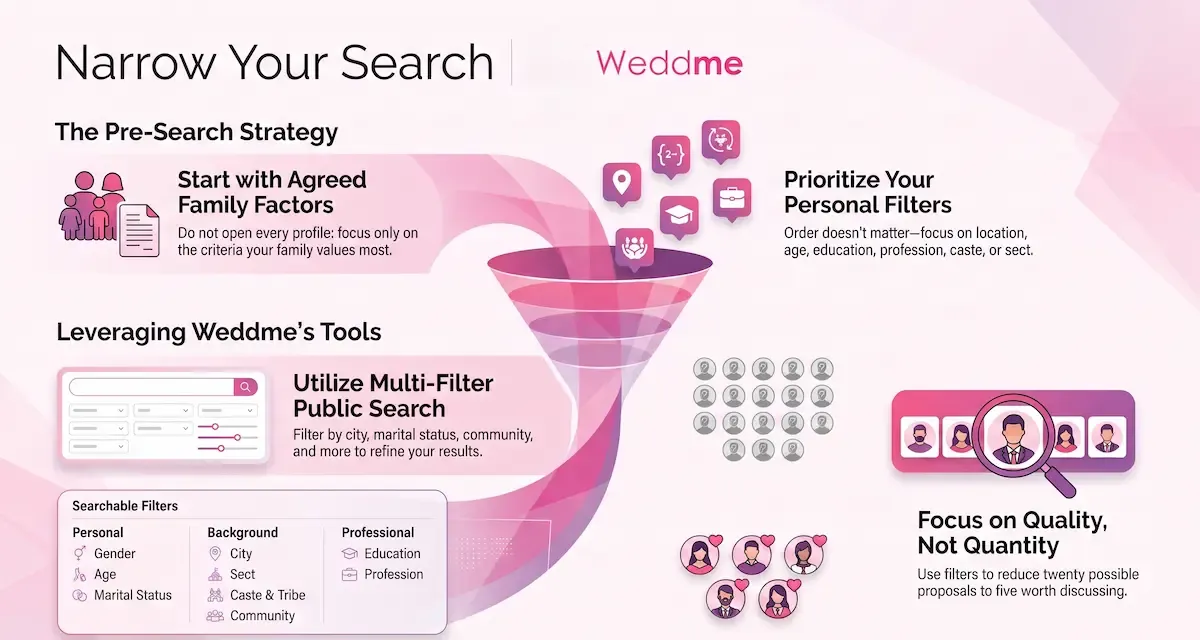
Narrow the Search Before You Start Contacting Families
Do not open every profile that appears.
Start with the factors your family has already agreed upon.
For example, an Okara family might begin with:
Okara → Groom → preferred age range → education → profession → caste or tribe
Another family may care less about biradari and start with:
Okara → Bride → age → sect → education → profession
There is no single correct order.
Use the filters that reflect what your family genuinely considers important.
Weddme currently lets families search across multiple profile characteristics rather than relying on a single city directory. Its public search includes city, gender, age, marital status, sect, caste and tribe, community, profession, and education.
This makes it easier to reduce twenty possible proposals to five worth discussing.
Keep the Search Family-Led
One advantage of an online search is that the prospective bride or groom does not have to be excluded while parents handle everything.
Sit together and review the shortlist.
A parent may notice family background. The young person may notice education, profession, interests, or expectations that matter to their future life. Both perspectives are useful.
Do not turn profile browsing into a secret process where the son or daughter only hears about a proposal after the families have already become emotionally invested.
Use Weddme as a family decision tool, not simply a profile catalogue.
Treat Verification as Your Responsibility
A profile appearing online does not mean every detail has been independently confirmed.
Weddme itself makes this clear. The platform says contact details may be verified where available, but families should independently confirm identity, education, profession, family information, and other important details before meetings or commitments.
That is the right approach.
Verification should happen whether the proposal comes from Weddme, a marriage bureau, your neighbour, or your closest relative.
Online searching helps you find a proposal.
It does not replace the family's responsibility to verify it.
Protect Personal Information While You Shortlist
Share information gradually.
At the first stage, another family usually needs enough information to decide whether a conversation makes sense. They do not need unrestricted access to every personal document, private photograph, home address, CNIC copy, or financial detail.
Weddme's current search emphasizes privacy-protected profile details and controlled contact information, but families should still use their own judgment about what they disclose and when.
A useful rule is simple:
Interest first. Verification second. Sensitive information later.
Never reverse that order.
Use Traditional Marriage Bureaus When You Want an Intermediary
Some Okara parents are comfortable searching profiles themselves.
Others prefer speaking to a person.
That is where a traditional marriage bureau can still be useful.
A bureau normally acts as an intermediary between two families. You explain the kind of proposal you are looking for, and the bureau checks its existing records or contacts families it believes may be suitable.
Established Pakistani services such as BZ Begum Zaheer Marriage Bureau are examples of this traditional model. BZ says it has operated since 1985 and follows a personalized family-to-family matchmaking process. Its office, however, is in North Nazimabad, Karachi rather than Okara.
For an Okara family, the lesson is not to choose a bureau because its name is well known.
Ask whether it actually has relevant proposals for Okara or the cities you are prepared to consider.
Before paying any bureau, ask:
How many suitable proposals do you currently have?
Do you have families from Okara?
What information do you verify?
What is included in the fee?
How long does the registration remain active?
Will we speak directly with the other family, or will communication stay through the bureau?
Get clear answers first.
A bureau can save time when it has the right network. It can waste months when it does not.
Activate Your Family and Biradari Network
Do not abandon the traditional network just because you are searching online.
In Okara, relatives and biradari contacts can still surface proposals that will never appear on a public matrimonial platform.
But give them useful criteria.
Do not simply tell ten relatives:
"Koi acha rishta ho to batana."
That is too broad.
Instead, tell two or three trusted people what you are genuinely looking for. Give them a short version of the criteria: approximate age, education, profession, preferred location, biradari if relevant, and any important family expectation.
The more specific you are, the fewer unsuitable proposals everyone has to process.
For example:
"We are looking for a groom around 27–31, preferably graduate or professionally qualified, based in Okara or Lahore. Arain background is preferred, but we can discuss a suitable family outside the biradari as well."
That gives the person something useful to work with.
It also prevents the entire extended family from circulating private biodata without control.
Do Not Treat a Relative's Recommendation as Verification
This deserves repeating.
A proposal introduced by a trusted relative can be excellent.
It can also contain incomplete information.
Perhaps your aunt knows the boy's mother but does not know much about his employment. Perhaps an uncle knows the family business but has never met the prospective bride. Perhaps everyone knows the family name, but nobody has asked what the young person actually wants from marriage.
Verify the proposal yourself.
Do it quietly and respectfully, without turning the process into gossip.
A trusted introduction should make verification easier.
It should never replace it.
Ask Trusted Mosque and Community Contacts
Mosque and community referrals can work particularly well when your family values a recommendation from someone who knows both households.
Approach the imam, teacher, community elder, or other trusted person privately.
Do not announce the search publicly unless your family is comfortable doing so.
Explain the basic criteria and ask whether they know a family that may be suitable. At this stage, a short privacy-safe biodata is enough.
This channel has one major advantage: trust.
It also has one major limitation: reach.
An imam or community elder may know several suitable families, or none at all. There is no searchable pool and usually no structured filtering.
Use this route alongside your main search rather than waiting indefinitely for it to produce a proposal.
Combine Online Search With Local Trust
For most Okara families, the strongest approach is not online versus traditional.
It is both.
Use Weddme.pk to actively search and compare relevant proposals. Keep trusted relatives and biradari contacts informed. Ask one or two respected community figures when appropriate. Consider a traditional bureau if your family wants an intermediary or needs access to a different network.
Then bring every serious proposal into the same family process.
Record it.
Discuss it.
Shortlist it.
Verify it.
And ask the prospective bride or groom whether they actually want to continue.
Expert Tip
Do not wait for one channel to fail before trying another.
Search Weddme.pk while your family network is active in parallel.
One route gives you structured access to profiles you may never encounter locally. The other gives you introductions supported by existing family and community connections.
The source of the proposal matters less than what happens next.
Your next job is to create a biodata that gives serious families enough information to consider the match without sharing more personal information than necessary.
Comparison of Rishta-Finding Channels
Not every Okara family needs the same rishta-search method.
Some families want speed and a wider pool. Others prefer a trusted intermediary. Some are comfortable searching online but still want relatives involved before any proposal becomes serious.
Use the comparison below to decide which channels deserve most of your attention.
| Channel | Pros | Cons | Typical Cost | Privacy Level | Best For | Time to Results |
| Weddme.pk | Large searchable pool, direct family-to-family contact, filters for city, age, education, profession, sect, caste or tribe, privacy controls, no marriage commission | Families must still verify every proposal independently; online searching requires careful shortlisting | Profile creation can start free. Current paid plans begin at PKR 1,000/month, with higher tiers for added visibility and filtering features | High when privacy settings are used carefully | Families who want a structured online search, direct communication, and more control over the shortlist | Profile discovery can begin immediately; finding a suitable match still varies by criteria |
| Traditional marriage bureaus | Human intermediary, personalized introductions, useful for parents who do not want to search profiles themselves | Smaller pool, repeated follow-ups may be needed, fees vary widely, quality depends heavily on the bureau | Varies by bureau and service level | Medium to High depending on how the bureau handles biodata and photos | Families who prefer personal assistance and traditional matchmaking | Varies; often weeks or longer |
| Family and biradari networks | Trusted introductions, existing family context, no direct cost, useful for families with strong local connections | Limited pool, information can spread quickly, family pressure can develop, referrals still require verification | Free | Medium | Families who place strong importance on family reputation, biradari, or known connections | Varies according to the strength of the family's network |
| Mosque and community referrals | Usually discreet, trusted community figures, no platform or bureau fee | Very small pool, limited profile information, no formal filtering system | Free | Medium if handled privately | Families who want an additional trusted community route | Unpredictable; suitable proposals may appear quickly or not at all |
Weddme currently describes itself as a direct family-to-family matrimonial platform rather than a traditional marriage bureau. Families can search and compare profiles using details such as city, age, education, profession, sect, caste or tribe, and family background. The platform also states that it does not charge a pre-marriage or post-marriage success commission.
Its current monthly pricing lists an Essential plan at PKR 1,000, Preferred at PKR 2,100, and Signature at PKR 4,200, although families should always check the current pricing page before subscribing because plans and offers can change.
Which Channel Should Your Family Choose?
For most Okara families, the answer should not be just one.
Use Weddme.pk as the main organized search channel, then keep one or two trusted offline routes active alongside it.
For example, parents can search Weddme profiles by Okara, education, profession, sect, or biradari while a trusted uncle or family elder quietly checks within the local network.
This gives you two advantages at once.
You get the wider reach of an online platform without losing the local knowledge that comes from family and community connections.
Choose Weddme.pk If You Want More Control
Weddme is the stronger starting point when your family wants to search actively rather than wait for a bureau or relative to call.
The platform lets parents, guardians, and individuals review profiles, compare relevant information, and decide which families are worth contacting. Weddme also supports family-managed profiles and privacy controls, so the search can remain a shared family process rather than something one person handles alone.
That control is useful when your criteria are specific.
If you are looking for an educated Arain groom from Okara within a certain age range, for example, a structured search can remove many unsuitable profiles before the first conversation even begins.
Choose a Marriage Bureau If You Need Someone to Manage Introductions
A bureau can still make sense for parents who do not want to browse profiles themselves.
The intermediary receives your criteria, looks through its available proposals, and introduces families when there appears to be a fit.
Before paying, however, ask what you are actually buying.
Confirm the registration fee, duration of service, number of proposals normally shared, whether there is any success commission, and whether the bureau currently has suitable Okara families in its database.
Do not assume a higher fee means better proposals.
Use Biradari Networks for Context, Not Proof
In Okara, a family or biradari referral often arrives with useful background.
Someone may already know the parents, village, family business, or extended relatives.
That is valuable.
But it is not enough to skip verification.
A relative may know that the family is respected without knowing whether the prospective groom's employment information is current. An elder may know the girl's parents without knowing whether she actually wants the proposed arrangement.
Use the network to open the door.
Then verify the proposal on its own merits.
Keep Mosque and Community Referrals as an Additional Channel
Mosque and community referrals work best as a quiet supporting route.
Tell a trusted imam or community elder what kind of proposal the family is seeking. Give only the basic information needed to identify a potentially suitable family.
Do not circulate complete biodata or private photographs widely.
This channel may produce fewer proposals, but sometimes one well-connected person knows a family your relatives and online search have not reached.
Expert Tip: Give Each Channel a Job
Do not use every channel in exactly the same way.
Use Weddme.pk for discovery and organized comparison.
Use relatives and biradari contacts for local context.
Use marriage bureaus when you need an intermediary.
Use mosque and community referrals to reach trusted families outside your immediate circle.
Then judge every serious proposal by the same standard.
Where the proposal came from should never decide whether it is trusted.
Verification should.
The next step is to prepare a biodata that gives suitable families enough information to respond seriously while keeping private information protected.
How to Create an Effective Rishta Profile or Biodata
A good rishta biodata should make the next decision easier.
It should tell another family enough to understand who you are, what your background is, and what kind of match you are looking for. It should not expose private information before trust has been built.
Keep it clear.
Keep it honest.
And do not turn it into a five-page family CV.
What to Include in a Pakistani Marriage Biodata
Start with the information another serious family actually needs.
Personal Details
Include your name, age, height, city, marital status, and a recent photo if you are comfortable sharing one.
Do not add your full home address, CNIC number, personal phone number, or exact workplace address to a biodata that may be shared widely.
For an Okara family, city-level information is usually enough at the beginning.
For example:
Age: 27
Height: 5'5"
City: Okara
Marital Status: Never married
That gives another family useful information without revealing where the person lives.
Education and Profession
State the highest qualification clearly.
Mention the university or institution when you are comfortable doing so. Then add the current profession or job title.
For example:
Education: BS Computer Science, University of the Punjab
Profession: Software Engineer
Employment: Private sector
Avoid vague descriptions such as "highly educated" or "good job."
Specific information is easier to evaluate.
At the same time, there is usually no reason to put an exact salary, office address, employee number, or detailed financial information in the first biodata.
Those conversations can happen later if both families decide to proceed.
Family Background
Give a short picture of the household.
Mention what the parents do or did professionally, how many siblings there are, whether they are married, and any family information that genuinely helps another household understand your background.
If biradari matters to your family, state it clearly.
For example:
Biradari: Arain
Father: Retired government employee
Mother: Homemaker
Siblings: Two brothers, one married
Do not fill this section with claims such as "very respectable family" or "well-known family."
Give facts.
Let the other family form its own opinion after conversations and verification.
Religious Practice
If religious practice matters to the prospective bride or groom, say so early.
Do not write broad labels that can mean different things to different families.
Instead of:
Religious: Very religious
write something more useful, such as:
Religious practice: Regular in five daily prayers and prefers a spouse with similar practice.
If sect or school of thought is important to your family, state that too.
The purpose is not to judge another family.
It is to avoid discovering a major incompatibility after several meetings.
Living Arrangements
Discuss expected living arrangements early enough to prevent misunderstandings.
If the groom expects to live with his parents after marriage, say so.
If a daughter strongly prefers a separate household, her family should not hide that preference until the engagement stage.
You do not need to make demands in the biodata.
A simple line is enough:
Expected living arrangement: Joint family initially.
Or:
Preference: Open to separate residence after marriage.
This is one of those details that may appear small on paper but can become very important later.
Use Weddme.pk to Build a Structured Rishta Profile
If you are searching online, use the profile fields instead of putting every detail into a single public description.
Weddme profiles are structured around matrimonial information such as age, city, education, profession, sect, community, caste or tribe, height, marital status, and partner preferences. This helps families compare proposals without relying on unstructured WhatsApp biodata.
Weddme also supports family-managed profiles. That suits the way many Pakistani households actually conduct the search rather than assuming the prospective bride or groom must manage everything alone. Weddme's August 2026 platform research found that 51.7% of women's profiles in the studied cohort were family-managed, although the company correctly notes that its figures describe Weddme users and are not national estimates for Pakistan.
Parents can help organize the search.
The young person should still know what is being written in their profile and be comfortable with the information being shared.
Use Weddme's Privacy Controls Before Sharing Photos or Contact Details
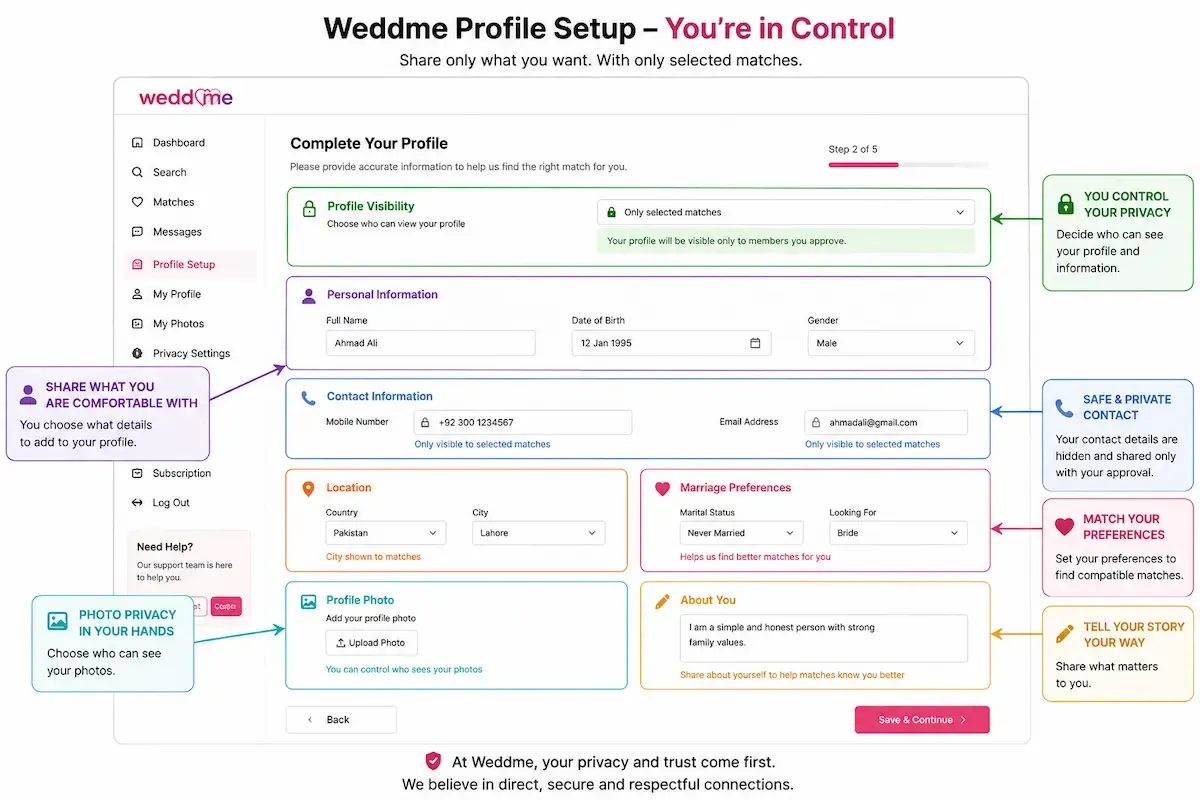
Weddme lets members control profile-photo visibility and whether phone or email information is visible. Its privacy policy says profile photos can be kept private and shared selectively, while contact information visibility can also be controlled through account settings.
Weddme's current safety guidance also recommends keeping sensitive details private until the family is comfortable and moving gradually from profile review to communication and verification.
That is the safer way to handle an online rishta search.
A father does not need to publish his daughter's phone number to let another family see her education and background.
A woman does not need to make every photograph public just because she has created a matrimonial profile.
Share more only when there is a reason to.
Weddme also warns that privacy controls cannot prevent another person from taking screenshots or saving information after they have been allowed to view it.
So make every sharing decision as if the information could eventually leave the platform.
Ask the Same Privacy Questions Before Using a Marriage Bureau
A printed biodata can spread just as easily as an online profile.
Before giving a marriage bureau a complete file, ask:
Who will see our biodata?
Do you send it through WhatsApp?
Do you share photographs automatically or ask first?
Can we remove our information if we stop using the service?
Who keeps copies of our documents?
If the answers are vague, do not hand over sensitive material.
A professional intermediary should be able to explain how client information is handled.
Write Everything With the Young Person Present
This is especially important when parents are creating a profile for a son or daughter.
Do not guess their preferences.
Ask.
Confirm the height.
Confirm the education information.
Ask how they want their religious practice described.
Discuss whether they are comfortable with a photograph.
Ask whether they would live in a joint family.
Ask which cities they would realistically consider.
A biodata may be managed by parents, but it describes the life of the person who may eventually marry.
They should recognize themselves in it.
Expert Tip: Create Two Versions of Your Biodata
Keep one privacy-safe version for early sharing.
It should contain basic personal details, education, profession, family background, city, biradari if relevant, and partner preferences.
Keep a second, more detailed version for families that have passed your first screening.
That version can include additional family context and contact information when both sides are comfortable.
Do not give every new proposal the maximum amount of information on day one.
Share enough to decide whether the conversation should continue. Then verify before you share more.
The next step is to turn those incoming profiles and biodata into a manageable shortlist instead of discussing every proposal as if it were equally suitable.
Separate Must-Haves From Preferences
This is one of the simplest ways to improve your shortlist.
Create three categories:
Must Have: A proposal does not move forward without it.
Preferred: Important, but the family can discuss an exception.
Open: No fixed requirement.
Your criteria might look like this:
| Criteria | Family Decision |
| Education | Bachelor's degree — Must Have |
| Profession | Stable profession — Must Have |
| Biradari | Arain — Preferred |
| Location | Okara/Sahiwal — Preferred; Lahore acceptable |
| Religious practice | Regular prayers — Must Have |
| Living arrangement | Separate portion/home — Preferred |
| Age difference | Up to 5 years — Preferred |
Do not make everything a must-have.
If you have twelve compulsory conditions, you are not really shortlisting. You are searching for one imaginary person who satisfies a specification sheet.
Leave room for an unexpectedly good proposal.
Build a Shortlist of 5–10 Profiles
Now start comparing actual proposals.
If you are searching through Weddme.pk, use the available filters to reduce the initial pool according to the criteria you have already agreed upon. Then save or record the profiles that appear genuinely relevant.
Do the same with proposals coming from bureaus, relatives, or community contacts.
Aim for around 5–10 serious profiles at one time.
That is enough to compare without creating confusion.
Do not keep 40 active proposals because you are afraid of missing someone better.
More profiles do not necessarily produce a better decision.
They often produce decision fatigue.
Use a Simple Shortlisting Method
You do not need complicated mathematics.
For each proposal, mark an important criterion as:
✓ Meets
~ Flexible / needs discussion
✕ Does not meet
A simple comparison could look like this:
| Criteria | Proposal A | Proposal B | Proposal C |
| Education | ✓ | ✓ | ✓ |
| Profession | ✓ | ~ | ✓ |
| Biradari | ✓ | ✕ | ✓ |
| Location | ~ | ✓ | ✓ |
| Religious compatibility | ✓ | ✓ | ~ |
| Living arrangement | ✓ | ~ | ✓ |
| Young person's interest | ✓ | ✓ | ✕ |
The last row is important.
A proposal can look excellent on paper and still not belong on the shortlist if the prospective bride or groom does not want to pursue it.
Do not award extra points because the family is wealthy, influential, or known to your relatives.
And do not reduce someone's entire suitability to a numerical score.
The tracker helps you compare facts.
It does not choose a spouse for you.
Keep a Family Rishta Tracker
Once you search through several channels at the same time, memory is no longer enough.
Create one tracker that the family uses for every proposal.
Do not maintain one WhatsApp list with your mother, another notebook with your father, and a separate set of saved Weddme profiles.
Use one record.
Printable Family Rishta Tracker
| Proposal | Source | Age | City | Education | Profession | Biradari | Core Criteria Met? | Young Person Interested? | Verification Status | Last Contact | Next Step |
| Proposal 01 | Weddme.pk | Not started | |||||||||
| Proposal 02 | Relative | Not started | |||||||||
| Proposal 03 | Marriage bureau | Not started | |||||||||
| Proposal 04 | Community referral | Not started | |||||||||
| Proposal 05 | Weddme.pk | Not started |
Review the Shortlist Once a Week
Choose one time when the people actually involved in the decision review the active proposals together.
You do not need a family meeting every evening.
Look at what changed.
Which families replied?
Which proposals need verification?
Which ones no longer meet the criteria?
Which profiles does the prospective bride or groom want to continue with?
Then decide the next action for each active proposal.
This keeps a multi-channel search organized without allowing rishta discussions to take over everyday family life.
Expert Tip: Shortlist First, Investigate Second
Do not conduct detailed background checks on every profile you see.
First apply your criteria.
Reduce the pool to 5–10 realistic possibilities.
Let the prospective bride or groom review them.
Then begin verification on the proposals where there is genuine mutual interest.
Your sequence should be:
Find → Filter → Shortlist → Discuss → Verify → Meet.
That saves time and protects everyone's privacy.
Once a proposal survives the shortlist, however, the standard changes. Before families become emotionally invested or start discussing engagement, you need to know whether the important information you have been given is actually true.
That is where respectful rishta verification begins.
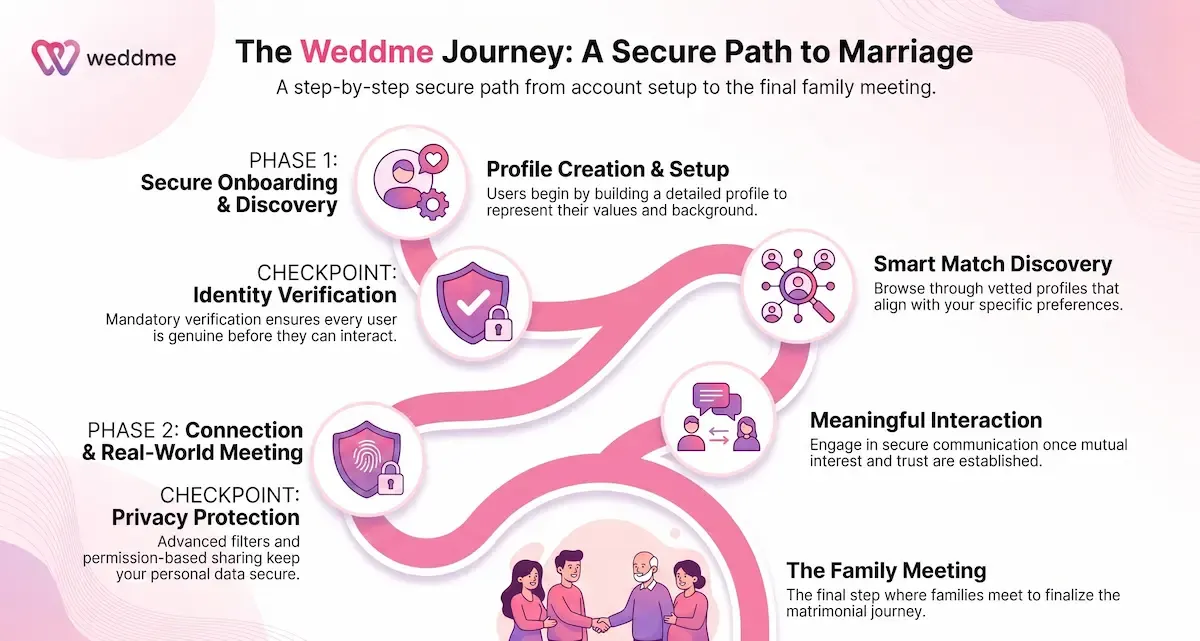
Use Weddme.pk Privacy Controls From the Start
When creating a profile on Weddme.pk, review the privacy settings before making the profile active.
Do not assume the default level is automatically right for your family.
Keep Photos Controlled
If your daughter is not comfortable showing her photograph publicly, do not make it openly visible.
Use the available privacy settings to control who can see profile photographs and share them only after a family appears genuinely relevant.
A photograph should not be the first piece of information a stranger receives.
Start with the basic profile.
Check whether the family fits your criteria.
Then decide whether you are comfortable sharing more.
This is particularly important because once another person has seen a photograph, no platform can completely control what happens outside the platform.
Screenshots are possible.
Treat every photo-sharing decision accordingly.
Keep the Search Family-Involved
If parents are leading the search, keep the prospective bride or groom involved in the profile and shortlist.
Do not create a detailed matrimonial profile in their name without showing them what has been written.
Review incoming proposals together.
This gives the young person a chance to say:
I am interested.
I am not comfortable with this.
I want more information before we respond.
I do not want my photo shared with this family yet.
That is much safer than allowing several relatives to manage the search independently.
Weddme supports family-managed matrimonial searching, which fits the way many Pakistani families already handle rishta discussions. The important part is making sure family involvement does not replace the young person's own voice.
Do Not Treat Profile Review as Full Verification
A platform can organize profiles and apply moderation or account controls.
It cannot guarantee that every personal claim is true.
That is why Weddme's own safety guidance places responsibility on families to verify important details before making commitments.
Use platform safeguards as the first layer.
Use your own family verification as the second.
Do not tell yourself:
"The profile is online, so it must already be verified."
Check identity, education, profession, and family background when the proposal becomes serious.
What Personal Details Should Stay Private?
The simplest rule is this:
A new contact gets only the information needed for the next decision.
Nothing more.
Never Share These Details Publicly
Do not place the following information on a public matrimonial profile or widely circulated biodata:
- full home address;
- CNIC number;
- CNIC photograph;
- exact workplace address;
- personal banking information;
- passport details;
- salary documents;
- private family documents;
- unnecessary phone numbers;
- photographs of relatives who have not agreed to be included.
Be especially careful when biodata is being forwarded through WhatsApp.
Once a document enters several family groups, you usually lose control over where it goes next.
Share Contact Details Gradually
A family does not need your daughter's personal phone number simply to express interest.
Early communication can remain through the parent, guardian, or the matrimonial platform.
Share a direct number only when both sides are comfortable moving forward.
The same applies to the exact workplace and home address.
City-level information such as Okara is usually enough during the first stage.
If meetings become serious, more specific details can be exchanged privately.
Be More Careful With a Daughter's Photographs
This deserves its own rule.
Do not send a daughter's photographs to every person who asks.
First check the basic profile.
Is the age suitable?
Does the education match what your family is looking for?
Is the location acceptable?
Is the family genuinely interested?
Does the prospective bride want to continue?
Only then consider sharing a photograph if she is comfortable.
And ask the other side to treat it privately.
A respectful family will understand.
If someone becomes aggressive because you will not immediately send photographs, that itself tells you something useful about the interaction.
Local Okara Resources and Next Steps
Once your family's profile, criteria, and privacy rules are ready, activate the search.
Do not open accounts on every matrimonial website you can find.
Use one organized online channel, then support it with trusted offline routes.
1. Create Your Main Profile on Weddme.pk
Start with Weddme.pk as the main online search channel.
Set the city to Okara where relevant.
Complete the profile accurately.
Add education, profession, family background, biradari or community if important, and clear partner preferences.
Then review the privacy settings before sharing photographs or personal contact information.
Use the platform to organize discovery.
Use your family process to decide which proposals deserve further contact.
2. Activate Two or Three Trusted Family Contacts
Choose relatives who understand what you are actually looking for.
Do not send the biodata to twenty people at once.
Tell a small number of sensible relatives:
- preferred age range;
- education;
- profession;
- location;
- biradari if relevant;
- religious expectations;
- any important living-arrangement preference.
Ask them to contact you before forwarding private photos or sensitive information.
This keeps the network useful without allowing the search to spread beyond your control.
3. Speak With a Traditional Marriage Bureau if Needed
Use a bureau when your family wants a human intermediary or your own network is producing too few suitable options.
Do not choose one simply because it appears in a Facebook post or WhatsApp advertisement.
Confirm:
Where is the office?
How long has the bureau operated?
Does it currently have Okara proposals?
What does it verify?
How much does it charge?
How is your biodata shared?
Can you remove your information later?
Some established Pakistani bureaus operate outside Okara, so location and current proposal coverage should always be confirmed directly.
4. Inform Trusted Biradari Elders
If biradari is important to your family, activate that network deliberately.
Do not simply say:
"We need a rishta."
Tell the elder what would make a proposal suitable.
For example:
"We are looking for an Arain groom, approximately 28–32, graduate or professionally qualified, preferably in Okara, Sahiwal, or Lahore."
That creates a much better filter.
5. Speak Privately With a Mosque or Community Contact
If your family has a trusted imam or community elder, speak to them privately.
Give a short description of the kind of match you are seeking.
Do not hand over a full biodata immediately.
Start with a privacy-safe version.
If they know a potentially suitable family, then you can decide what to share next.
Okara Rishta Channel Decision Flowchart
Use this simple guide when deciding where to focus first.
What matters most to your family?
If your priority is SPEED
Start with Weddme.pk → Apply Okara and other important filters → Shortlist 5–10 profiles → Keep family referrals active in parallel.
Online search gives you immediate access to profiles rather than waiting for someone to remember a suitable family.
If your priority is PRIVACY
Start with Weddme.pk → Keep photos and contact details restricted → Use a parent or guardian as the first contact → Share personal details gradually.
Avoid uncontrolled WhatsApp circulation.
Use one central profile and one family contact where possible.
If your priority is BIRADARI
Start with trusted biradari elders → Search Weddme.pk using relevant community or caste information → Compare both sources through the same shortlist.
Do not assume the offline proposal is safer simply because it came through a known family.
Verify both.
If your priority is LOW COST
Start with Weddme.pk's basic profile options + family network + mosque/community referrals → Add a paid bureau only if the search is too limited.
Do not pay several services at the beginning.
First see what your existing network and organized online search can produce.
If your priority is HUMAN HELP
Speak with a reputable marriage bureau → Ask whether it currently has relevant Okara proposals → Keep your Weddme.pk profile active in parallel.
The bureau can handle introductions.
Your family should still control verification and the final decision.
If you are NOT SURE
Use this combination:
Weddme.pk + two trusted relatives + one community contact.
Run all three for a few weeks.
Then review which channel is actually producing serious proposals.
Family Rishta Tracker Template
Do not depend on memory.
Use one tracker for every proposal, regardless of where it came from.
Printable Family Rishta Tracker
| Proposal Source | Name / Reference | Age | Education | Profession | Biradari | Location | Identity Checked | Education Checked | Job Checked | Family Checked | Young Person Interested? | Next Step | Notes |
| Weddme.pk | ☐ | ☐ | ☐ | ☐ | |||||||||
| Relative | ☐ | ☐ | ☐ | ☐ | |||||||||
| Marriage bureau | ☐ | ☐ | ☐ | ☐ | |||||||||
| Mosque/community | ☐ | ☐ | ☐ | ☐ | |||||||||
| Weddme.pk | ☐ | ☐ | ☐ | ☐ |
How to Use the Tracker
Update it after every meaningful conversation.
Do not wait until the end of the week and try to remember what happened.
If a family sends new information, update it.
If education is verified, mark it.
If the prospective bride or groom does not want to continue, record that and close the proposal.
If a meeting is arranged, write the date in the notes.
Then review the tracker once a week as a family.
Focus on three questions:
Which proposals are still genuinely suitable?
What still needs to be verified?
What is the next action?
That is enough.
The tracker should reduce confusion, not create more paperwork.
Expert Tip
Keep the entire rishta search in one system.
Use Weddme.pk for organized online discovery, your family and community network for trusted introductions, and one shared tracker for every proposal.
Protect photographs and personal information from the beginning.
Verify before trust becomes emotional.
And before any proposal moves from possible to serious, ask the prospective bride or groom one clear question:
“Are you comfortable continuing with this match?”
That answer should guide the next step.
Author Credentials and Accuracy Commitment
This guide was prepared by the Weddme.pk team, based on hands-on experience with Pakistani matrimonial searches and the practical concerns families face when comparing proposals, protecting privacy, verifying information, and involving both parents and the prospective bride or groom in the decision.
Our guidance is written for Pakistani families, including families in Punjab and Okara who may use a combination of online matrimonial platforms, biradari networks, relatives, marriage bureaus, mosque contacts, and community referrals.
Where biradari matters, we have addressed common Okara search patterns involving communities such as Arain and Rajput families. We have also kept the guidance practical for families who are open to suitable proposals outside their immediate biradari or city.
We do not claim that one search method works for every family.
Our aim is to help families search in a more organized, private, and respectful way while keeping the prospective bride or groom involved throughout the process.
Our Accuracy Commitment
Matrimonial platforms, privacy features, subscription prices, marriage bureau services, and verification procedures can change.
For that reason, we distinguish between information we can confirm and information that families should verify directly.
Any local bureau name, current fee, service area, response time, or verification claim that we cannot independently confirm should be treated as:
Not confirmed — verify directly before registering or paying.
The same principle applies to individual rishta profiles.
A profile on Weddme.pk, a recommendation from a relative, or an introduction through a marriage bureau should never be treated as proof that every personal claim is correct. Families should independently verify important details before making a commitment.
We also avoid presenting estimates such as “you will find a match within a few weeks” as guarantees. The time required depends on your criteria, location, family preferences, available proposals, and whether both individuals want to proceed.
If you notice outdated or incorrect information in this guide, we encourage you to contact the Weddme.pk team so it can be reviewed and corrected.
Frequently Asked Questions
Is it safe to use online matrimonial platforms for a daughter's rishta?
Yes, if you use privacy controls like photo-view requests and family co-account access, and never share a full home address, CNIC number, or workplace details publicly. Choose platforms with manual profile review and verified profiles.
How do I verify a proposal without offending the other family?
Frame verification as standard due diligence, not suspicion. Use respectful phrasing like, "As part of our family's standard process, we would like to verify a few details." Ask for CNIC, degree, and employer information early, before emotional investment.
What if the biradari does not match but the young person likes the proposal?
Keep the young person's comfort and preferences central. Biradari compatibility is important to many Okara families, but it should not override the individual's consent. Discuss openly as a family and decide together.
How long does a typical rishta search take in Okara?
It varies widely. A structured multi-channel approach can shorten the search, but families should expect weeks to months. Avoid pressure to decide quickly; a genuine match is worth the time.
What are the biggest red flags to watch for?
Requests for money, refusal to meet in person, pressure to decide quickly, and refusal to share verifiable details. Treat these as serious warning signs and walk away.
Compare profiles when your family is ready.
Use Weddme search filters to review profiles with clearer context before starting a serious conversation.