Second Marriage in Pakistan 2026: Complete Guide to Rishta, Legal Permission and Islamic Rules
Learn the legal and Islamic rules for second marriage in Pakistan, including Arbitration Council permission, required documents, first and second wife's rights, and the rishta process.

Introduction
Do you need your first wife's permission to marry again in Pakistan?
If you are considering a second marriage after divorce or widowhood, or you want to marry again while already married, this question matters. The answer depends on a distinction many families overlook: Islamic rules and Pakistani law are not the same thing.
Under Pakistani law, a man who wants to contract another marriage during an existing marriage must obtain prior permission from the Arbitration Council. Going ahead without following the legal procedure can result in financial penalties and imprisonment. The first wife also has legal rights in this process, including the right to raise an objection in writing.
For divorcees and widows, the situation is different, but documentation still matters. Missing or incorrect documents can delay the nikah registration and create problems later.
This is where confusion often starts. A marriage may be permitted under Islamic principles but still require specific legal steps under Pakistani law. Treating the two as interchangeable can lead to an unregistered marriage, financial liability, or a serious family dispute.
This guide brings the process together in one place. It covers the rishta search, Arbitration Council permission, legal requirements, Islamic rules, rights of the first and second wife, required documents, and practical rishta profile guidance.
You will also find a step-by-step legal checklist and a clear comparison between Islamic principles and Pakistani legal requirements, so you can understand what applies before making a decision.
Important: This article is for informational purposes only. It does not constitute legal or religious advice. Your circumstances may require advice from a qualified family lawyer and a religious scholar.
What Is a Second Marriage in Pakistan?
In Pakistan, “second marriage” does not always mean polygamy. It simply means entering a marriage after having been married before. The legal process depends on whether the earlier marriage has ended or is still continuing.
There are three different situations:
- Remarriage after divorce: If the previous marriage ended through divorce or khula, the person can remarry after completing the applicable iddat period. This is a new marriage, not polygamy.
- Remarriage after widowhood: If the previous spouse has died, the widow or widower can remarry after the applicable iddat period. The death of the previous spouse ends the earlier marriage.
- Polygamy during an existing marriage: If a husband is still married to his first wife and wants to marry another woman, the first marriage is still subsisting. This situation falls under Section 6 of the Muslim Family Laws Ordinance 1961 (MFLO) and requires prior written permission from the Arbitration Council.
Why This Distinction Matters
The legal requirements are significantly different.
If your previous marriage ended through divorce or the death of your spouse, you generally do not need Arbitration Council permission for the new marriage. You must complete the standard nikah and registration requirements and provide documents establishing that the previous marriage has ended.
If your first marriage is still continuing, you must obtain prior written permission from the Arbitration Council before contracting another marriage.
A second marriage is not automatically polygamy under Pakistani law. Section 6 applies when the first marriage is still subsisting.
Expert Tip: If you are a divorcee or widow, keep your divorce certificate or death certificate available. These documents help establish that your previous marriage has ended. Confirm the exact documentation required by your Nikah Registrar or local Union Council before the nikah.
Islamic Rules on Second Marriage
What Does the Quran Say About Second Marriage?
The Quran permits a Muslim man to marry up to four wives, subject to the condition of justice. In Quran 4:3, Allah says:
“Marry those that please you of women, two, three, or four. But if you fear that you will not be just, then marry only one.”
The central issue is just treatment. A husband who takes another wife takes on additional responsibilities. These include financial maintenance, accommodation, time, and fair treatment.
The permission to marry more than one wife is therefore not a licence to ignore the rights of either wife.
Does Sharia Require the First Wife's Permission?
No. Islamic law does not generally make the first wife's permission a condition for the validity of a husband's second marriage.
However, that religious rule does not remove the husband's obligation to treat his wives justly. Quran 4:3 specifically warns that if a man fears he cannot maintain justice, he should marry only one.
This is also separate from Pakistani law. A religious ruling about whether the first wife's consent is required should not be confused with the country's statutory requirement for Arbitration Council permission. IslamQA ruling on marrying another wife without the first wife's permission
What Does Just Treatment Require?
The husband should realistically assess whether he can meet the rights and responsibilities involved, including:
- Equal financial maintenance according to each wife's legitimate needs and circumstances.
- Fair accommodation, without deliberately disadvantaging one wife.
- Equal allocation of time and overnight stays.
- Fair and respectful treatment in matters within his control.
- Genuine financial and practical capacity to fulfil these responsibilities.
Emotional equality is more complicated because a person's feelings cannot always be controlled. The practical obligation is to avoid deliberate favoritism and unfair treatment in matters within the husband's control.
Islamic Permission and Legal Permission Are Different
This distinction is critical.
Islamic permission does not replace Pakistani legal permission.
A man may believe that Sharia permits him to marry another wife without obtaining her first wife's consent. If his first marriage is still subsisting, however, Pakistani law still requires him to obtain prior permission from the Arbitration Council.
The reverse is also true. Obtaining Arbitration Council permission does not automatically mean that the man has fulfilled his Islamic duty of justice.
The two questions must therefore be considered separately:
| Question | What applies? |
| Does Sharia generally require the first wife's permission? | No |
| Does Sharia require just treatment? | Yes |
| Does Pakistani law require Arbitration Council permission for another marriage during an existing marriage? | Yes |
| Does legal permission automatically prove Islamic compliance? | No |
Speak to both a family lawyer and a qualified Islamic scholar before proceeding. The lawyer can explain the requirements under Section 6 of the MFLO, while the scholar can help you assess the religious responsibilities involved in maintaining justice.
Islamic scholar consultation: If you are considering polygamy, seek a qualified scholar who can explain the practical requirements of adl (justice), rather than giving only a theoretical ruling. Your financial responsibilities, accommodation, time allocation, existing marriage conditions, and personal circumstances should be considered.
Primary Islamic source: Quran 4:3 — Quran.com
Legal Requirements Under Section 6 of the Muslim Family Laws Ordinance 1961
The Core Legal Requirement
If a man wants to contract another marriage while his existing marriage is still in force, Section 6 of the Muslim Family Laws Ordinance 1961 requires prior written permission from the Arbitration Council.
This is a legal requirement, not a recommendation. The permission must be obtained before the second nikah. Section 6 also states that a marriage contracted without this permission cannot be registered under the Ordinance.
What Does Section 6 Require?
The husband must submit an application to the Chairman of the relevant Union Council in the prescribed manner and pay the prescribed fee. The application must state:
- The reasons for the proposed second marriage.
- Whether the consent of the existing wife or wives has been obtained.
After receiving the application, the Chairman asks the husband and his existing wife or wives to nominate representatives. The Arbitration Council then considers whether the proposed marriage is necessary and just before deciding whether to grant permission.
The first wife's consent is therefore relevant to the legal process, but consent and Arbitration Council permission are not the same thing.
Penalties for Contracting a Second Marriage Without Permission
The consequences are serious.
Under Section 6(5), a man who contracts another marriage without Arbitration Council permission must:
- Pay the entire amount of dower immediately due to his existing wife or wives. If it is not paid, it can be recovered as arrears of land revenue.
- On conviction, face simple imprisonment for up to one year, or a fine of up to Rs. 5,000, or both.
An unauthorized second marriage can also create separate family-law consequences. In PLD 2025 SC 262, the Supreme Court of Pakistan recognized an unauthorized second marriage as a ground that can support dissolution of the first marriage under the applicable law.
Do not treat Arbitration Council permission as paperwork that can be completed after the nikah. Obtain it first.
The PLD 2025 SC 262 Ruling
The Supreme Court's decision in Dr. Faryal Maqsood v. Khurram Shehzad Durrani, PLD 2025 SC 262, is particularly important for first wives.
The Court confirmed that contracting a second marriage without the mandatory Arbitration Council permission under Section 6 MFLO can provide an independent ground for dissolution of the existing marriage under Section 2(ii-a) of the Dissolution of Muslim Marriages Act, 1939.
The decision reinforces an important point: failure to obtain prior permission is not merely a technical violation with a small financial penalty. It can have consequences for the existing marriage itself.
Get the written Arbitration Council permission before the second nikah. Do not assume that obtaining permission afterward will cure the violation.
Official Muslim Family Laws Ordinance 1961 — Ministry of Religious Affairs
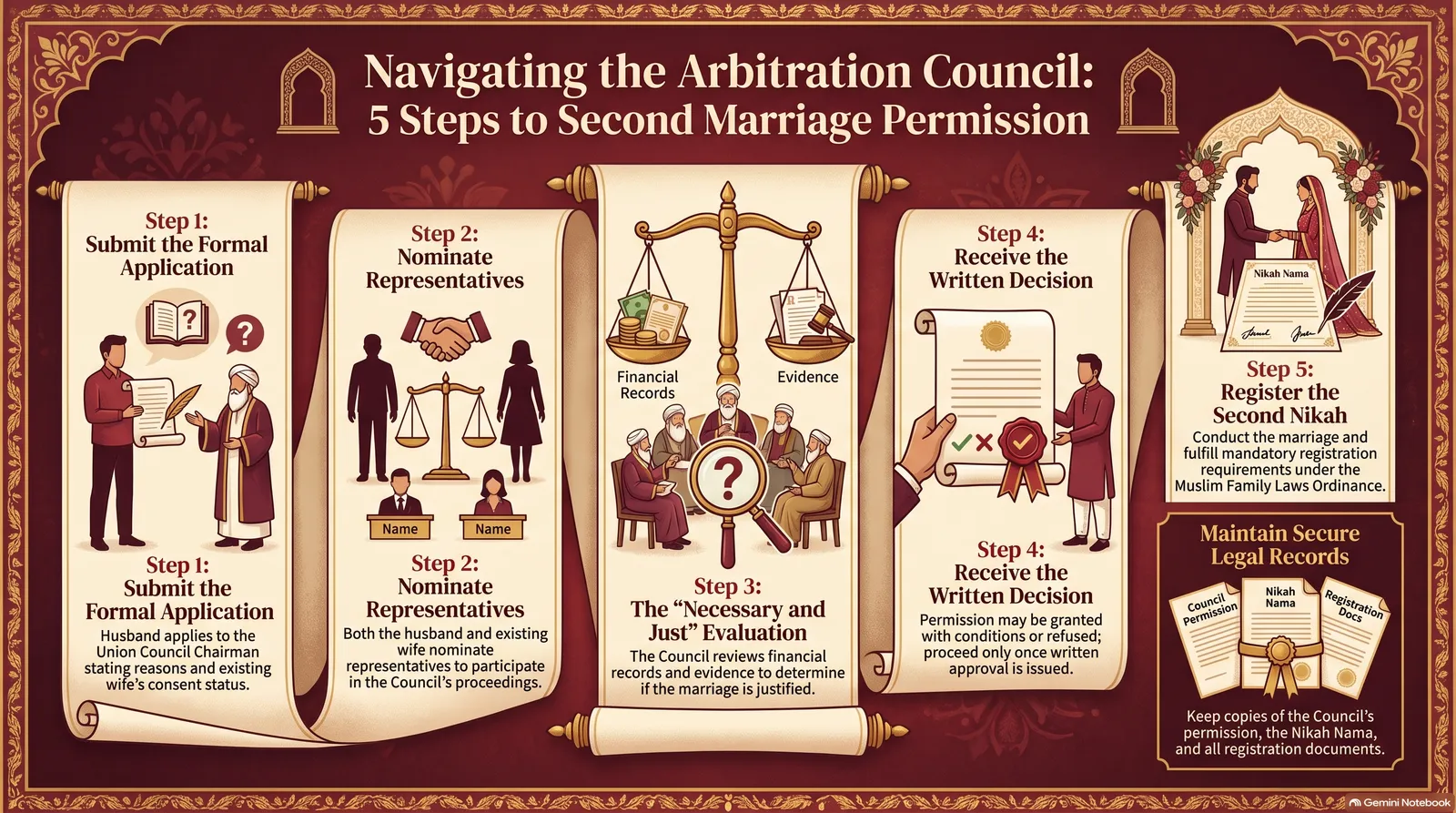
Step-by-Step Arbitration Council Permission Process
Step 1: Prepare the Application
The husband submits an application to the Chairman of the relevant Union Council in the prescribed manner.
The application should accurately provide the information required under Section 6, including:
- Reasons for the proposed marriage.
- Whether the existing wife or wives have given consent.
- Details required by the prescribed application procedure.
- Any supporting information requested by the Union Council.
Do not provide misleading information. The Arbitration Council will consider whether the proposed marriage is necessary and just.
Step 2: Notice and Representation of the Existing Wife
After receiving the application, the Chairman asks the husband and his existing wife or wives to nominate representatives for the Arbitration Council.
This gives the existing wife an opportunity to participate in the process and present her position. Her objections should not simply be ignored. The Council must consider the matter before deciding whether permission should be granted.
Step 3: Arbitration Council Proceedings
The Arbitration Council considers the application and the positions of the parties.
The Council may examine the reasons given for the proposed marriage and whether the proposed marriage is necessary and just. The process is not simply an automatic approval of every application.
Keep relevant financial information and supporting documents organized. If the Union Council asks for evidence of income, expenses, or existing financial obligations, provide accurate records.
Step 4: The Decision
The Arbitration Council records the reasons for its decision and may grant permission subject to conditions. If permission is refused, the applicant has a prescribed revision process under Section 6.
Do not proceed with the second nikah until the required written permission has been obtained.
Step 5: Register the Second Nikah
Once the required permission has been obtained, proceed with the nikah and its registration according to the applicable marriage-registration requirements.
The Muslim Family Laws Ordinance separately requires Muslim marriages to be registered through the prescribed process.
Keep copies of the Arbitration Council permission, nikah nama, and registration documents with your other important legal records.
What Documents Should You Prepare?
The exact documents and forms can vary according to the local Union Council and applicable rules. Before submitting the application, confirm the current requirements with the relevant Union Council.
Useful records to keep ready may include:
- CNIC copies.
- Existing nikah nama.
- Details of the existing wife or wives.
- Information about the proposed marriage.
- Evidence of income and financial obligations where requested.
- Any other documents required by the relevant Union Council.
Family Lawyer Consultation
If you are unsure about the Section 6 procedure, a family lawyer can help prepare the application, identify the correct Union Council, explain the applicable rules, and represent you where necessary.
This is particularly important if your first wife objects, there are disputes about maintenance or dower, or your circumstances involve previous litigation.
Important Correction About NADRA
Marriage registration and NADRA record updates are related but are not the same legal step. Do not assume that obtaining a CNIC record update automatically replaces Union Council marriage registration.
Complete the required marriage registration first, then confirm the current NADRA procedure for updating the marital record.
Keep a realistic household budget and accurate financial records. If your financial capacity becomes relevant to the proceedings, salary slips, bank records, and a clear record of existing maintenance obligations can help demonstrate your actual financial position. Do not create figures simply to make the application look stronger.
First Wife's Rights
• Right to
Object: Explain that the first wife has the right to submit a written
objection to the Arbitration Council during the notice period. This objection
must be considered by the Council before a decision is made. The objection can
be based on the husband's inability to maintain two wives justly, lack of
financial capacity, or other valid grounds.
• Right to
Seek Khula: If the husband contracts a second marriage without permission,
or if the first wife is unhappy with the situation, she has the right to seek
khula (dissolution of marriage initiated by the wife). The PLD 2025 SC 262
ruling clarified that an unauthorized second marriage can justify dissolution.
• Right to
Maintenance and Dower: The first wife retains her right to maintenance and
dower. The husband's second marriage does not diminish these rights. If the
husband fails to provide equal maintenance, the first wife can seek legal
remedy.
• Right to
Housing: The first wife has the right to separate, adequate housing. The
husband cannot force both wives to live in the same house without their
consent.
• The PLD
2025 SC 262 Position: Explain the Supreme Court's position in detail: the
Court protected a wife's financial rights and clarified that an unauthorized
second marriage can be grounds for dissolution. This ruling is a significant
protection for first wives.
First wives should submit any objection to the Arbitration Council in writing
during the notice period to protect their rights. A written objection creates a
formal record and ensures the Council must consider your position before
granting permission.
Consideration: Cite PLD 2025 Supreme Court 262 with a direct link to a
reputable legal source. Explain the case in accessible language so first wives
understand their legal protections.
Product
Recommendation: Written maintenance and housing agreement template, provide
a template that first wives and husbands can use to formalize maintenance and
housing arrangements before the second marriage, reducing future disputes.
Rights
of the Second Wife
• Equal
Maintenance: The second wife is entitled to equal maintenance, just like
the first wife. The husband must provide for her food, clothing, housing, and
other necessities at the same standard as the first wife.
• Dower
(Haq Mehr): The second wife is entitled to her full dower, which must be
specified in the nikah nama. Her dower rights are not weaker than the first
wife's.
• Inheritance
Rights: The second wife has full inheritance rights under Islamic law and
Pakistani succession law. She inherits from her husband's estate just like the
first wife, in the shares prescribed by sharia.
• Housing
Rights: The second wife has the right to separate, adequate housing. The
husband cannot house both wives together without their consent.
• Legal
Status if Permission Not Obtained: Address the common fear: if the husband
did not obtain Arbitration Council permission, the second wife's legal status
may be affected. The marriage may be considered irregular, which can impact her
ability to claim certain legal rights. This is why obtaining permission before
the nikah is critical for the second wife's protection.
Consider a written agreement on maintenance and housing before the second
marriage to reduce future disputes. This agreement can clarify expectations and
provide a reference point if disagreements arise later.
Differentiation
Opportunity: This section addresses a common fear, that the second wife's
rights are weaker, and provides clear, reassuring information that builds trust
with this audience. No competitor currently gives equal weight to the second
wife's perspective.
Required
Documents Checklist
• CNIC
(Computerized National Identity Card): Both the husband and the prospective
second wife must have valid CNICs. This is required for the nikah registration
and the Arbitration Council application.
◦ Previous Marriage Documents:
◦ Divorce
certificate: If the previous marriage ended in divorce, the divorce
certificate (or khula decree) is required.
◦ Death
certificate: If the previous spouse passed away, the death certificate is
required.
These documents prove that the previous marriage has ended and determine whether
Arbitration Council permission is needed.
• Nikah Nama:
The original nikah nama from the first marriage (if applicable) and
the new nikah nama for the second marriage.
• Arbitration
Council Application: The completed application form for permission to
contract a second marriage, if the first marriage is still subsisting.
• Financial
Documents: Bank statements, salary slips, and a budget showing capacity to
maintain both wives. These are examined by the Arbitration Council.
• Witnesses:
Two adult Muslim witnesses for the nikah ceremony.
Product
Recommendation: CNIC and previous marriage documents such as divorce
certificate or death certificate, advise readers to obtain certified copies of
these documents well in advance, as they are required for both the Arbitration
Council application and the nikah registration.
The Rishta Process for Second Marriage
• Writing an Honest Profile:
Guide readers on how to present their situation honestly
but with dignity. Key points:
◦ Disclose
marital status clearly (divorced, widowed, or married seeking second wife)
◦ Mention
children if applicable, but without oversharing personal details
◦ Be
upfront about the second-marriage situation to avoid wasting time and building
trust
◦ Use
discretion but not deception, present circumstances truthfully while
maintaining privacy
• Disclosing
Children: Explain how to mention children in a rishta profile:
◦ State
the number of children and their ages
◦ Do
not share children's names, photos, or school details publicly
◦ Be
prepared to discuss children's adjustment in private conversations
• Choosing a Platform with Marital-Status Filtering:
Recommend matrimonial platforms that offer marital-status filtering, such as weddme.pk or QuickRishta. Explain
how these features help second-marriage seekers find compatible matches without
awkward conversations.
• Maintaining
Discretion:
◦ Use
a separate phone number or email for rishta communications
◦ Avoid
sharing workplace or home address until trust is established
◦ Be
cautious about sharing photos that could be misused
Be honest about a previous marriage and children in your rishta profile; hiding
them can make the second marriage irregular and destroy trust. Honesty from the
start builds a foundation of trust that is essential for a successful second
marriage.
Use discretion but not deception; present your circumstances with dignity while
remaining truthful. There is a difference between protecting your privacy and
misleading a potential spouse.
Verify the prospective spouse's marital status and legal standing before
committing to avoid fraud or an unregistered marriage. Ask for documents and
confirm their situation independently.
Product
Recommendation: Matrimonial platform with marital-status filtering, such as
weddme.pk or QuickRishta, these platforms allow you to filter for
second-marriage seekers and disclose your status upfront, reducing awkward
conversations.
First
Wife's Rights
• Right to
Object: Explain that the first wife has the right to submit a written
objection to the Arbitration Council during the notice period. This objection
must be considered by the Council before a decision is made. The objection can
be based on the husband's inability to maintain two wives justly, lack of
financial capacity, or other valid grounds.
• Right to
Seek Khula: If the husband contracts a second marriage without permission,
or if the first wife is unhappy with the situation, she has the right to seek
khula (dissolution of marriage initiated by the wife). The PLD 2025 SC 262
ruling clarified that an unauthorized second marriage can justify dissolution.
• Right to
Maintenance and Dower: The first wife retains her right to maintenance and
dower. The husband's second marriage does not diminish these rights. If the
husband fails to provide equal maintenance, the first wife can seek legal
remedy.
• Right to
Housing: The first wife has the right to separate, adequate housing. The
husband cannot force both wives to live in the same house without their
consent.
• The PLD
2025 SC 262 Position: Explain the Supreme Court's position in detail: the
Court protected a wife's financial rights and clarified that an unauthorized
second marriage can be grounds for dissolution. This ruling is a significant
protection for first wives.
First wives should submit any objection to the Arbitration Council in writing
during the notice period to protect their rights. A written objection creates a
formal record and ensures the Council must consider your position before
granting permission.
Rights
of the Second Wife
• Equal
Maintenance: The second wife is entitled to equal maintenance, just like
the first wife. The husband must provide for her food, clothing, housing, and
other necessities at the same standard as the first wife.
• Dower
(Haq Mehr): The second wife is entitled to her full dower, which must be
specified in the nikah nama. Her dower rights are not weaker than the first
wife's.
• Inheritance
Rights: The second wife has full inheritance rights under Islamic law and
Pakistani succession law. She inherits from her husband's estate just like the
first wife, in the shares prescribed by sharia.
• Housing
Rights: The second wife has the right to separate, adequate housing. The
husband cannot house both wives together without their consent.
• Legal
Status if Permission Not Obtained: Address the common fear: if the husband
did not obtain Arbitration Council permission, the second wife's legal status
may be affected. The marriage may be considered irregular, which can impact her
ability to claim certain legal rights. This is why obtaining permission before
the nikah is critical for the second wife's protection.
Consider a written agreement on maintenance and housing before the second
marriage to reduce future disputes. This agreement can clarify expectations and
provide a reference point if disagreements arise later.
Required
Documents Checklist
• CNIC
(Computerized National Identity Card): Both the husband and the prospective
second wife must have valid CNICs. This is required for the nikah registration
and the Arbitration Council application.
◦ Previous
Marriage Documents: **
◦ Divorce
certificate: If the previous marriage ended in divorce, the divorce
certificate (or khula decree) is required.
◦ Death
certificate: If the previous spouse passed away, the death certificate is
required.
These documents prove that the previous marriage has ended and determine whether
Arbitration Council permission is needed.
• Nikah
Nama: The original nikah nama from the first marriage (if applicable) and
the new nikah nama for the second marriage.
• Arbitration
Council Application: The completed application form for permission to
contract a second marriage, if the first marriage is still subsisting.
• Financial
Documents: Bank statements, salary slips, and a budget showing capacity to
maintain both wives. These are examined by the Arbitration Council.
• Witnesses:
Two adult Muslim witnesses for the nikah ceremony.
The Rishta Process for Second Marriage
• Writing an Honest Profile:
Guide readers on how to present their situation honestly
but with dignity.
Key points:
◦ Disclose
marital status clearly (divorced, widowed, or married seeking second wife)
◦ Mention
children if applicable, but without oversharing personal details
◦ Be
upfront about the second-marriage situation to avoid wasting time and building
trust
◦ Use
discretion but not deception, present circumstances truthfully while
maintaining privacy
• Disclosing
◦ State
the number of children and their ages
◦ Do
not share children's names, photos, or school details publicly
◦ Be
prepared to discuss children's adjustment in private conversations
• Verifying
the Prospective Spouse: Advise readers to verify the prospective spouse's
marital status and legal standing before committing. This prevents fraud and
unregistered marriages.
Decision Readiness Self-Checklist
A second marriage should not be treated as a decision based only on whether it is legally possible. Before beginning the rishta process, assess whether you are actually prepared for the responsibilities involved.
Financial Readiness
Ask yourself:
- Can I afford to maintain two households without neglecting either?
- Have I prepared a written budget covering both households?
- Do I have savings for unexpected medical, household, or family expenses?
- Can I consistently provide housing, food, clothing, healthcare, and other necessary expenses?
- Have I considered existing debts and financial commitments?
- Can I meet my current family's needs without relying on unrealistic future income?
If the answer to these questions is no, do not treat the second marriage as a problem that money will somehow solve later.
Emotional Readiness
Ask yourself:
- Am I genuinely prepared to treat both wives fairly?
- Can I manage the emotional demands of two marriages without deliberately neglecting either?
- Have I considered how the decision may affect my children?
- Am I prepared for disagreement, jealousy, or family tension?
- Am I pursuing this marriage for a considered reason rather than impulse, pressure, or temporary attraction?
Islamic permission does not remove the responsibility of just treatment.
Family Readiness
Ask yourself:
- Have I communicated honestly with the people directly affected by the decision?
- Am I prepared for opposition from my first wife or other family members?
- Have I considered how my children may react?
- Do I have trustworthy people who can provide practical support?
- Am I prepared to handle social pressure without allowing it to control the decision?
Family disagreement does not automatically determine the legal position, but ignoring it can create avoidable conflict.
Legal Readiness
Before proceeding, ask yourself:
- Do I understand the Section 6 MFLO 1961 requirement?
- Is my first marriage still legally subsisting?
- If it is, have I started the Arbitration Council permission process?
- Have I consulted a qualified family lawyer?
- Do I have the required CNICs and relevant marriage documents?
- If a previous marriage ended, do I have the divorce, khula, or death documentation?
- Have I prepared accurate financial information if required by the Arbitration Council?
- Am I prepared to obtain permission before the second nikah?
Do not arrange the second nikah first and attempt to fix the legal requirements afterward.
First Wife vs Second Wife Rights at a Glance
| Right | First Wife | Second Wife |
| Dower (Haq Mehr) | Entitled to the dower agreed in her nikah nama. | Entitled to the dower agreed in her nikah nama. |
| Maintenance | Retains her applicable maintenance rights. | Has applicable maintenance rights as a wife. |
| Inheritance | Can inherit from her husband's estate under applicable Islamic and Pakistani succession rules. | Can inherit from her husband's estate under applicable Islamic and Pakistani succession rules. |
| Housing | Has legitimate accommodation rights under applicable Islamic and family-law principles. | Has legitimate accommodation rights under applicable Islamic and family-law principles. |
| Participation in second-marriage process | Her position is relevant to the Arbitration Council process under Section 6. | Not applicable as an existing wife. |
| Dissolution / Khula | Can pursue applicable remedies, including dissolution on the statutory ground where Section 2(ii-a) applies, or khula where properly sought. | Can pursue applicable marital remedies, including khula where the legal requirements are met. |
| If Arbitration Council permission was not obtained | May have a statutory ground for dissolution under Section 2(ii-a); the husband also faces Section 6 consequences. | The marriage cannot be registered under the MFLO without the required permission; other legal consequences and rights should be assessed according to the circumstances. |
The Important Difference
The two wives do not become unequal in their basic marital rights simply because one is the first wife and the other is the second.
However, their legal positions are not identical in every respect.
The first wife is the existing wife whose position is considered in the Arbitration Council process. She may also have a statutory ground for dissolution if the husband contracts another marriage without the required permission.
The second wife is the woman entering the proposed new marriage. If the husband fails to obtain the required permission, Section 6 creates legal consequences for him and prevents registration of that marriage under the MFLO. That does not justify the blanket statement that the second wife automatically has no legal rights.
The safest approach is to obtain the required permission before the nikah and ensure the marriage is properly documented and registered.
Sources and Review Information
This article should identify its sources and reviewers clearly.
Primary Legal Sources
- Muslim Family Laws Ordinance 1961, Section 6 particularly the requirements for Arbitration Council permission and the consequences of contracting another marriage without that permission.
- Dissolution of Muslim Marriages Act 1939, Section 2(ii-a) relevant to the first wife's statutory ground for dissolution.
- PLD 2025 SC 262 — Supreme Court authority concerning an un-authorized additional marriage and dissolution of the existing marriage.
Islamic Sources
- Quran 4:3 the primary Quranic source concerning plural marriage and the requirement of justice.
- Reputable Islamic rulings concerning the first wife's consent and the husband's obligations of just treatment.
This article is for general informational purposes only. It does not constitute legal or religious advice. Pakistani family law and Islamic rulings can depend on the specific circumstances of a case. Readers should consult a qualified family lawyer and a qualified Islamic scholar before making decisions about a second marriage.
Compare profiles when your family is ready.
Use Weddme search filters to review profiles with clearer context before starting a serious conversation.