Weddme vs Marriage Bureaus: A Direct, Family-Led Rishta Search
Weddme's direct rishta search starts free, plans from PKR 1,000 a month, no commission. Learn profile privacy, respectful contact, and verification steps.
The phone sat silent for the third week running, and your daughter's rishta file was still sitting on a bureau desk somewhere in Gulberg, waiting for a callback that never came. You had already paid the registration fee, the "premium listing" fee, and a small advance against the commission they promised to collect only after the wedding.
The total so far: somewhere north of PKR 25,000, with nothing to show for it but a stack of photocopied biodata forms and a vague promise to "call when something suitable comes up."
That is the bureau model, and it is the reason this guide exists.
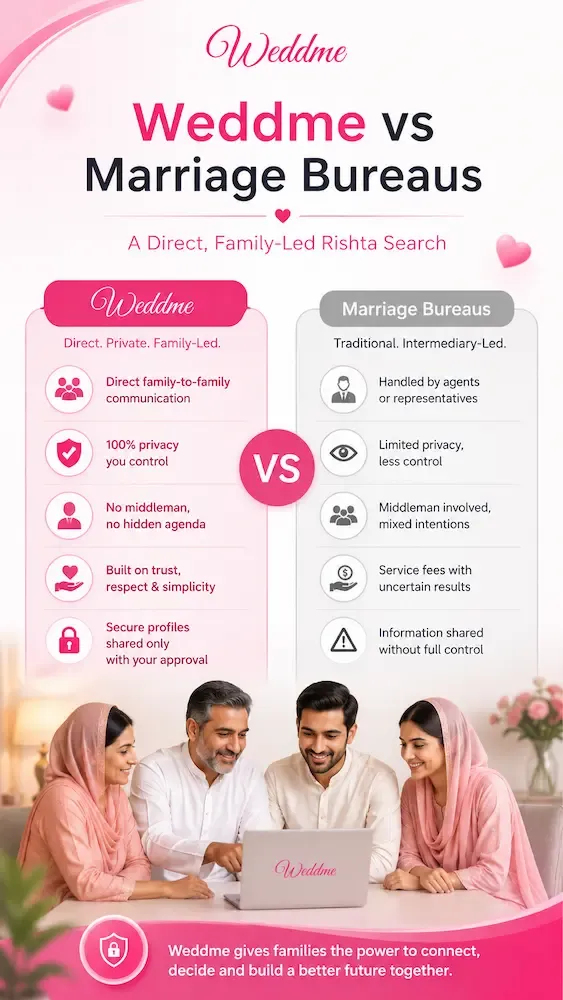
I sat in a bureau office in Lahore one June afternoon, watching a family hand over PKR 5,000 for a "priority listing" while the owner explained that the real fee, the marriage commission, would be settled later, and I remember thinking the family had just paid for the privilege of waiting. The math is unforgiving: PKR 25,000 to 50,000 upfront across five to ten bureaus, then PKR 50,000 to 100,000 or more in post-marriage commission, with no guarantee of a single serious proposal. Weddme's own published cost comparison puts those figures side by side with a start-free model and plans from PKR 1,000 a month, zero success fee.
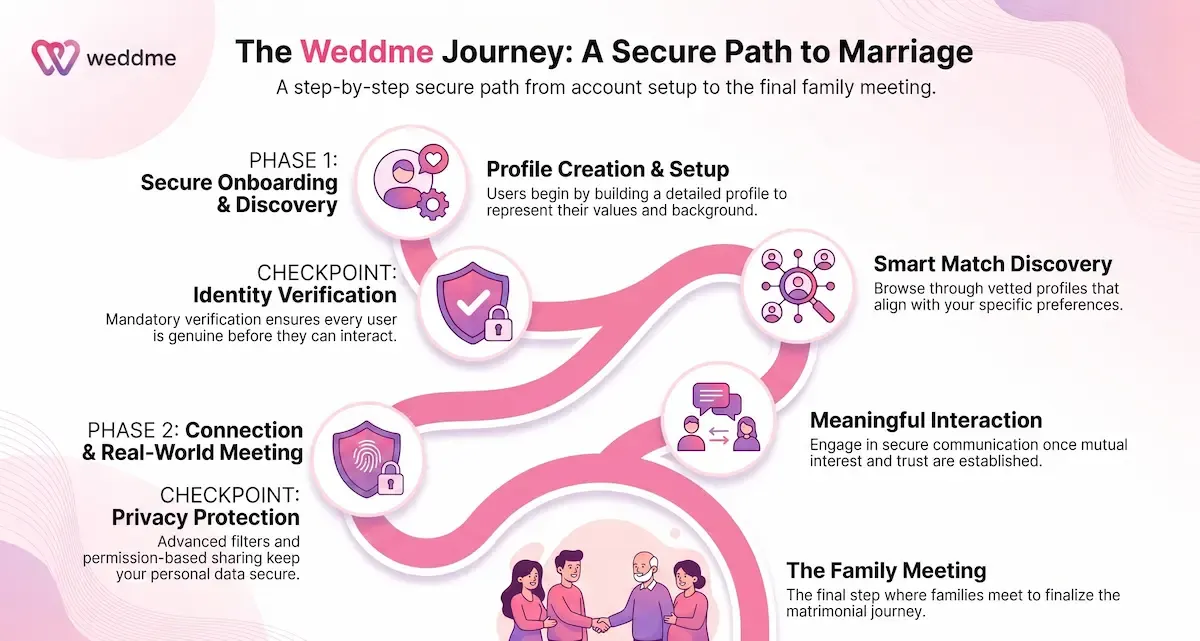
This guide walks you through the entire Weddme journey, from a private profile to a serious, verified family conversation. There is no middleman and no commission. Just your family, the other family, and a direct line between them.
What you gain is control. Your profile shows what you choose and hides what you choose. You decide who can see your daughter's details and who cannot. When a conversation moves from the platform to a phone call is your call, and so is when a proposal is worth a family meeting. That control makes the search safer and more respectful, because nothing happens without your say-so.
Direct family-to-family contact replaces the broker-mediated search, and it does so without discarding tradition. Caste, tribe, and sect still matter, and they are handled respectfully, in your own words, at your own pace. The difference is that the conversation happens between two households, not through a third party who is paid by the outcome.
The bureau model is the problem this guide solves. The next section lays out exactly what it costs, and what "direct" really means.
Why the Direct, Family-Led Approach Matters
The introduction promised a better way. Here is the cost of the old way, in rupees and in control.
A traditional marriage bureau search runs PKR 25,000 to 50,000 upfront, paid across five to ten bureaus at roughly PKR 5,000 each. That money leaves your pocket before a single serious conversation happens. Then, if a match succeeds, the bureau takes PKR 50,000 to 100,000 or more as a post-marriage commission. Families routinely spend over a lakh before the first family meeting.
The money is only half the problem. The bureau model takes control from the family. The bureau decides which proposals to show, when to contact, and how much to share. A family waits for callbacks. A family hopes the bureau understood what they actually want. A family pays for the privilege of being managed.
We have watched families hand over PKR 30,000 to a bureau and then sit for months waiting on a phone call that never came. The bureau's "shortlist" turned out to be whoever was available, not whoever matched. That is the unglamorous truth of the old way: you pay upfront, you lose the steering wheel, and you still do the waiting yourself. Weddme's own published comparison puts the bureau path at PKR 25,000 to 50,000 upfront plus PKR 50,000 to 100,000 or more in commission, and that figure matches what we have seen families actually spend. The design choice that changes everything is simple: on Weddme, nobody sits between your family and the families you want to talk to.
Weddme's direct model removes the broker entirely. Families discover and message each other on the platform. No middleman decides who sees your profile or when you reach out. Plans start at PKR 1,000 per month, and there is no pre-marriage fee, no post-marriage fee, and no success commission. The platform charges a flat monthly plan, nothing more.
| Aspect | Traditional Marriage Bureau | Weddme Direct Search |
| Upfront search cost | PKR 25,000–50,000 across multiple bureaus | Start free; plans from PKR 1,000/month |
| After-marriage commission | PKR 50,000–100,000+ success fee | PKR 0, no success commission |
| Typical search time | Months of waiting on bureau callbacks | Families message directly, on their own pace |
| Control over proposals | Bureau decides what to show and when | Family sees and chooses every proposal |
| Privacy | Shared through a third party, limited say | Family controls visibility and sharing |
| Middleman involvement | Broker between both families at every step | None; family-to-family contact on the platform |
Direct search means the family holds the shortlist, the timing, and the final call. You decide which families to approach. You decide when to move from messages to a meeting. You decide who to accept. The platform gives you the tools; it never takes the decision.
That is the whole point of avoiding middlemen and bureau delays: the money you save matters, but the control you keep matters more.
Direct search only works if your profile is built for it. The next section treats profile setup as a privacy decision, not a form-filling task.
Setting Up Your Profile With Privacy in Mind
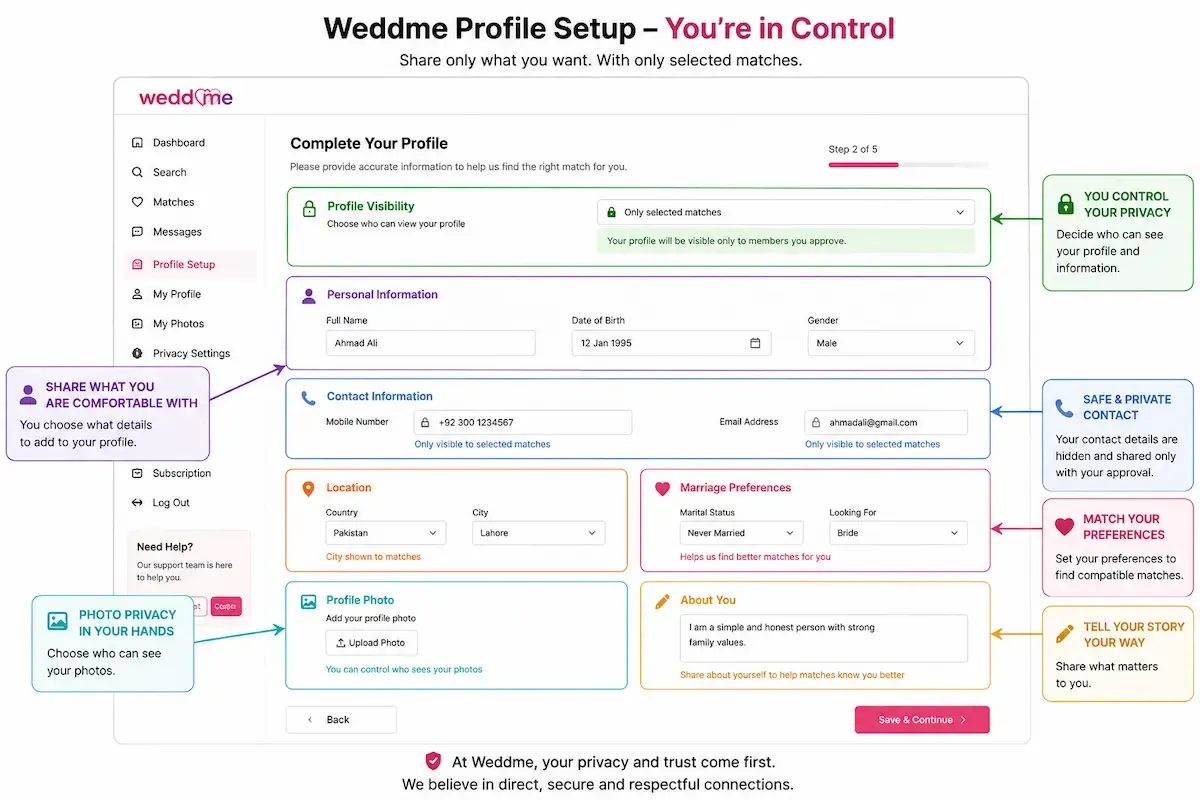
Now that the direct model is clear, the profile is where control begins: what you show and what you hide. Every field you fill is a privacy decision, not just a form entry. What you share shapes who reaches out and how seriously they take the proposal.
A complete profile attracts serious families. Age, city, education, profession, marital status, sect, caste or tribe, family background, and lifestyle preferences all help another household decide if your child is a good match. A sparse profile invites mismatched proposals because families cannot tell if you are compatible. Fill out every field you are comfortable sharing.
Contact details are never shown on public search pages. The platform protects them by default. You decide when to share a phone number or other contact information, and only after you have exchanged enough messages to feel comfortable. Wondering how much to share before a family even says salaam?
I set up a profile for my niece last winter and we went field by field, asking "does this help a serious family decide, or does it just expose us?" The contact number stayed hidden until we had exchanged a few messages with a family we liked.
That one decision saved us from a dozen cold calls from people who had not even read her education details. That is the control the platform gives you.
The platform's profile visibility settings let you decide exactly what appears on public search pages and what stays hidden until you choose to share it. The exact names of these settings are not confirmed on the live site, so use descriptive labels like "visible to serious families only" and confirm the precise wording before publishing. You can also block profiles, report suspicious behavior, and turn off incoming interactions at any time.
Here is a simple way to think about each element:
| Profile Element | Recommended Setting | Why It Matters |
| Photos | Show a clear, modest photo; keep it visible only to serious families | A photo helps families recognize you, but you control who sees it |
| Contact details | Keep hidden until you choose to share; never on public pages | Protects your privacy and prevents unsolicited calls |
| Caste/tribe/sect | Share if it matters to your family; it helps filter compatible proposals | Saves time by attracting families with similar expectations |
| Family background | Share a brief, respectful summary | Builds trust and shows you are serious |
| Profession and education | Share fully | Signals seriousness and helps shortlisting |
A complete, private profile is only useful if you search and shortlist with judgment. The next section covers both the mechanics and the traps.
profile visibility settings covers this in more depth.
Searching and Shortlisting: What to Do and What to Avoid
A well-built profile gets you seen. Now the judgment work begins: filtering well and shortlisting wisely.
Weddme gives you two search paths: public rishta pages you can browse without an account, and private account filters once you sign in. Use the filters for city, education, profession, age, sect, caste, community, and marital status to narrow the pool. But keep them flexible. A perfect match on paper may live one city over or follow a slightly different profession than you imagined.
Before you message any family, read the full profile. Photos alone hide the details that matter: how a family describes their values, what they say about lifestyle, whether they mention expectations for the daughter-in-law or son-in-law. Weddme does not verify every user identity, so treat each profile as a starting point, not a finished fact. Three weeks of checking profiles taught me that, so I now budget time for my own checks before any meeting.
Keep a simple written note on each shortlisted family. Write what attracted you, what concerns you, and what you still need to ask. A notebook or a notes app works. This keeps you from mixing up families when conversations start.
The goal is a shortlist of five to seven families you are seriously considering. No more than five to seven families at a time. Beyond that, conversations blur, details get mixed up, and families feel rushed. Involve elders early. The shortlist should reflect the whole household's priorities, not just one person's preference.
Avoid judging on photos alone. A beautiful photo tells you nothing about character or family background. Avoid messaging too many families at once; you will lose track of who said what. And do not ignore red flags because a profile looks perfect. Many families repeat the same online rishta search mistakes, such as these.
A shortlist is only as good as the first contact. The next section explains the three ways to reach a family and when to use each.
Contacting Families: Messages, Calls, and Direct Contact
You have a shortlist. Now the question every family asks: how do we actually reach them, and how much do we reveal? The answer is simple. Start inside Weddme's in-app messaging and escalate only as trust builds. That keeps contact details private and lets both families set the pace.
Every new rishta conversation begins with in-app messages. These stay inside the platform, so no phone number or address is exposed. Both families can read, think, and reply on their own time. This is the safest first step, and it is where most serious conversations start.
After a few exchanges, if both families feel comfortable, you can move to direct messages. This is still inside Weddme but feels more personal. It is the first step of gradual escalation, not a leap. Only do this when the other family has shown genuine interest and respect.
Share a phone number or address only when a serious conversation is underway. Never in a first message. And only after a family-to-family video call, which Weddme's own guidance places before any in-person meeting. That video call is the moment both sides confirm they are real and serious.
The table below matches each contact method to the level of trust already built, so no family reveals more than intended.
| Method | Best For | Privacy Level | When to Use |
| In-app messages | First contact, getting to know each other | Highest, no personal details shared | Always at the start of a new conversation |
| Direct messages | Continuing a conversation after initial comfort | Still private, but more personal | After a few in-app exchanges and mutual comfort |
| Phone calls | Hearing each other's voices, serious discussion | Lower, phone number is shared | Only after a video call and when a serious conversation is underway |
| Sharing full contact details | Arranging an in-person meeting | Lowest, full address and numbers shared | Only after a video call and when both families agree to meet |
Seven years in, I expected families to rush to phone calls, but the opposite happens. The families who take their time with in-app messages are the ones who end up with the most respectful meetings. One family last winter exchanged messages for three weeks before even suggesting a call. They kept their contact details off public pages the whole time, and by the time they shared numbers, both sides already knew the other was serious. That patience is what gradual escalation is for.
As you move from in-app messages to direct messages and eventually calls, the platform's guide to contacting families directly explains each step in detail.
How you write matters as much as which channel you use. The next section covers the tone and etiquette of rishta conversations.
Communicating Respectfully With Families
Contact is open. Now the words themselves carry the weight of your household's reputation.
A first message is not just an introduction; it is the first judgment the other family makes about your seriousness, your manners, and your respect for their time. The way you write shapes how the other family judges your household. A respectful, specific message tells them you are a family-led household that reads carefully and values direct, honest conversation.
A generic copy-paste message tells them you are browsing casually.
Your first message should be brief, warm, and specific. Name one detail from the other family's profile, state your family's intent clearly, and propose a simple next step. For example, if the profile mentions a daughter completing her medical degree, you might write: "We read with interest that your daughter is finishing her MBBS.
Our son works as an engineer in Lahore, and our family is looking for a serious, educated match.
Would your family be open to a short conversation this week?" That message does three things: it shows you read the profile, it states who you are and what you want, and it moves the conversation forward without pressure.
During the wedding season rush last winter, I reviewed dozens of opening messages families sent through the platform. The ones that got replies almost always mentioned a specific detail from the profile, like a city, a profession, or a hobby. The ones that got ignored were the mass messages: "Salam, we are a good family, please consider our son." That pattern taught me something simple: a little attention to the other family's words is the fastest way to earn their attention in return.
Message Template
Template: "Assalam-o-Alaikum. We noticed your profile mentions [specific detail, e.g., your son's interest in cricket]. Our family is looking for a serious rishta for our daughter, who is [brief, relevant fact about your child]. If your family is open to it, we would be happy to share more details and arrange a conversation at your convenience."
Parent variation: "Salam. We read that your daughter teaches at a university in Karachi. Our son is a civil engineer in Islamabad, and we are looking for a well-educated, family-oriented match. Would you be comfortable if we exchanged a few messages to see if our families align?"
Individual variation: "Hello. I saw on your profile that you enjoy reading Urdu poetry. I work in finance and my family is looking for a thoughtful, educated partner for me. If you are open to it, I would like to ask a few questions and see if we share similar values."
Early questions should stick to compatibility basics: education, work, family background, and living arrangements. These are the practical matters that determine whether two households can build a life together.
Ask them politely, one or two at a time, and give the other family room to answer in their own words. If the answers show a mismatch, decline promptly and kindly with a short, non-specific reason.
"Thank you for your time, but we feel our families are looking for different things" is enough. Never ghost. Silence leaves the other family guessing and reflects poorly on your own household's manners.
Keep elders involved through one family spokesperson while the individual adds their own voice. The spokesperson handles the formal introductions and the big questions; the son or daughter can then speak directly about their own preferences and personality. This balance shows respect for both generations. Every message you send, from the first greeting to the final decline, signals your household's seriousness and respect. That is what separates a family worth meeting from a name on a long list.
Some topics need extra care. The next section handles the most delicate part of the conversation: caste, tribe, sect, and community.
communicating with families respectfully covers this in more depth.
Discussing Caste, Tribe, Sect, and Community
Respectful conversation sets the tone. Now the topic that most often tests that respect: identity and community.
Raise identity preferences early in the first serious conversation. Both families save time when you are clear from the start. In a Lahore living room, we watched a family's first serious conversation stall over a single question about biradari. That moment taught us that how you ask matters as much as what you ask.
State your own family's preference before you ask about theirs. It softens the question and shows you are not interrogating them.
Use neutral, open phrasing. 'May I ask which biradari your family belongs to?' sounds respectful. 'What caste are you?' sounds like a demand. The phrasing matters more than the question itself, and we have covered the respectful way to discuss caste and sect in more depth.
Treat the other family's answer as information for your shortlist, not as a score or judgment. If a preference is non-negotiable, say so plainly but kindly: 'We are only considering families from our own biradari, and we hope you understand.'
Words build trust, but trust is only real when it is checked. The next section makes verification a non-negotiable step before any meeting.
Verifying Rishta Details Before a Family Meeting
The conversation has gone well. Now comes the step that separates a serious family from a hopeful one: checking every claim.
Verification is not an accusation. It is the same care you would take before any major decision. A serious family expects these questions and answers them without hesitation.
Skipping verification is carelessness dressed up as politeness. I sat with a family during their first video call with a proposal from Lahore. The father asked, plainly, to see the degree certificate. The young man on the other end went quiet, then said it was "at his uncle's house." The call ended politely. No meeting happened. That one question saved the family months.
Here is what to check, how to check it, and what should make you pause.
| What to Verify | How to Verify | Red Flags |
| Identity and age | CNIC or B-form | Mismatched names, altered dates |
| Education and profession | Degree certificates, employer references | Reluctance to show documents |
| Marital status | Direct questions, family references | Vague or evasive answers |
| Family background | Speak with elders, cross-check references | Contradictory stories |
| Sect/caste/tribe claims | Ask directly, confirm with community elders | Defensiveness, changing answers |
| Photos and appearance | Video call before meeting | Heavily filtered or outdated photos |
The family-to-family video call is the final check before any in-person meeting. Keep all initial conversation inside Weddme's messaging until you are satisfied. Sharing a phone number or address comes only after the core details hold up.
No family meeting should happen until the core details are confirmed.
Every verification step in this guide comes from real family experiences and platform guidance, and we flag any method that could put your family's privacy at risk.
The checklist above covers the essentials of verifying rishta details before any meeting.
Verification is one half of safety. The next section answers the question every family asks first: is the platform itself safe?
Safety and Privacy on Weddme
Verification is the family's job. Now the platform's job: what Weddme protects, and what it cannot.
Weddme's safety features give families control over public visibility, contact visibility, and interaction settings, so you decide who sees your profile and who can reach you. Contact details are never shown on public rishta search pages. Families share them only when they choose, keeping the first conversation private.
Is this platform safe? That's the question every family asks first, and the answer sits in the settings page. A family I guided through their first search discovered this the hard way: an inappropriate message arrived, and they used the block and report tools immediately. The platform responded quickly, and the profile was gone from their view.
The controls are granular enough that a family can shut down one bad interaction without closing the whole search.
Blocking and reporting tools let you stop unwanted contact and flag suspicious behavior immediately. Weddme does not verify every user identity. Final verification of a proposal's details is the family's responsibility before any meeting.
Why Families Trust Weddme
Safety features explain what the platform does. The deeper reason families stay in control is trust.
PKR 0, that's the marriage commission Weddme charges, and it's the first number I check when a family asks whether a rishta platform can be trusted. The no-commission model means no incentive to push a match. The platform earns only from monthly plans, so its interest aligns with families taking their time.
Direct family-to-family contact keeps conversations between the two households. No broker can pressure either side.
Privacy controls let the family decide what is visible publicly, what is visible to contacts, and who can interact. Blocking and reporting are always available.
Trust has to be earned. Weddme does not verify every user identity, so families must do their own verification before any meeting. Published member stories and ratings are one input among several, and the family's own judgment remains the deciding factor.
Every trust claim in this article is tied to a verifiable fact, the no-commission pricing, the privacy controls, or a named member story, never a vague promise.
Trust turns into action through a clear path. The next section lays out the full journey as one checkable checklist.
The Complete Weddme Checklist
Every section so far has been one stage. Here they become one path a family can follow step by step.
Picture the outcome first: a respectful, verified family meeting, not a rushed exchange of numbers. That is what this checklist builds toward.
FAQ
What does Weddme cost?
Three monthly plans. Essential is PKR 1,000, Preferred is PKR 2,100, and Signature is PKR 4,200. There is no pre-marriage fee, no post-marriage fee, and no success commission. You pay for the plan you choose, nothing more.
How is this different from a marriage bureau?
A traditional bureau search typically costs PKR 25,000 to 50,000 upfront, across five to ten bureaus at roughly PKR 5,000 each. Then comes the post-marriage commission, often PKR 50,000 to 100,000 or more. Weddme starts free, plans begin at PKR 1,000 a month, and the success fee is PKR 0.
Does Weddme verify every profile?
No, and the platform says so plainly. Weddme does not verify every user identity. That part is the family's job. Before any meeting, verify the proposal's details yourself. What the platform does provide is privacy controls for visibility, contact, and interaction, plus tools to block profiles and report suspicious behavior.
When should we share our phone number?
That is a family decision, and the safe default is to keep everything in-app until trust is built. Share a phone number only when the family is ready for direct conversation. Nothing forces you to move faster than you want.
How do we discuss caste and sect respectfully?
The platform lets families state preferences openly. The tone is what matters. Keep it dignified and focused on compatibility, not exclusion. A preference stated with respect invites serious families. A demand stated harshly closes doors.
What should we verify before meeting?
The family's own independent checks of a proposal's details. Confirm the identity, the family background, and the claims in the profile before any meeting. The platform gives you the tools to connect; the verification is yours.
Is Weddme a dating app?
Weddme is a rishta platform built for family-led search, not a dating app. Communication is family-to-family, direct, without a broker. The goal is a respectful, verified family meeting, not casual conversation.
The answers point one way. The conclusion closes the loop and asks the reader to begin.
Conclusion
The questions are answered. Now the decision is the family's.
Before, a traditional bureau search meant PKR 25,000–50,000 upfront and PKR 50,000–100,000+ in post-marriage commission, with the family losing control of the process. After, Weddme offers a direct, private, family-led path from profile to family meeting, with plans from PKR 1,000/month and no success fee.
At a family's dining table in Karachi, the father tallied the bureau fees he had already paid and still had no shortlist. Three weeks on Weddme at PKR 1,000 a month, he had several serious conversations and zero commission owed.
The checklist and linked guides on this page walk you through each step. They cover everything from profile visibility to final verification. The family controls every decision, and the platform takes no commission.
Create a free Weddme profile today and start the search on your family's own terms: no middleman, no commission.
Compare profiles when your family is ready.
Use Weddme search filters to review profiles with clearer context before starting a serious conversation.