Trust & Verification in Online Matrimony
What 6,258 Weddme profiles reveal about contact confirmation, profile readiness, privacy boundaries and platform participation
An anonymized study of contact-channel confirmation, stored profile-readiness signals, privacy settings and first-month participation.
Scope and methodology in brief
This report measures email or phone contact-channel confirmation, profile readiness, privacy settings and first-month platform behaviour. It does not measure identity verification, background checks, safety, compatibility, engagements, marriages or national matrimonial preferences.
How this report fits the research library
This report extends Weddme's behavioural research after Education & Matrimonial Preferences in Pakistan, Marriage Age Preferences in Pakistan, and Family Participation in Pakistan's Digital Matrimony. For broader digital-rishta context, see Pakistan's Digital Matrimonial Transformation 2026.
1. Executive Summary
Trust in online matrimony is easy to talk about and difficult to measure. A small badge can look reassuring, but the useful question is more specific: what was actually checked?
This Weddme Research report studies contact-channel confirmation, profile readiness, privacy settings and early platform participation among eligible active Weddme profiles. It does not measure legal identity verification, document checks, background checks, compatibility, family approval, engagement, marriage or safety outcomes.
The analysis uses a fixed anonymized production snapshot captured on 8 September 2026 at 16:00:29 UTC / 21:00:29 PKT. The strict eligible cohort contained 6,258 active Weddme profiles after excluding inactive, flagged, non-clean-risk and obvious test records. A separate first-30-day behavioural cohort contained 5,237 eligible profiles created from 24 March 2026 through 9 August 2026, each with a complete 30-day observation window.
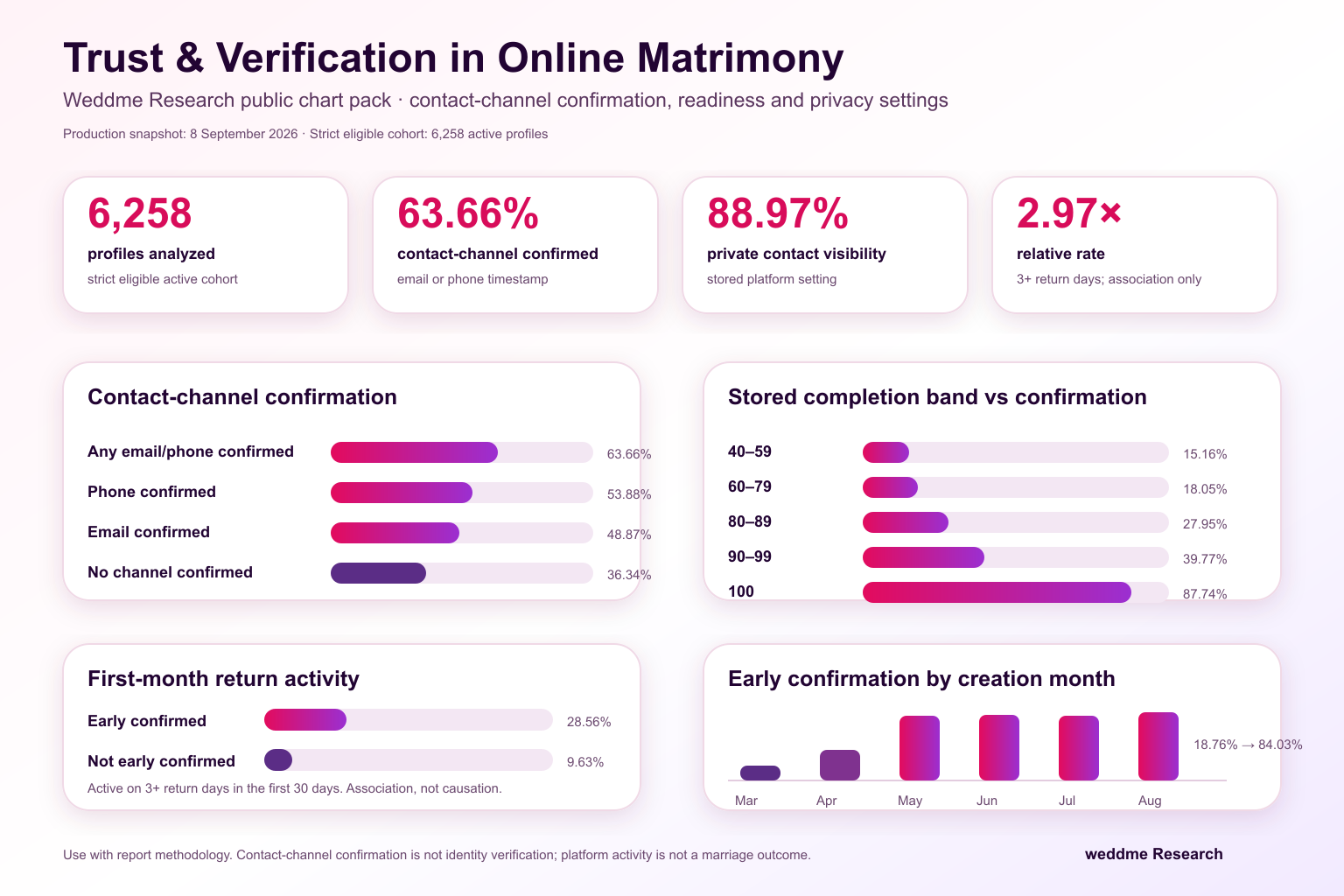
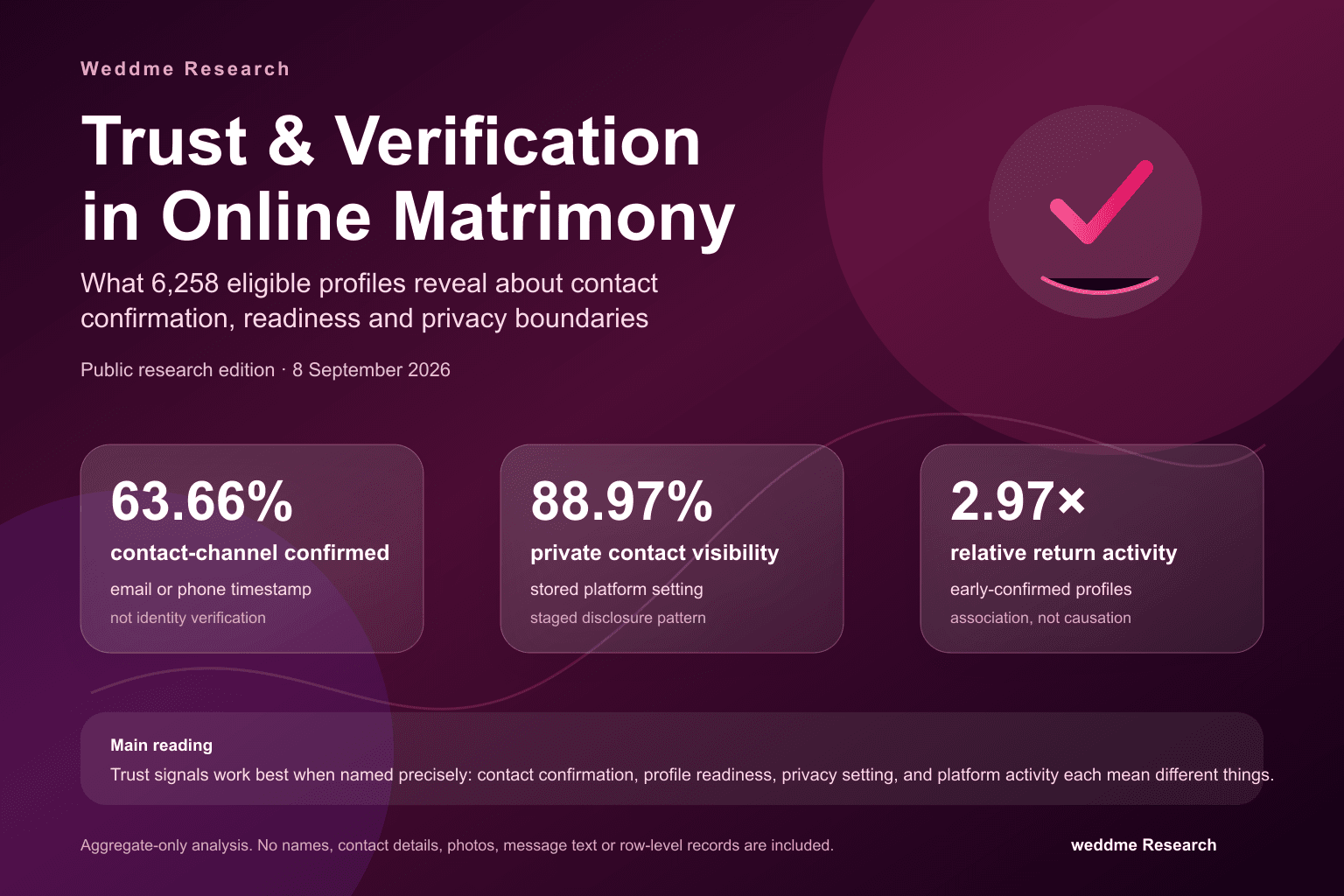
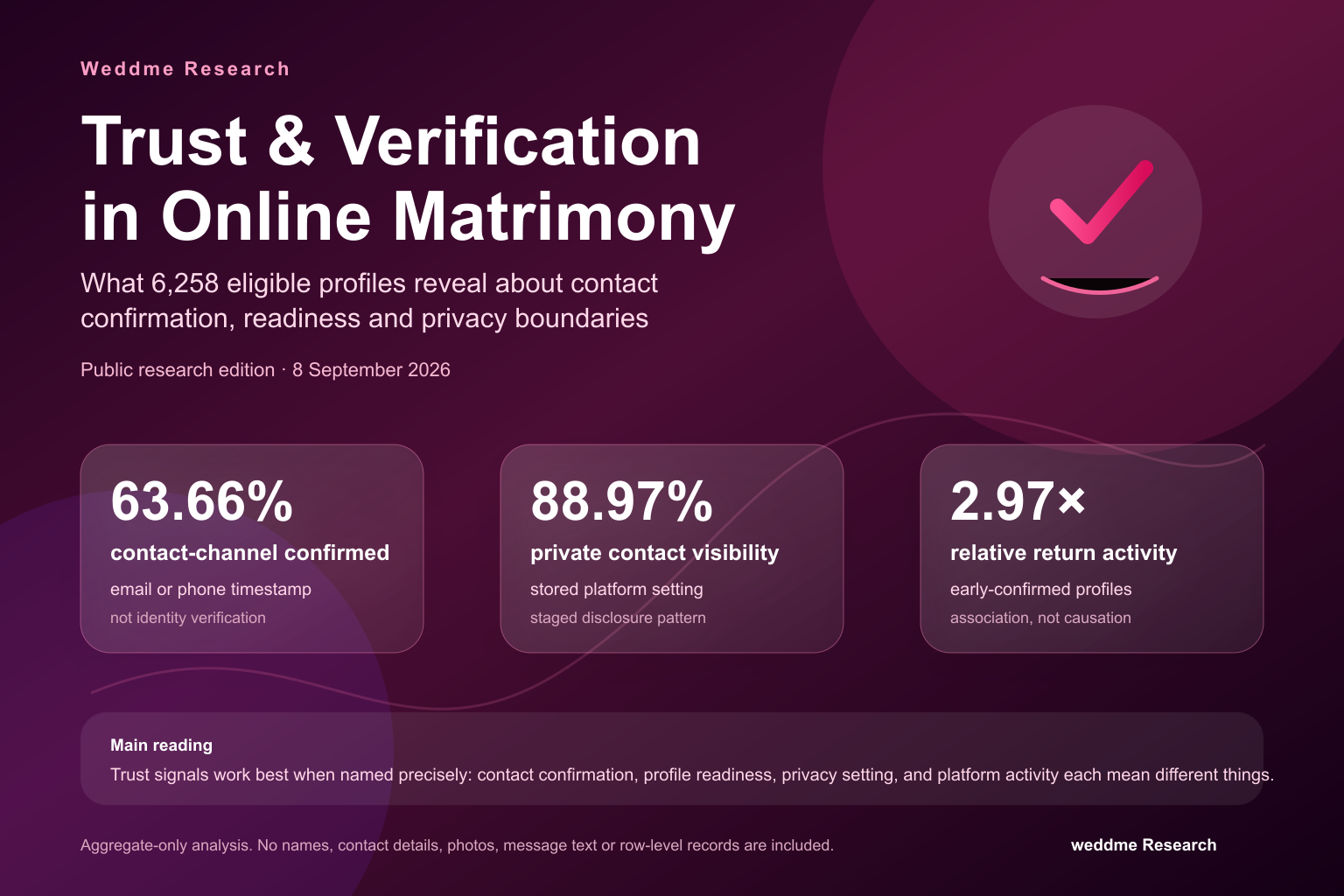
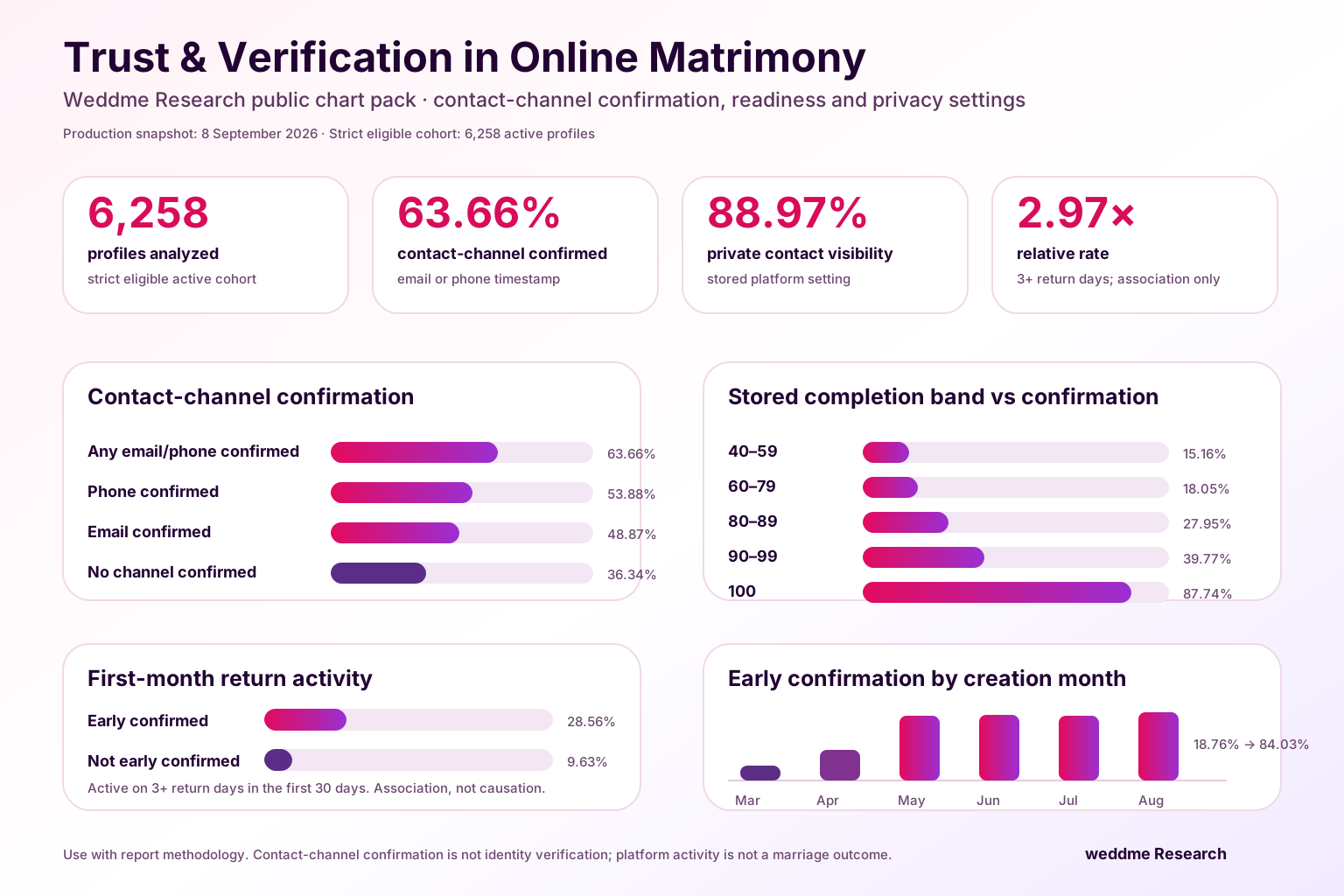
The clearest headline finding is that 3,984 of 6,258 eligible profiles, or 63.66%, had at least one recorded email or phone confirmation timestamp. That is contact-channel confirmation. It means a platform event showed access to a phone number or email address. It does not mean the person’s identity, education, employment, family background or marriage intention was independently verified.
Profile readiness and contact-channel confirmation appeared together often. Among profiles with a stored completion score of 100, 87.74% had at least one confirmed contact channel. In the stored 40–59 completion band, the corresponding share was 15.16%. This is a strong association, but not proof that completion caused confirmation or that confirmation caused completion.
Privacy settings also showed a layered pattern. Contact visibility was private for 5,568 of 6,258 eligible profiles, or 88.97%. The most common combined configuration paired public stored profile visibility with private contact visibility, appearing in 5,269 profiles, or 84.20%. Because private contact visibility is currently applied during signup, this should be read as a platform-setting pattern rather than a direct statement of user motive.
The strongest behavioural association appeared in the first month after profile creation. Among profiles with early contact-channel confirmation, 28.56% recorded authenticated activity on three or more return days during the first 30 days. Among profiles without early confirmation, the share was 9.63%. The relative rate was 2.97. Early-confirmed profiles were also more likely to send at least one user-authored message in the first 30 days: 54.41% compared with 37.27%.
These findings are useful because they separate signals that are often mixed together. A confirmed contact channel supports reachability. A completed profile supports review. A privacy setting controls disclosure. Activity shows return behaviour. None of these signals, alone, proves trustworthiness, honesty, compatibility or matrimonial success.
2. Key Findings
| Finding | Result | What it means |
|---|---|---|
| Any contact channel confirmed | 3,984 / 6,258 = 63.66% | At least one recorded email or phone confirmation event |
| Phone confirmed | 3,372 / 6,258 = 53.88% | Phone-channel confirmation timestamp recorded |
| Email confirmed | 3,058 / 6,258 = 48.87% | Email-channel confirmation timestamp recorded |
| Private contact setting | 5,568 / 6,258 = 88.97% | Stored setting; influenced by current signup defaults |
| Public profile + private contact | 5,269 / 6,258 = 84.20% | Stored platform configuration consistent with staged disclosure |
| Early confirmed + 3+ return days | 825 / 2,889 = 28.56% | First-month behavioural association |
| Not early confirmed + 3+ return days | 226 / 2,348 = 9.63% | Comparison group for first-month return activity |
| Early confirmed + user-authored message | 1,572 / 2,889 = 54.41% | Sent at least one user-authored message during the first 30 days |
| Not early confirmed + user-authored message | 875 / 2,348 = 37.27% | Comparison group for first-month messaging |
Snapshot findings use the 6,258-profile strict eligible cohort. First-30-day behavioural findings use the 5,237-profile standardized behavioural cohort.
3. Why Trust Is Not One Badge
A confirmed contact channel supports reachability. It is not the same thing as identity verification.
Weddme Research, 2026
Matrimonial search begins with information. A profile may show age, city, education, profession, family background, religious or cultural details, photos, contact settings and communication options. Some of that information is structured. Some needs interpretation. Some must be checked outside the platform by the people and families involved.
That is why the word “verified” needs care. A phone confirmation is not the same as a national identity check. An email confirmation is not the same as employment verification. A completed profile is not the same as a truthful profile. A private contact setting is not the same as caution, seriousness or mistrust.
This report uses narrower language on purpose. It studies contact-channel confirmation rather than identity verification. It studies profile readiness rather than profile truthfulness. It studies privacy configuration rather than personal motive. It studies platform activity rather than matrimonial outcome.
That distinction is not a technical detail. It is the difference between useful evidence and false confidence.
4. What This Study Measures
| Term | Meaning in this report |
|---|---|
| Contact-channel confirmation | A recorded email or phone confirmation event |
| Identity verification | Not measured in this report |
| Profile readiness | Structured profile information has been supplied |
| Privacy setting | A stored configuration controlling visibility |
| Return activity | Authenticated platform activity after the profile-creation day |
| Engagement behaviour | Profile views, expressions of interest, user-authored messages or block actions |
None of these measures independently establishes identity, honesty, compatibility, family approval, serious marriage intention, personal safety, successful matching, engagement or marriage.
5. Dataset and Cohorts
The analysis uses Weddme first-party production data from a fixed read-only snapshot captured on 8 September 2026 at 16:00:29 UTC / 21:00:29 PKT.
The unit of analysis is the represented matrimonial profile, joined to the client account where account-level fields are required. All public findings are aggregate. No names, emails, phone numbers, profile IDs, biographies, message text, photographs, payment records or row-level records are included.
Cohort flow
| Stage | Count |
|---|---|
| Production users | 7,321 |
| Production profiles | 7,290 |
| Joined user-profile rows | 7,290 |
| Active client account + active profile | 6,745 |
| After deleted/purged exclusion | 6,745 |
| After valid, unflagged, clean-risk filter | 6,260 |
| Obvious test-string records excluded after quality filter | 2 |
| Strict eligible cohort | 6,258 |
The strict eligible cohort includes profiles where the account is a client account, account and profile are active, neither is deleted, the account is valid, the account is not flagged, the risk state is clean and obvious test-string records are excluded.
The standardized behavioural cohort contains 5,237 eligible profiles created from 24 March 2026 through 9 August 2026. Each profile had a complete first-30-day observation window before the snapshot.
6. Contact-Channel Confirmation
63.66% of eligible active profiles had at least one recorded email or phone confirmation timestamp.
Weddme Research, 2026
Among 6,258 eligible active Weddme profiles analyzed on 8 September 2026, 3,984 profiles, or 63.66%, had at least one recorded email or phone contact-channel confirmation timestamp.
Phone and email were the observed confirmation channels in this report.
Contact-channel confirmation prevalence
| Contact-channel signal | Profiles | Share of strict eligible cohort |
|---|---|---|
| Phone number present | 6,257 | 99.98% |
| Email present | 4,872 | 77.85% |
| Phone confirmed | 3,372 | 53.88% |
| Email confirmed | 3,058 | 48.87% |
| Any email/phone channel confirmed | 3,984 | 63.66% |
| No channel confirmed | 2,274 | 36.34% |
Confirmation combinations
Contact-channel confirmation combinations
| Combination | Profiles | Share of strict eligible cohort |
|---|---|---|
| Email + phone confirmed | 2,446 | 39.08% |
| Phone only confirmed | 926 | 14.80% |
| Email only confirmed | 612 | 9.78% |
| No channel confirmed | 2,274 | 36.34% |
The safest interpretation is direct: nearly two-thirds of eligible active profiles had at least one recorded contact-channel confirmation event. The result should not be restated as identity verification or proof that the represented person is genuine.
7. Profile Readiness and Completion
Profile completion can help a platform understand whether a profile is ready for review. It cannot confirm that the information supplied is true.
In this report, completion is used carefully because the stored completion score does not perfectly match the current profile-completion formula for every historical record. The stored score remains useful as supporting context, but it is not used as the headline trust metric.
Stored completion band vs channel confirmation
| Stored completion band | Profiles | Any channel confirmed | Share channel confirmed |
|---|---|---|---|
| 40–59 | 1,629 | 247 | 15.16% |
| 60–79 | 205 | 37 | 18.05% |
| 80–89 | 161 | 45 | 27.95% |
| 90–99 | 176 | 70 | 39.77% |
| 100 | 4,085 | 3,584 | 87.74% |
The gap between the stored 100-completion band and the 40–59 band was 72.58 percentage points. That is large, but it should be read as a readiness cluster, not a cause-and-effect claim.
One practical reading is that members who move further through the profile process are also more likely to complete contact confirmation. Another is that the product journey itself encourages both behaviours. The data cannot separate those explanations with certainty.
8. Privacy and Staged Disclosure
The dominant stored configuration kept profile visibility public while keeping contact visibility private.
Weddme Research, 2026
Privacy in matrimonial search is not simply public or private. A person or family may be comfortable making a profile discoverable while still keeping direct contact information restricted.
In the final snapshot, 5,568 of 6,258 eligible profiles, or 88.97%, had private contact visibility stored. Public contact visibility appeared on 639 profiles, or 10.21%. Members-only contact visibility appeared on 51 profiles, or 0.81%.
Stored contact-visibility settings
| Stored contact visibility | Profiles | Share of strict eligible cohort |
|---|---|---|
| Private | 5,568 | 88.97% |
| Public | 639 | 10.21% |
| Members only | 51 | 0.81% |
Stored profile visibility showed a different distribution:
Stored profile-visibility settings
| Stored profile-visibility setting | Profiles | Share of strict eligible cohort |
|---|---|---|
| Public | 5,912 | 94.47% |
| Private | 251 | 4.01% |
| Members only | 95 | 1.52% |
The dominant combined configuration paired public stored profile visibility with private contact visibility. Among 6,258 eligible active Weddme profiles, 5,269 profiles, or 84.20%, had this combined setting.
This is best described as staged disclosure at the platform-setting level. It does not prove that every profile holder actively chose that arrangement or had the same motive. Current signup applies private contact visibility by default, so the result partly reflects product design.
9. Early Confirmation and First-Month Activity
The main behavioural question is whether contact-channel confirmation appeared alongside continued platform participation after signup.
Early contact-channel confirmation means at least one email or phone confirmation timestamp occurred within the profile’s first 30 days. Return activity means authenticated activity recorded after the profile-creation day and within the first 30-day observation window.
Among 2,889 early-confirmed profiles, 825 profiles, or 28.56%, recorded authenticated activity on three or more return days during the first 30 days. Among 2,348 profiles without early confirmation, 226 profiles, or 9.63%, recorded authenticated activity on three or more return days.
The relative rate was 2.97 and the odds ratio was 3.75.
Early confirmation and first-month return activity
| Early contact-channel confirmation status | Profiles | Active on 1+ return days | Active on 3+ return days | Mean return active days | Median return active days |
|---|---|---|---|---|---|
| Confirmed within first 30 days | 2,889 | 1,563 | 825 | 2.70 | 1 |
| Not confirmed within first 30 days | 2,348 | 616 | 226 | 0.75 | 0 |
This association is meaningful, but it is not causal proof. More motivated users may be more likely both to confirm a contact channel and to return. Product-flow changes may also affect both behaviours.
10. What Happened After Confirmation?
The early-confirmation comparison is useful, but a stricter question is what happened after the first recorded confirmation timestamp.
Among the 2,889 profiles with early contact-channel confirmation, the following events occurred after the first recorded confirmation timestamp and before the end of the first 30 days:
Behaviour after first contact-channel confirmation
| Subsequent behaviour after first confirmation | Numerator | Denominator | Rate |
|---|---|---|---|
| Active on 1+ later return days, excluding confirmation date | 1,467 | 2,889 | 50.78% |
| Active on 3+ later return days, excluding confirmation date | 726 | 2,889 | 25.13% |
| Made profile view after confirmation | 1,572 | 2,889 | 54.41% |
| Expressed interest after confirmation | 1,004 | 2,889 | 34.75% |
| Sent user-authored message after confirmation | 1,474 | 2,889 | 51.02% |
| Made block action after confirmation | 64 | 2,889 | 2.22% |
This table supports careful sequence-aware wording: many early-confirmed profiles continued to use the platform after confirmation. It still does not prove that confirmation caused later activity, partly because profiles that confirmed earlier had more remaining observation time in the 30-day window.
11. Confirmation and Communication Behaviour
Messaging is a useful behavioural signal, but it should not be overread. It shows that an account sent at least one user-authored message during the first 30 days. It does not measure tone, quality, reciprocal interest, family approval or outcome.
Among 2,889 profiles with early contact-channel confirmation, 1,572 profiles, or 54.41%, sent at least one user-authored message during their first 30 days. Among 2,348 profiles without early confirmation, 875 profiles, or 37.27%, sent at least one user-authored message during their first 30 days.
The relative rate was 1.46 and the odds ratio was 2.01.
Early confirmation and first-month messaging
| Early contact-channel confirmation status | Profiles | Sent user-authored message in first 30 days | Share |
|---|---|---|---|
| Confirmed within first 30 days | 2,889 | 1,572 | 54.41% |
| Not confirmed within first 30 days | 2,348 | 875 | 37.27% |
The result shows a platform-behaviour difference. It does not show better matches, safer conversations, compatibility, engagement or marriage.
12. Why Creation Month Matters
The strongest warning against overinterpretation comes from creation-month analysis.
Early contact-channel confirmation changed sharply across monthly cohorts. In the standardized behavioural cohort, 85 of 453 March-created profiles, or 18.76%, confirmed at least one channel within the first 30 days. In April, the share was 899 of 2,428, or 37.03%. From May onward, early confirmation exceeded 79% in each monthly cohort shown.
Early confirmation by profile-creation month
| Creation month | Behavioural cohort profiles | Early confirmed | Early-confirmation rate |
|---|---|---|---|
| March 2026 | 453 | 85 | 18.76% |
| April 2026 | 2,428 | 899 | 37.03% |
| May 2026 | 872 | 703 | 80.62% |
| June 2026 | 500 | 409 | 81.80% |
| July 2026 | 746 | 593 | 79.49% |
| August 2026 eligible cohort | 238 | 200 | 84.03% |
The same month table shows that return activity and messaging did not simply rise in parallel with early confirmation:
Creation month, confirmation, activity and messaging
| Creation month | Profiles | Early confirmed | Active on 3+ return days | Sent user-authored message |
|---|---|---|---|---|
| March 2026 | 453 | 18.76% | 32.89% | 58.72% |
| April 2026 | 2,428 | 37.03% | 27.43% | 49.26% |
| May 2026 | 872 | 80.62% | 25.34% | 38.65% |
| June 2026 | 500 | 81.80% | 26.40% | 44.40% |
| July 2026 | 746 | 79.49% | 25.74% | 43.83% |
| August 2026 eligible cohort | 238 | 84.03% | 25.21% | 41.60% |
That pattern matters. It suggests that onboarding flow, acquisition period or other time-related factors shaped the aggregate result. The report therefore treats the confirmation/activity relationship as an association rather than a universal behavioural rule.
13. What the Signals Mean
The findings point to a practical way of thinking about trust in matrimonial platforms.
Contact-channel confirmation helps establish that a phone number or email address passed a platform confirmation process. That is useful for reachability and account control, but it is not a legal identity check.
Profile completion helps reviewers see more structured information. That can make search more useful, but it does not verify the truth of the details.
Privacy settings help define disclosure boundaries. They can support safer, staged communication, but they do not reveal motive by themselves.
Activity and messaging show platform participation. They do not establish seriousness, family consent, compatibility, offline progress or matrimonial success.
The safest conclusion is not “verified profiles perform better.” The stronger conclusion is that platform-readiness signals tend to appear together, and early contact-channel confirmation is associated with greater first-month participation within this eligible active cohort.
14. Limits of the Evidence
The findings describe eligible active Weddme profiles at one snapshot. They are not national estimates for Pakistan.
Weddme Research, 2026
This report has several important limits.
Weddme’s cohort is not nationally representative of Pakistan. The findings describe eligible active Weddme profiles at one production snapshot, not Pakistanis generally and not all matrimonial searchers.
The analysis is observational. It can show associations, but it cannot prove causality.
Contact-channel confirmation is not identity verification. The studied fields do not verify government identity, documents, background, education, employment, marital status, income, family history, intention or safety.
Profile completion does not verify truthfulness. It measures whether fields were populated. The stored score also does not perfectly match the current completion formula for all records.
Activity does not establish serious marriage intention. Messaging does not establish compatibility, reciprocal interest, family approval, successful matching, engagement or marriage.
Privacy settings may reflect product defaults. Contact-visibility statistics should not be read as pure user preference without additional field-history evidence.
Survivor selection affects the cohort. The strict eligible cohort excludes inactive, flagged, non-clean-risk and obvious test records. It therefore does not describe every account historically created on Weddme.
Offline family activity is not captured. Phone calls, in-person meetings, family visits, document checks and final decisions happen outside the observed platform data.
15. Methodology
This report uses anonymized aggregate analysis of Weddme first-party production data captured in a read-only snapshot on 8 September 2026 at 16:00:29 UTC / 21:00:29 PKT.
The strict eligible cohort was built from joined account and profile records. Eligibility required active client account status, active profile status, no account/profile deletion, no purge state, valid account status, no account flag, clean account risk state and exclusion of obvious test-string records.
The strict eligible cohort contained 6,258 profiles. It is used for snapshot findings such as contact-channel confirmation, stored completion and privacy settings.
The standardized behavioural cohort contained 5,237 profiles created from 24 March 2026 through 9 August 2026. Each had a complete first-30-day observation window. It is used for first-month return activity, engagement and post-confirmation behaviour.
Contact-channel confirmation was defined by the presence of at least one account-level email or phone confirmation timestamp.
Early contact-channel confirmation was defined as the first recorded email or phone confirmation timestamp occurring within 30 days of profile creation.
Return activity was measured from authenticated platform activity records. The creation day was excluded from return-activity counts.
User-authored messaging was measured from chat-message metadata. Official and system message types were excluded. Message bodies were not used.
Profile views, expressions of interest and block actions were measured from platform interaction metadata. These are platform actions only and do not imply reciprocal interest or outcome.
Completion analysis used stored profile-completion scores for supporting tables. Because stored completion did not perfectly match the current formula, stored completion is not used as a hero statistic.
Percentages are rounded to two decimal places. Groups with very small counts are not used for interpretive claims.
16. Privacy and Ethical Reporting
This report follows an aggregate-only standard.
It excludes names, emails, phone numbers, profile IDs, account IDs, biographies, message text, photographs, payment records and row-level records.
The purpose is to explain broad platform patterns without exposing individual users or conversations. Moderation and safety records were reviewed during audit work, but they are not used as public behavioural findings because the relevant records were too sparse or too product-dependent for stable conclusions.
Legal-consent records are not used as behavioural evidence in this report. Consent evidence belongs to legal and operational record-keeping, while this study focuses on contact confirmation, profile readiness, privacy settings and early platform participation.
17. External Research Context
External research is used only as context. External percentages and Weddme percentages should not be combined as if they came from the same population.
Digital identity guidance supports the report’s decision to separate channel confirmation from identity verification. NIST’s Digital Identity Guidelines distinguish identity proofing and authentication rather than treating digital trust as one generic event. The World Bank’s Principles on Identification for Sustainable Development also emphasize privacy, security, user rights, accountability and safeguards.
Online trust research supports similar caution. Studies on online trust, privacy calculus and online dating self-presentation show that trust, disclosure and profile information are not single observable events. They require careful interpretation, especially where personal decisions carry family, social and safety consequences.
Pakistan’s digital context also matters. Internet access, mobile use, affordability, literacy, skills and social norms do not move together automatically. That is one reason Weddme’s platform cohort should not be treated as a national estimate.
18. Research FAQs
Does Weddme identity-verify matrimonial profiles?
This study does not measure identity verification. It measures recorded contact-channel confirmation events such as phone or email confirmation. A confirmed contact channel should not be read as government identity verification, document verification or background verification.
What does a confirmed matrimonial profile mean in this study?
In this study, a confirmed profile means the profile’s account had at least one recorded email or phone confirmation timestamp. Among 6,258 eligible active Weddme profiles, 3,984 profiles, or 63.66%, had at least one such timestamp.
Does confirmation make users more active?
The data cannot prove that. Profiles with early contact-channel confirmation were more likely to record activity on three or more return days during their first 30 days: 28.56% versus 9.63%. This is an association, not evidence that confirmation caused additional activity.
Does a complete matrimonial profile mean the information is genuine?
No. Profile completion means structured fields were populated. It does not verify that the information is true.
What did the study find about privacy settings?
Among 6,258 eligible active Weddme profiles, 5,568 profiles, or 88.97%, had private contact visibility stored. Because current signup applies private contact visibility by default, this should be interpreted as a platform-setting pattern, not proof of individual motive.
Are confirmed profiles safer?
This study cannot answer that. Contact-channel confirmation may support account reachability, but it does not prove identity, intention, safety or honesty. Safety requires moderation systems, user reporting, careful communication and offline due diligence beyond the signals measured here.
Does more messaging mean better matrimonial matches?
No. Messaging is a platform behaviour. It does not establish compatibility, reciprocal interest, family approval, successful matching, engagement or marriage.
Are these findings representative of Pakistan?
No. The findings describe eligible active Weddme profiles at one production snapshot. They should not be generalized to all Pakistanis, all matrimonial searchers or all online matrimonial platforms.
19. References
- National Institute of Standards and Technology. Digital Identity Guidelines: SP 800-63-4. August 2025.
- World Bank Identification for Development. Principles on Identification for Sustainable Development.
- World Bank Identification for Development. Privacy & Security.
- OECD. Privacy Principles.
- Gefen, D., Karahanna, E., & Straub, D. W. “Trust and TAM in Online Shopping: An Integrated Model.” MIS Quarterly, 27(1), 51–90. 2003.
- Dinev, T., & Hart, P. “An Extended Privacy Calculus Model for E-Commerce Transactions.” Information Systems Research, 17(1), 61–80. 2006.
- Ellison, N., Heino, R., & Gibbs, J. “Managing Impressions Online: Self-Presentation Processes in the Online Dating Environment.” Journal of Computer-Mediated Communication, 11(2), 415–441. 2006.
- Gibbs, J. L., Ellison, N. B., & Lai, C. H. “First Comes Love, Then Comes Google: An Investigation of Uncertainty Reduction Strategies and Self-Disclosure in Online Dating.” Communication Research, 38(1), 70–100. 2011.
- Toma, C. L., Hancock, J. T., & Ellison, N. B. “Separating Fact From Fiction: An Examination of Deceptive Self-Presentation in Online Dating Profiles.” Personality and Social Psychology Bulletin, 34(8), 1023–1036. 2008.
Suggested citation
Weddme Research Team. (2026). Trust & Verification in Online Matrimony: What 6,258 Weddme Profiles Reveal About Contact Confirmation, Profile Readiness, Privacy Boundaries and Platform Participation. Weddme Research & Insights. https://weddme.pk/research/trust-verification-online-matrimony
Describe the figures as contact-channel confirmation, profile-readiness, privacy-setting and platform-behaviour findings from an eligible Weddme cohort. Do not cite them as identity verification, safety, compatibility or marriage-outcome findings.
Reporting resources
Download the public summary, editorial cover, chart pack and aggregate publication data. The public data contains only grouped findings used in this report.