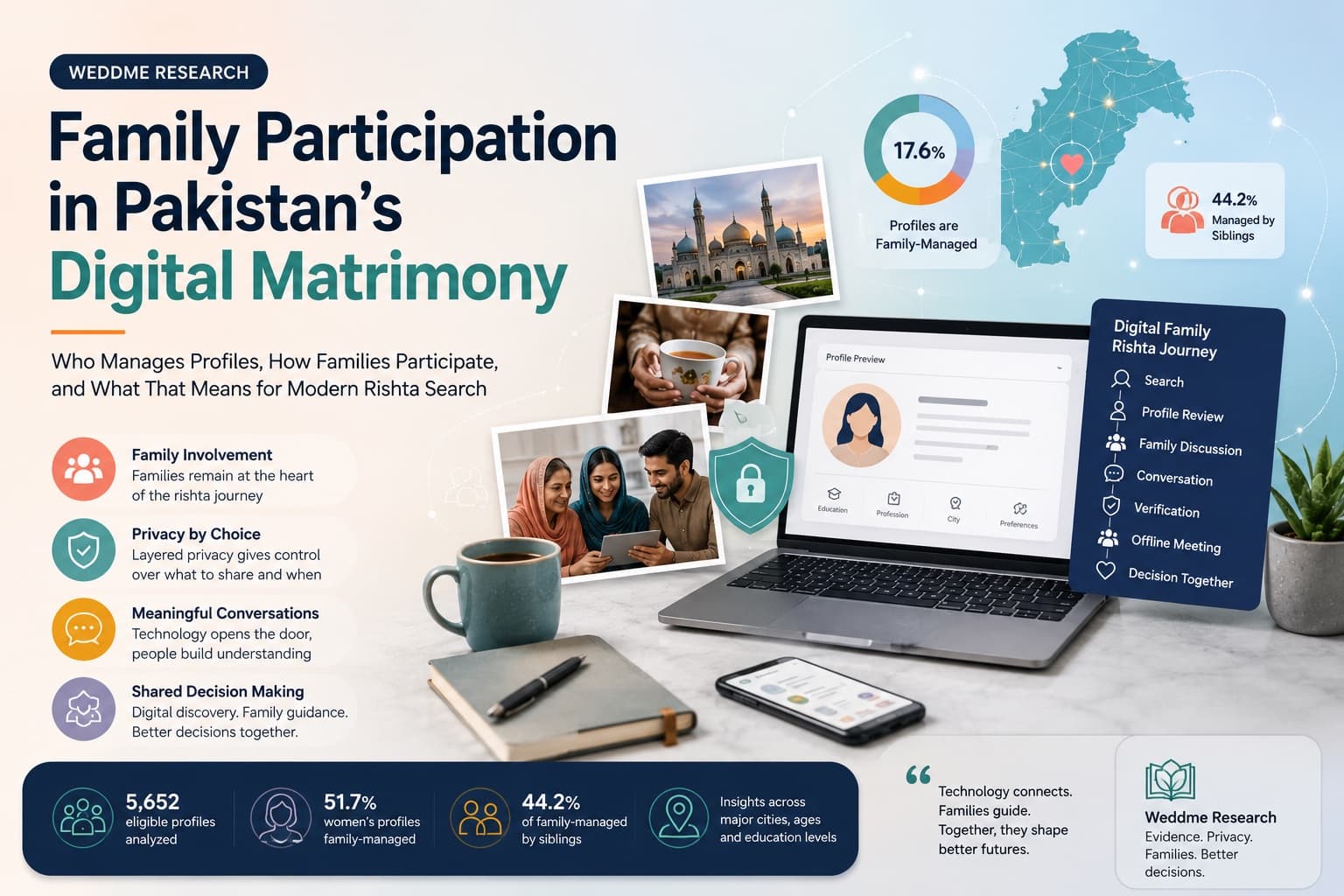
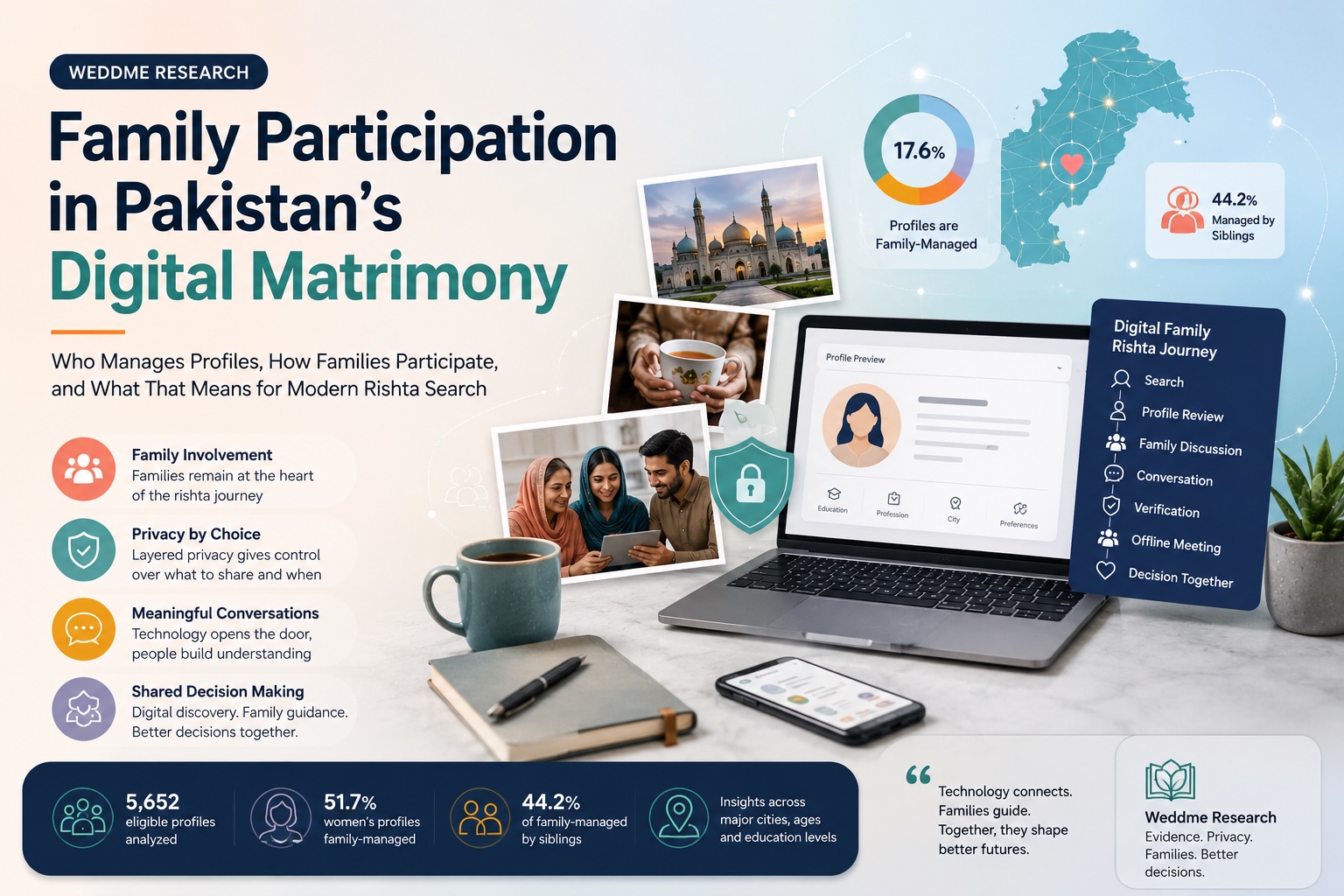
Family Participation in Pakistan's Digital Matrimony
Who Manages Profiles, How Families Participate, and What That Means for Modern Rishta Search
An anonymized platform study of 5,652 eligible Weddme profiles, with manager information available for 5,651.
Scope and methodology in brief
This report describes recorded profile management and selected account-level actions within an eligible Weddme cohort. It does not estimate family participation across Pakistan, identify decision authority, or measure matrimonial success.
1. Executive Summary
Digital matrimonial search is often imagined as an individual holding a phone and making choices alone. That image is incomplete. Pakistan's rishta process has long involved individuals, parents, siblings, guardians, relatives, and trusted intermediaries. When discovery moves online, family participation does not necessarily disappear; some of it becomes visible in the structure of the digital profile.
This report asks how family participation appears within Weddme's digital matrimonial environment. It uses an anonymized, read-only snapshot of 5,652 eligible profiles represented on Weddme on 17 August 2026. Manager information was available for 5,651 profiles. The report compares self-managed and family-managed profiles, examines the recorded relationship of family managers, and describes variation by gender, age, selected cities, and education. A separate standardized cohort is used only to establish whether both management models were represented among accounts initiating digital conversations during a common first-30-day observation window.
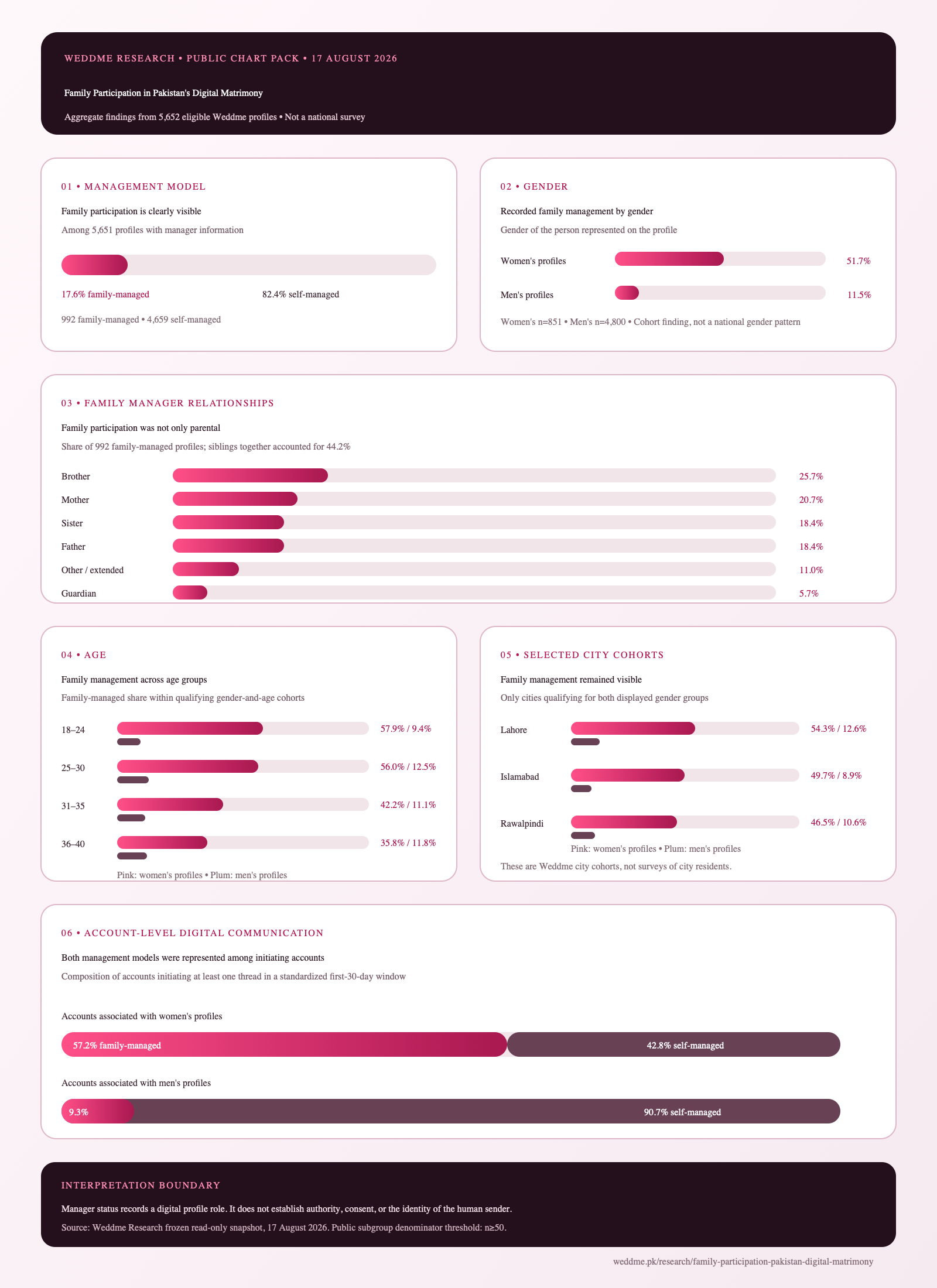
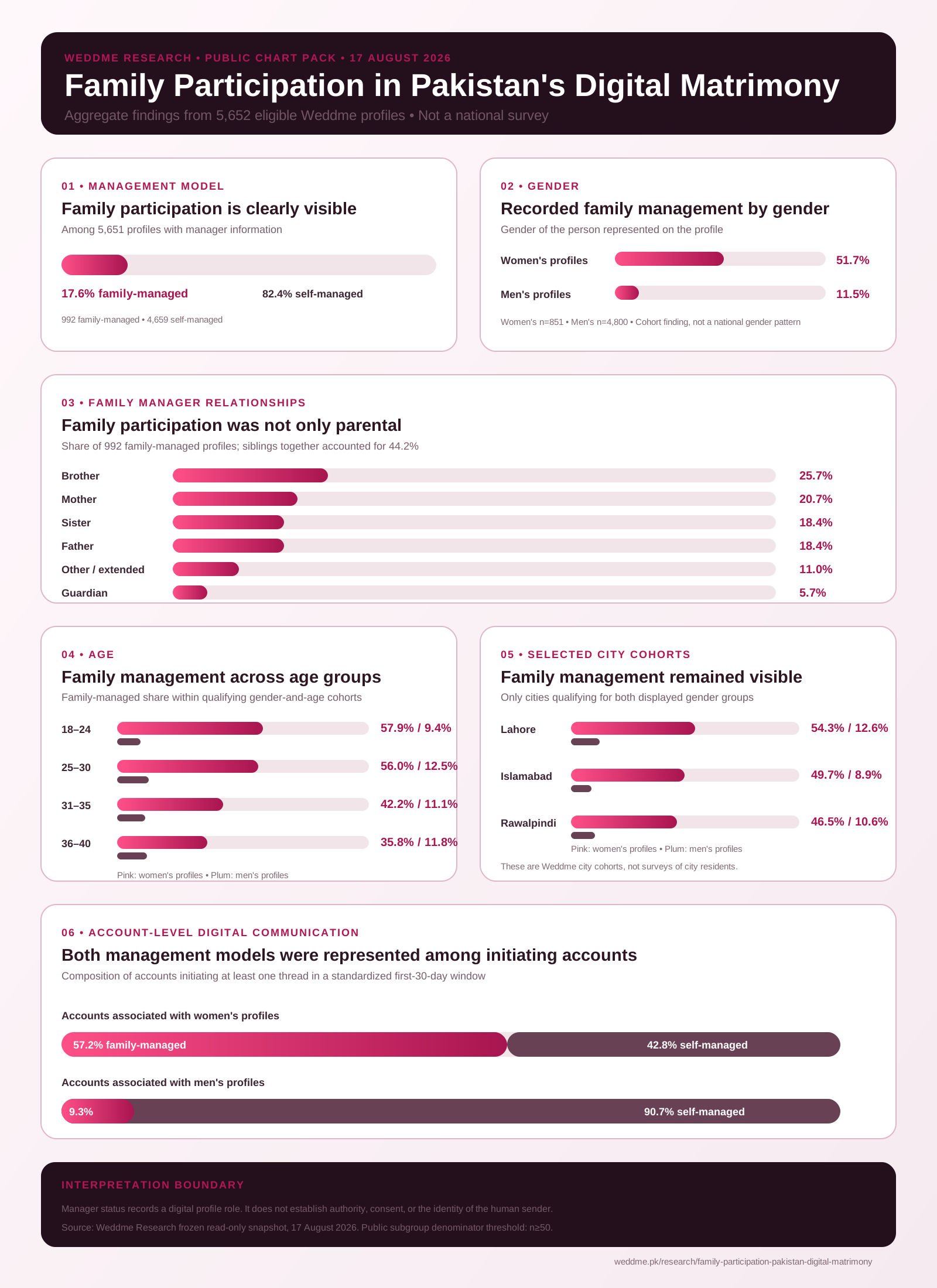
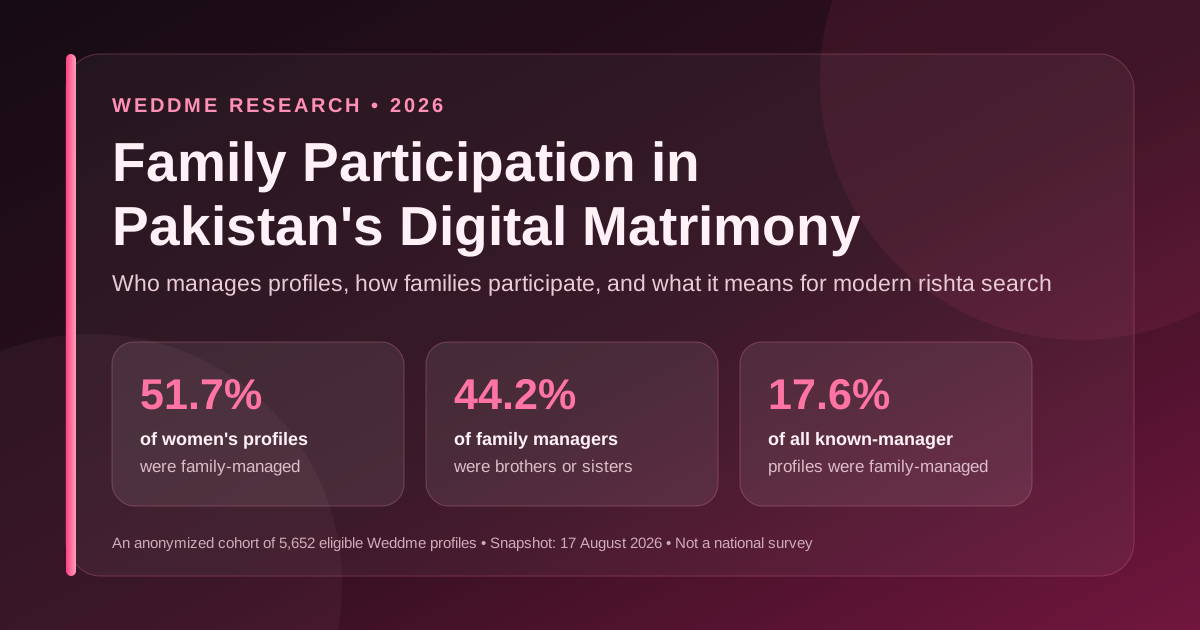
Among profiles with manager information, 992 of 5,651, or 17.6%, were recorded as managed by someone other than the person represented. Family management was more frequently recorded among women's profiles: 440 of 851, or 51.7%, compared with 552 of 4,800 men's profiles, or 11.5%. Siblings played a particularly visible role: brothers and sisters together managed 438 of the 992 family-managed profiles, or 44.2%. The pattern differed by the gender of the person represented: mothers and sisters were most frequently recorded on family-managed women's profiles, while brothers and fathers were most frequent on family-managed men's profiles. The remaining 4,659 profiles with manager information, or 82.4%, were self-managed.
The data also shows that family-managed accounts participate in digital actions rather than existing only as static representations. Both self-managed and family-managed account groups initiated conversations during the standardized observation window. However, an account-level event cannot identify the human being who typed a message. It records only that the account associated with a particular manager label initiated the thread.
The findings support a careful conclusion: digital discovery can accommodate both individual and family participation. They do not establish who made final decisions, whether the person represented consented to each action, what happened offline, or whether any conversation resulted in a marriage.
2. Key Findings
Finding 1: Family participation was clearly visible in digital matrimony
Among 5,651 eligible profiles with manager information, 992 (17.6%) were family-managed. The remaining 4,659 (82.4%) were self-managed. This establishes the platform-level baseline and shows that an explicitly recorded family role was present for almost one in six profiles. It does not estimate the national prevalence of family-managed matrimonial search.
Finding 2: Family management was recorded much more often on women's profiles
Among 851 eligible women's profiles with manager information, 440 (51.7%) were family-managed. Among 4,800 eligible men's profiles with manager information, 552 (11.5%) were family-managed. This difference describes the analyzed Weddme cohort and should not be interpreted as dependence, control, or a national gender pattern.
Finding 3: Family participation was not only parental—siblings played a large role
Among the 992 family-managed profiles, brothers managed 255 (25.7%) and sisters managed 183 (18.4%). Together, siblings managed 438 profiles, or 44.2% of the family-managed cohort. Mothers managed 205 (20.7%) and fathers 183 (18.4%). Guardian and other or extended-family labels made up the remainder. Profile management is evidence of a recorded digital role, not proof of decision authority.
Finding 4: Family management took different recorded forms for women's and men's profiles
Mothers and sisters were the two largest recorded manager groups for family-managed women's profiles. Brothers and fathers were the two largest for family-managed men's profiles. This describes account roles, not authority, dependence, or the full family network around a self-managed profile.
Finding 5: Family participation changed with age and remained visible across major city cohorts
Within the analyzed women's cohort, the family-managed share was 57.9% for ages 18–24, 56.0% for ages 25–30, 42.2% for ages 31–35, and 35.8% for ages 36–40. Family management also remained visible in the qualifying Lahore, Islamabad, and Rawalpindi cohorts. These are unadjusted platform observations, not causal age effects or city surveys.
Finding 6: Family-managed accounts participated in digital communication as well as profile representation
Both self-managed and family-managed accounts were represented among accounts initiating conversations during the standardized first-30-day observation window. The measured event belongs to the account, not an identified human sender. It does not establish initiation success, response, or what happened afterward.
3. Why Family Participation Matters
Individual and family participation coexist within the same digital matrimonial environment.
Weddme Research, 2026
The rishta process in Pakistan is not a single, uniform sequence. An introduction may begin through an individual, parent, sibling, extended relative, friend, community contact, or marriage bureau. The person seeking a spouse may lead every step, may collaborate with relatives, or may ask a trusted family member to manage part of the search. Roles can also change as an introduction progresses.
Digital systems enter that existing social process. They add searchable profiles, standardized fields, privacy controls, verification events, and in-platform communication. They do not automatically replace family consultation, personal judgment, independent checks, meetings, or consent. The important research question is therefore not whether digital matrimony is “traditional” or “modern.” It is how established forms of participation are represented when part of the journey moves online.
The profile-manager field offers one window into that transition. It allows an account to state that a profile is managed by the person represented or by a mother, father, sister, brother, guardian, or another person. This makes a role that may previously have remained informal more observable. It also creates a need for interpretive restraint. A manager label cannot tell researchers who proposed creating the profile, who approves possible matches, who types every message, or who makes the final decision.
Self-management should be interpreted just as carefully. A self-managed profile does not imply that family members are absent. The individual may discuss profiles with relatives, seek advice, or involve family members later without changing the manager label. The field therefore captures recorded profile management, not the full social network around the person.
This distinction is central to the report. It prevents the data from being used to claim either that digital matrimony removes families or that family-managed accounts prove family control. The evidence supports a narrower and more useful finding: individual and family participation coexist within the same digital environment.
4. Who Manages Matrimonial Profiles?
The main cohort contained 5,652 eligible profiles at the frozen snapshot. Manager information was missing for one profile, leaving a denominator of 5,651 for the manager baseline.
Self-managed and family-managed profiles
| Recorded management model | Profiles | Share of 5,651 profiles with manager information |
|---|---|---|
| Self-managed | 4,659 | 82.4% |
| Family-managed | 992 | 17.6% |
Source note: Weddme Research read-only production snapshot, 17 August 2026 at 01:13:28 PKT. Eligible active client profiles only; invalid, flagged, deleted, non-clean-risk, and non-client records were excluded.
The majority of profiles were self-managed. At the same time, almost one in six profiles had a family-manager label. The second figure is substantial enough to show that family participation is not peripheral to the platform's account structure.
The two categories should not be treated as opposing social models. They describe who was recorded as managing the digital profile at the snapshot. A family-managed profile may involve substantial participation by the person represented. A self-managed profile may involve substantial offline family consultation. The categories are best understood as different digital arrangements within a wider matrimonial journey.
5. Mothers, Fathers, Sisters and Brothers
Family participation was not only parental: brothers and sisters managed 44.2% of family-managed profiles.
Weddme Research, 2026
The family-managed group included both parent and sibling roles.
Family manager relationships
| Recorded family manager | Profiles | Share of 992 family-managed profiles |
|---|---|---|
| Brother | 255 | 25.7% |
| Mother | 205 | 20.7% |
| Sister | 183 | 18.4% |
| Father | 183 | 18.4% |
| Other or extended family | 109 | 11.0% |
| Guardian | 57 | 5.7% |
Category note: “Other or extended family” combines the general other category with individual extended-family labels so that no displayed category falls below the report's minimum publication threshold of 50.
No one relationship represented a majority of family-managed profiles. Siblings together accounted for 438 profiles, while mothers and fathers together accounted for 388. This distribution is useful because it broadens the idea of family participation beyond parental management. Brothers and sisters were prominent participants in the digital representation of a rishta search.
Family participation was not only parental. Brothers and sisters together managed 44.2% of all family-managed profiles in the analyzed cohort.
The data does not explain why a particular relative was selected. It cannot distinguish convenience, digital confidence, family preference, the wishes of the person represented, or another reason. Nor can it establish that the recorded manager personally performed every action. Those questions require consent-based qualitative research rather than inference from an account field.
6. Family Participation Across Gender
Gender produced the clearest descriptive difference in the main cohort.
Profile management by gender
| Gender of person represented | Profiles with manager information | Family-managed | Self-managed |
|---|---|---|---|
| Women | 851 | 440 (51.7%) | 411 (48.3%) |
| Men | 4,800 | 552 (11.5%) | 4,248 (88.5%) |
Among women's family-managed profiles, mothers were the largest displayed group at 135 of 440 (30.7%), followed by sisters at 122 (27.7%), fathers at 72 (16.4%), and brothers at 68 (15.5%). Less common manager labels were not separated because their gender-specific counts fell below the publication threshold.
Among men's family-managed profiles, brothers were the largest group at 187 of 552 (33.9%). Fathers managed 111 (20.1%), the general other category 86 (15.6%), mothers 70 (12.7%), and sisters 61 (11.1%). Less common labels were again suppressed.
These distributions show that family participation took different recorded forms across women's and men's profiles. Mothers and sisters were especially visible in managing women's profiles; brothers and fathers were especially visible in managing men's profiles. That is a description of account roles, not a judgment about either gender.
Several interpretations would exceed the evidence. The results do not show that women lack agency, that men search without family input, or that the manager makes matrimonial decisions. They also do not reveal whether manager labels were selected consistently by every household. The defensible conclusion is limited to the digital record: family management was more frequently recorded among women's profiles in this cohort, and both parent and sibling roles were present.
7. Family Participation Across Age Groups
Age patterns were analyzed separately by gender to avoid allowing the cohort's gender composition to drive the comparison. Only age-and-gender groups with at least 50 profiles are shown.
Family management by age and gender
| Age band | Women's profiles: family-managed | Men's profiles: family-managed |
|---|---|---|
| 18–24 | 103 of 178 (57.9%) | 93 of 991 (9.4%) |
| 25–30 | 249 of 445 (56.0%) | 324 of 2,590 (12.5%) |
| 31–35 | 57 of 135 (42.2%) | 76 of 688 (11.1%) |
| 36–40 | 19 of 53 (35.8%) | 32 of 271 (11.8%) |
| 41–50 | Not displayed | 19 of 208 (9.1%) |
| 51+ | Not displayed | 8 of 52 (15.4%) |
Within the women's cohort, family management was more frequently recorded in the two younger displayed bands and less frequently recorded in the 31–35 and 36–40 bands. The men's-profile percentages varied within a narrower range, with no simple monotonic progression by age.
This is not evidence that age causes family participation. Age may be associated with marital history, education, professional stage, household arrangements, who joined the platform, or how the service was introduced. The analysis does not adjust for those factors. Older women's groups that did not meet the threshold were omitted rather than combined into an unstable comparison.
8. Geographic Patterns
City comparisons were also separated by gender. The three cities below were the only locations in which both the women's and men's cohorts met the minimum threshold.
Family management in selected city cohorts
| Residential city | Women's profiles: family-managed | Men's profiles: family-managed |
|---|---|---|
| Lahore | 215 of 396 (54.3%) | 248 of 1,964 (12.6%) |
| Islamabad | 74 of 149 (49.7%) | 71 of 795 (8.9%) |
| Rawalpindi | 80 of 172 (46.5%) | 71 of 667 (10.6%) |
Family management was visible in each city cohort. Differences between the three percentages were modest relative to the much larger difference between women's and men's profiles. The report does not test whether those city differences are statistically significant, nor does it control for age, education, profession, registration source, or other composition effects.
The wording “within the analyzed Lahore cohort” is essential. Weddme users are not a probability sample of Lahore, Islamabad, or Rawalpindi. The results cannot be generalized to families living in those cities, and cities that did not meet the threshold are not described as having less family participation.
9. Education Context
Education did not produce a large difference within the most common comparable categories. Among women's profiles, 196 of 380 bachelor's-level profiles (51.6%), 157 of 313 master's-level profiles (50.2%), and 27 of 53 higher-secondary profiles (50.9%) were family-managed. Among men's profiles, the corresponding shares were 211 of 2,117 (10.0%), 95 of 818 (11.6%), and 97 of 917 (10.6%).
These similarities suggest that the gender pattern observed in this cohort was not confined to one of these three education groups. They do not show that education has no relationship with family participation. The categories are broad, self-reported, and not adjusted for age or other differences.
10. Family-Managed Accounts Also Participate in Digital Communication
The measured event belongs to the account, not an identified human sender.
Weddme Research, 2026
Profile management and conversation initiation are different measurements. Management comes from the profile's recorded manager label. Initiation is an event: the account sent the first recorded message in a new thread during its first 30 days on the platform.
To compare accounts on a common basis, the communication analysis included eligible profiles created from 24 March 2026 through the point 30 days before the frozen snapshot. Each included account had a complete first-30-day observation window. Message contents were never retrieved or examined.
Both self-managed and family-managed accounts were represented among accounts initiating conversations. Among initiating accounts associated with women's profiles, 57.2% were family-managed and 42.8% were self-managed. Among initiating accounts associated with men's profiles, 9.3% were family-managed and 90.7% were self-managed. Every displayed manager-and-gender cell exceeded the minimum publication threshold.
These percentages answer a limited question: what manager labels were attached to accounts that initiated at least one thread? They do not report how often eligible accounts initiated, how many messages they sent, whether anyone replied, whether a conversation continued, or whether an offline introduction occurred. Those measures were excluded because they are not necessary to explain family participation and could be mistaken for product or matchmaking performance.
Most importantly, the data does not identify the human sender. A family-managed label indicates the recorded relationship of the profile manager at the snapshot. It does not prove that this manager typed the first message. Likewise, a self-managed label does not prove that a relative was absent when the message was composed. The communication evidence supports only this conclusion: accounts under both management models used the platform to begin conversations.
11. Privacy Within Self-Managed and Family-Managed Digital Journeys
Privacy configuration provides another view of how the two management models can use the available environment. Restricted contact details were the dominant configuration for women's and men's profiles under both self-managed and family-managed arrangements.
The privacy pattern is relevant to a collaborative journey because profile representation and direct access do not need to happen at the same time. A profile can support discovery while keeping contact information behind a later boundary. This may allow an individual or family to stage participation: represent the person, review potential profiles, begin an in-platform exchange, and decide later whether to share direct contact information. The database records privacy settings, not the household reasoning behind them, so the observed configuration should not be described as a measured preference.
12. What the Evidence Means for Digital Matrimony
The findings point toward a hybrid model rather than a choice between family-led and individual-led search.
The Digital Family Rishta Journey
Digital tools can organize the beginning of a rishta search while consultation, verification, consent, and decisions remain human.
Digital environment
- Digital discovery
The platform provides a searchable environment for profiles.
- Profile representation
A profile represents the person seeking a matrimonial introduction.
- Individual or family participation
The profile records a self or family-manager relationship.
- Initial communication
Account-level metadata can identify which account began a thread.
Human and offline journey
- Family or individual discussion
Consultation may continue outside the platform.
- Independent verification
People and families check information through appropriate channels.
- Offline interaction
Meetings and further discussion take place beyond platform observation.
- Human decision and consent
The final choice belongs to the people involved.
The sequence is illustrative, not universal. This dataset directly observes profile representation, the current manager label, selected settings, and account-level initiation—not later offline stages.
Weddme data directly observes profile representation, the recorded management model, selected settings, verification events, and in-platform initiation. It does not directly observe the later discussion, independent checks, meetings, decisions, or outcomes shown in the lower half of the model. Those stages are conceptual context for understanding where platform visibility ends.
The model allows several routes. An individual may create and manage a profile, initiate a conversation, and involve family later. A parent or sibling may manage early discovery while the person represented participates in evaluation and consent. A self-managed account may be collaborative offline. A family-managed account may act under the direct wishes of the person represented. The recorded manager label does not resolve those possibilities.
This has practical implications for responsible platform design. The person represented and the manager role should be clear. Account interfaces should not treat family management as automatic consent. Privacy controls should support staged disclosure. Verification should be described accurately as confirmation of a specific event rather than proof of every personal claim. Safety guidance should address both individual users and relatives acting on their behalf.
For researchers, the hybrid model shifts the unit of analysis. A matrimonial profile can represent one person while its digital use may involve more than one person. Standard assumptions about a solitary account holder may therefore miss an important part of the social process. Better future evidence would combine aggregate platform records with voluntary, consent-based interviews of people represented and family managers.
13. What the Data Cannot Tell Us
This study has clear boundaries.
First, Weddme users are not representative of all Pakistanis. The cohort is shaped by internet access, platform awareness, registration sources, cities served, eligibility rules, and who chose to participate. Platform percentages are not national prevalence estimates.
Second, manager status does not establish authority. It does not show who suggested creating the profile, who selected criteria, who approved a conversation, or who made a final decision. The status recorded at the snapshot may also differ from the manager arrangement at an earlier point.
Third, communication initiation is account-level metadata. It cannot identify the human sender, the intent of the message, its quality, or what happened afterward. Initiation is not relationship success.
Fourth, online activity does not measure engagements or marriages. The report deliberately avoids response, conversion, payment, retention, and outcome measures.
Fifth, profile information and manager labels may be self-reported. Verification timestamps confirm particular platform events; they do not verify every biographical claim or family relationship.
Sixth, subgroup results are observational and unadjusted. Differences by age, city, or education may reflect other characteristics. They should not be interpreted as causal.
Seventh, the publication threshold prevents unstable or potentially identifying small-group statistics, but it also means some relationships, cities, ages, and occupations are not shown. Absence from a table does not mean absence from the platform.
14. Methodology
14.1 Research objective
The analysis asked three questions: who is recorded as managing eligible Weddme profiles; how does recorded family management vary across observable cohorts; and what can account-level initiation and selected settings safely reveal about digital collaboration?
14.2 Frozen snapshot and eligibility
The main data was captured in a repeatable-read, read-only production database transaction at 16 August 2026, 20:13:28 UTC, equivalent to 17 August 2026, 01:13:28 Pakistan Standard Time. It contained 5,652 eligible profiles.
Eligibility required an active client user and active profile; neither record could be deleted; the user had to be marked valid, not flagged, and in a clean risk state. Non-client accounts were excluded. The same general eligibility framework was used in Weddme's preceding research so that definitions remain consistent, although the snapshot dates and cohort sizes differ.
14.3 Manager classification
Manager labels were normalized to lower case and trimmed. “Self” was classified as self-managed. Any recognized non-self relationship was classified as family-managed. One missing label was classified as unknown and excluded from manager denominators. For the public relationship table, very small extended-family labels were combined with the general other category.
14.4 Cohort comparisons
Gender, age, residential city, and education fields came from the current eligible profile record. Residential city was used where available, with profile city as a fallback. Analysis was separated by gender where composition could otherwise distort interpretation. A subgroup required at least 50 profiles before it could be displayed publicly.
14.5 Conversation initiation
The standardized communication cohort included current eligible profiles created no earlier than 24 March 2026 and at least 30 days before the frozen snapshot. For each chat thread, the earliest message by timestamp and record order defined the initiating account. An account was classified as an initiator when that first message fell between profile creation and the end of its first 30 days. Only metadata required to identify the first sender and timestamp was analyzed. Message bodies were not selected, read, searched, or exported.
The manager label used for interpretation was the current snapshot label. The analysis cannot prove that the label was unchanged when a thread began or that the recorded manager was the human sender. Public results describe only the composition of initiating accounts. Initiation rates, replies, downstream actions, and outcomes are outside scope.
14.6 Data quality and reproducibility
Of 5,652 eligible profiles, manager information was missing for one, city for three, education for three, and age was missing or outside the analyzed valid range for three. Each public number was calculated from the frozen cohort with a versioned aggregate SQL query. No row-level identifiers or content are included in the publication dataset.
15. Privacy and Ethics
This report uses grouped results only. It does not publish names, account identifiers, email addresses, phone numbers, photographs, biographies, exact addresses, message contents, or identifiable excerpts. The analysis did not retrieve message bodies.
A minimum public cohort size of 50 was applied to displayed subgroups. Small relationship labels were pooled only where the combined category met that threshold; otherwise small cells were suppressed. The report avoids cross-tabulations that would make a person or household more identifiable.
Privacy is not only a disclosure rule. It also shapes interpretation. A family-manager label should not be used to make claims about a specific household's consent, authority, or relationships. Gender, age, city, and education are treated as descriptive fields, not as explanations of behavior or grounds for stereotyping.
The report excludes payment, revenue, conversion, response, rejection, drop-off, retention, and marriage-outcome metrics. This is a legitimate scope decision: those measures are not required to answer the stated research question and could be harmful or misleading when detached from a different research design.
16. References
Weddme Research
- Weddme Research. Pakistan Matrimonial Trends Report 2026. Published 2026.
- Weddme Research. Pakistan's Digital Matrimonial Transformation 2026. Published 2026.
- Weddme Research. Family Participation in Pakistan's Digital Matrimony: Frozen Aggregate Research Extract. Internal read-only dataset, snapshot 17 August 2026 at 01:13:28 PKT. No personal identifiers or message contents included.
Contextual research
- Khurshid, A. (2020). “Love Marriage or Arranged Marriage? Choice, Rights, and Empowerment for Educated Muslim Women from Rural and Low-Income Pakistani Communities.” Compare: A Journal of Comparative and International Education, 50(1), 90–106. https://doi.org/10.1080/03057925.2018.1507726.
Suggested citation
Weddme Research Team. (2026). Family Participation in Pakistan's Digital Matrimony: Who Manages Profiles, How Families Participate, and What That Means for Modern Rishta Search. Weddme Research & Insights. https://weddme.pk/research/family-participation-pakistan-digital-matrimony
Describe the figures as findings from an eligible Weddme platform cohort, not as national estimates for Pakistan.
Reporting resources
Download the public summary, editorial assets, chart pack, and aggregate publication data. The public data contains only grouped findings used in this report—no personal or row-level records.