Pakistan Matrimonial Trends Report 2026
What 5,427 eligible profiles represented on Weddme tell us about family participation, partner-age preferences, education, and the relationship between profile readiness and sustained platform activity.
Source: Weddme production data, synchronized snapshot taken 8 August 2026. Definitions and denominators are explained below.
Digital matrimonial search is individual and family-led at the same time
A matrimonial profile can look like a personal digital object: one person’s age, education, work, and preferences arranged on a screen. The Weddme data shows that this is only part of the picture. For many members, especially women represented on the platform, the profile also sits inside a family process.
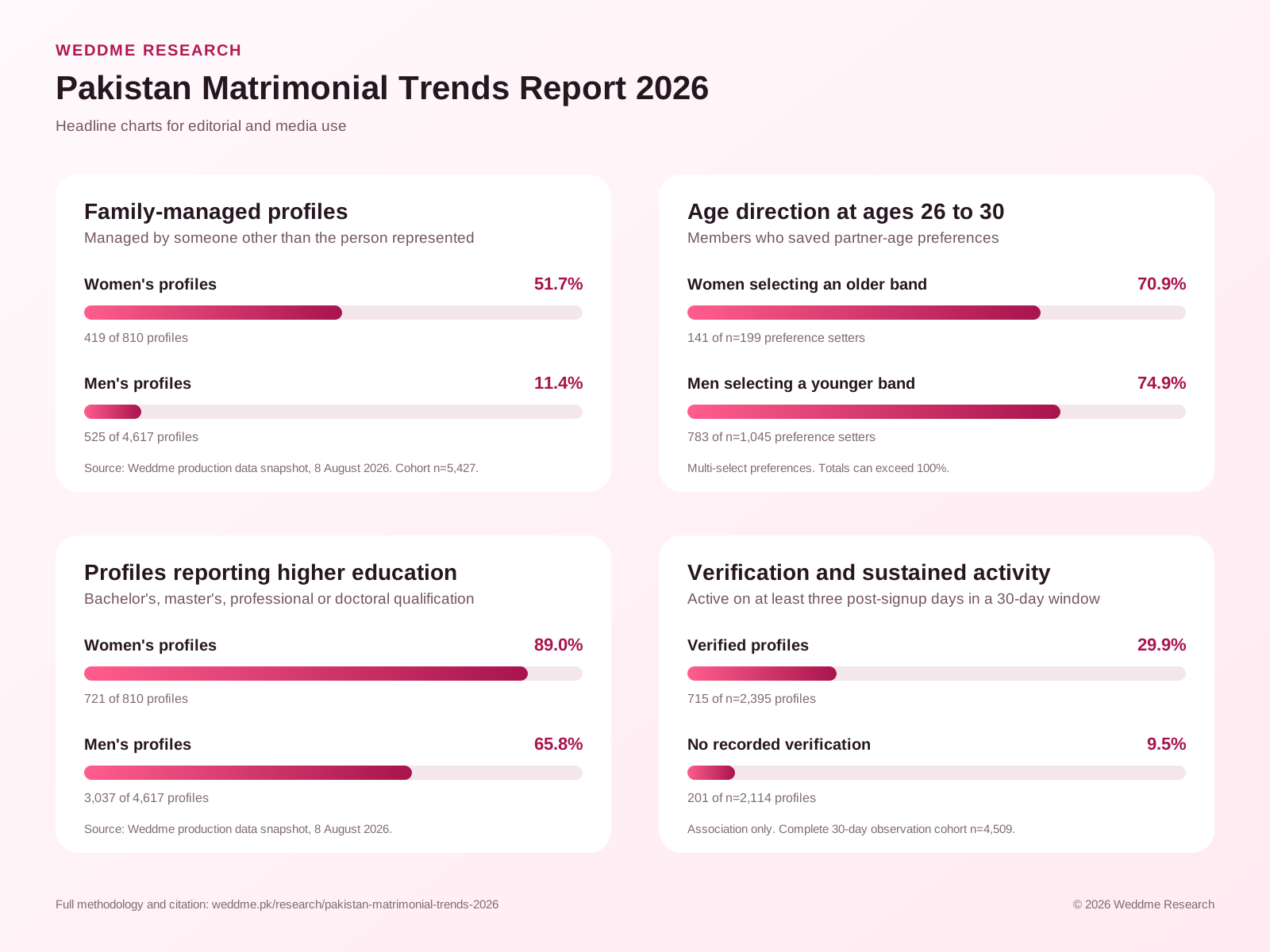
Just over half of women’s profiles in the analyzed Weddme cohort were managed by someone other than the woman represented. The equivalent share for men was much lower. Mothers and sisters were especially visible as managers of women’s profiles, while brothers were the largest manager group for family-managed men’s profiles. The pattern held across the main age groups and in Lahore, Islamabad, and Rawalpindi. This makes family participation more than a background detail. It is one of the clearest features of how this platform population approaches digital matrimonial search.
Age preferences provide a second clear theme. The overall selections differ between men and women, but the more revealing comparison holds age constant. Among members aged 26 to 30 who saved age preferences, women commonly included an older band and men commonly included a younger band. Members could choose several bands, and many selected their own band as well. The finding therefore describes the direction and breadth of saved preferences, not a single fixed requirement.
Education is prominent both in member profiles and in saved partner preferences. More than two-thirds of the profiles reported a bachelor’s degree or higher, with an especially high share among women represented on Weddme. When preference setters are compared with their own education, members often selected their own level, but not only their own level. Bachelor’s-educated women selected master’s and professional qualifications more often than bachelor’s-educated men did, while men’s selections extended across a wider range of qualifications.
Finally, complete and verified profiles were associated with more sustained authenticated activity during a standardized 30-day period. That relationship is meaningful, but it is not proof that completion or verification caused the additional activity. Active members may also be more inclined to finish and verify their profiles. The responsible conclusion is that profile readiness and continued participation travel together within the analyzed cohort.
The report in 30 seconds
- 01Family participation remains substantial in digital matrimonial search.
Someone else managed 419 of 810 women’s profiles, or 51.7%.
- 02Age-direction preferences differ in a like-for-like comparison.
Among preference setters aged 26 to 30, 141 of n=199 women selected an older band and 783 of n=1,045 men selected a younger band.
- 03Higher education is strongly represented.
Bachelor’s-level education or above appeared on 3,758 of 5,427 analyzed profiles, or 69.2%.
- 04Profile readiness is associated with continued participation.
Verified profiles reached the three-day activity threshold at more than three times the rate of profiles without recorded verification.
Family participation is built into the digital profile
The strongest finding in this report is not about a preferred age or degree. It is about who is doing the searching. Within the analyzed Weddme cohort, profiles frequently represent a shared family effort, particularly when the person represented is a woman.
Profiles managed by someone other than the person represented
The contrast remains large after separating women’s and men’s profiles.
Of the 810 women’s profiles, 419 were managed by another person. Of the 4,617 men’s profiles, 525 were managed by another person. A family-managed profile does not tell us who made every decision or who wrote every field. It does show that someone other than the person represented was recorded as the profile manager.
Among the 419 family-managed women’s profiles, mothers were the largest group at 128, or 30.5%. Sisters followed at 112, or 26.7%. Fathers managed 72, brothers managed 66, and guardians managed 24. Among the 525 family-managed men’s profiles, brothers were the largest group at 177, or 33.7%, followed by fathers at 104. Mothers managed 71 and sisters managed 58.
Mothers managed 47 of the 131 family-managed women’s profiles at ages 18 to 25, or 35.9%. At ages 26 to 30, mothers managed 60 of 205 and sisters managed 59 of 205. Among the smaller 31 to 35 group, sisters managed 19 of 55 family-managed profiles, compared with 15 managed by mothers. This suggests that sibling participation becomes more visible with age, although the older subgroup is too small for a sweeping conclusion.
Age alone does not explain the broader gender difference. Family management covered 131 of 233 women’s profiles aged 18 to 25 and 205 of 360 aged 26 to 30. It remained present in 55 of 129 women’s profiles aged 31 to 35. Among men, family-managed shares stayed close to one in ten across the major age groups.
Nor is the pattern confined to one city. Family members managed 208 of 383 women’s profiles in Lahore, 71 of 144 in Islamabad, and 66 of 144 in Rawalpindi. The equivalent figures for men were 241 of 1,907 in Lahore, 65 of 755 in Islamabad, and 58 of 535 in Rawalpindi. Only city and gender groups with at least 20 profiles were considered for this comparison.
The useful interpretation is not that digital search has displaced family participation. For these Weddme members, the two often operate together. A profile can give the person represented a structured presence online while a parent or sibling helps manage discovery, comparison, or contact. That has practical implications for product language, consent, privacy controls, and the way platforms explain who is speaking on behalf of whom. Weddme’s own how-it-works guidance and safety guidance are relevant context, but this report does not assume that every family-managed profile follows the same process.
A young profile population, with different directions in saved age preferences
The people represented on Weddme are concentrated in their twenties. Of 5,424 profiles with valid age data, 4,032 were between 18 and 30. The median age was 27 for both women and men.
Age composition of the analyzed cohort
Profile age describes the person represented. It is not age at marriage.
That profile composition provides context, but it is not evidence of whom members want to meet. For that question, the analysis turns to saved age preferences. There were 468 women and 2,340 men with at least one saved age-band selection.
Most frequently saved age bands
Each line uses the exact number of members who saved an age preference for that gender.
Multi-select preference field. A member can appear in more than one bar, so percentages can total more than 100%.
The broad pattern is visible: 268 of n=468 women who saved an age preference selected ages 26 to 30, and 220 of n=468 selected 31 to 35. Among men who saved age preferences, 1,678 of n=2,340 selected 18 to 25 and 1,254 of n=2,340 selected 26 to 30. These are selections, not requirements, and they do not indicate whom a member contacted or ultimately matched with.
The like-for-like comparison at ages 26 to 30
Comparing members of the same age helps separate preference direction from the age composition of the platform. An “older” selection means a saved band whose lower bound was above the member’s own age. A “younger” selection means a band whose upper bound was below the member’s age. A member could select an older band, their own band, and a younger band at the same time.
How members aged 26 to 30 positioned their saved age preferences
Women commonly included an older band, while men commonly included a younger band.
Categories overlap because members could save several age bands. Totals should not be added together.
Among women aged 26 to 30 who saved age preferences, 141 of n=199 selected at least one wholly older band. Among men of the same age who saved preferences, 783 of n=1,045 selected at least one wholly younger band. At the same time, 132 of n=199 women and 642 of n=1,045 men selected the band containing their own age. The data therefore points to a difference in direction, but also to flexibility and overlap.
The same broader tendency appears across valid-age preference setters. Among women, 340 of n=466 selected at least one wholly older band, while 48 of n=466 selected a wholly younger band. Among men, 1,308 of n=2,340 selected at least one wholly younger band and 579 of n=2,340 selected an older band. Two women with saved age preferences were excluded from this relative analysis because their own age values were invalid.
This is a platform preference finding. It should not be retold as “what Pakistani men want” or “what Pakistani women want.” The accurate language is narrower: these are the age bands saved by Weddme members in the analyzed cohort. Readers who want to understand how age categories are presented elsewhere on the site can consult the age-based rishta guide, which is separate from this research analysis.
Education is prominent in profiles and in partner preferences
Higher education is strongly represented in the current platform population. In this report, “higher education” means a reported bachelor’s, master’s, professional, or doctoral qualification.
Profiles reporting higher education
Women represented on Weddme form an especially highly educated segment of the current cohort.
Overall, 3,758 of 5,427 profiles reported higher education. The share was 721 of 810 among women’s profiles and 3,037 of 4,617 among men’s profiles. This is a composition finding. It does not measure educational attainment across Pakistan and it does not, on its own, show what members prefer in a partner.
Saved education preferences provide that second view. Among women who saved education preferences, 304 of n=480 selected a bachelor’s degree and 304 of n=480 selected a master’s degree. Professional degrees were selected by 177 of n=480, and doctorates by 151 of n=480. Among men who saved education preferences, 1,522 of n=2,303 selected a bachelor’s degree, 1,028 of n=2,303 selected higher secondary, 911 of n=2,303 selected a master’s degree, 629 of n=2,303 selected secondary school, and 623 of n=2,303 selected a diploma. As with age, these were multi-select fields and totals can exceed 100%.
What members selected relative to their own education
The relative comparison shows both similarity and range. Members with a bachelor’s degree frequently selected the same level, but their other selections differed.
Preferences among bachelor’s-educated members
The denominator is limited to bachelor’s-educated members who saved at least one education preference.
Multi-select preference field. Members can be counted in several qualification bars.
Among bachelor’s-educated women who saved education preferences, 178 of n=220 selected a bachelor’s degree and 129 of n=220 selected a master’s degree. Professional qualifications were selected by 69 of n=220 and doctorates by 61 of n=220. Among bachelor’s-educated men who saved preferences, 914 of n=1,083 selected a bachelor’s degree, 409 of n=1,083 selected a master’s degree, 426 of n=1,083 selected higher secondary, and 288 of n=1,083 selected a diploma.
Among women whose own profiles reported a master’s, professional, or doctoral qualification, 163 of n=220 selected a master’s degree and 106 of n=220 selected a bachelor’s degree. In the equivalent group of men, 377 of n=554 selected a master’s degree and 399 of n=554 selected a bachelor’s degree. Both groups therefore showed substantial openness to a qualification below the broad level recorded on their own profile, although the categories do not reveal how members rank one selection against another.
The evidence supports a measured conclusion: education appears to matter, but saved preferences are not a simple mirror of the member’s own degree. Women represented among preference setters selected postgraduate and professional qualifications relatively often. Men’s selections covered a wider formal-education range. The platform does not ask members to explain why, so the analysis should not assign motivations such as status, income, or family pressure. The education guide explains the public search categories, while this report deals only with the analyzed profile and preference records.
Profile readiness is associated with sustained activity
A profile can exist without becoming part of an ongoing search. To look beyond creation, this analysis measured authenticated activity after signup using a consistent 30-day window.
The activity cohort contains 4,509 profiles created between 24 March, when daily activity records begin, and 9 July, the last creation date that allowed a complete 30-day window before the report snapshot. The creation day was excluded. A profile counted as showing sustained activity when its member recorded authenticated activity on at least three separate days during the following 30 days.
Profiles active on at least three post-signup days
Current profile completion is compared with activity during a standardized 30-day observation window.
Only 64 of 1,298 profiles below 60% completion reached the three-day threshold. The rate rose to 34 of 186 for profiles at 60% to 79%, 92 of 324 for profiles at 80% to 99%, and 726 of 2,701 for complete profiles. The pattern is not perfectly linear, but the gap between very incomplete and substantially complete profiles is large.
Verification and sustained activity
Verification means at least one recorded email, phone, or WhatsApp verification timestamp at the snapshot.
Among verified profiles, 715 of 2,395 recorded activity on at least three post-signup days. Among profiles without a recorded verification, 201 of 2,114 did so. At the higher threshold of seven active days, the figures were 333 of 2,395 verified profiles and 48 of 2,114 profiles without verification.
The association is meaningful, but its direction is unresolved. A complete, verified profile may give a member more confidence to keep searching. It is equally plausible that members who return more often are more likely to finish fields and complete verification. Completion and verification are measured at the snapshot rather than fixed at signup, so this report cannot separate those pathways. It can say that readiness signals and sustained participation appear together within this Weddme cohort.
Authenticated request days are also a limited measure. They do not show whether a member found a suitable profile, formed a relationship, became engaged, or married. Weddme does not currently have a sufficiently complete outcome field for a defensible success rate, so none is reported here.
Where the cohort comes from and what else profiles disclose
Geography
The analyzed cohort is concentrated in Punjab and Islamabad. Punjab accounts for 4,214 of 5,427 profiles, or 77.6%, while Islamabad accounts for 899, or 16.6%. Khyber Pakhtunkhwa contributes 130 profiles and Sindh 100. This differs substantially from the national population distribution in the Pakistan Bureau of Statistics 2023 Census, where Punjab represents about 52.9% of the population and Islamabad about 1.0%.
Source: Weddme production data snapshot, n=5,427, and Pakistan Bureau of Statistics, 7th Population and Housing Census 2023. Residential location was used where available, with origin location as fallback.
The difference is a direct reason not to call this a national survey. It may reflect Weddme’s early reach, acquisition channels, product awareness, or other selection effects that the database cannot identify. City and regional figures are therefore background to the four main themes, not estimates of Pakistan’s matrimonial population.
Professions and marital history
Business owner was the largest reported profession at 717 profiles, followed by software engineer at 447, sales and marketing at 393, government employee at 306, teacher at 262, manager at 194, and doctor at 185. Profession was available for nearly all eligible profiles, but these shares reflect who is represented on Weddme rather than Pakistan’s labour market. Readers can view the site’s separate profession categories for search context.
Never married was reported on 4,261 profiles. The cohort also includes 400 profiles reporting divorced without children, 260 separated, 208 annulled, 174 divorced with children, and 113 widowed with or without children. Those records show that the platform population includes different matrimonial histories. They should be presented without treating one history as more desirable than another.
Saved marital-status preferences tell a related but separate story. Among women who saved these preferences, 372 of n=438 selected never married and 107 of n=438 selected divorced without children. Among men, 1,969 of n=2,254 selected never married, 725 of n=2,254 selected divorced without children, 515 of n=2,254 selected widowed without children, and 469 of n=2,254 selected separated. These are multi-select preferences, so totals may exceed 100%. They indicate stated openness among some Weddme members, not contact behavior or eventual outcomes.
Profile additions during the observation period
The database begins partway through March and the report closes partway through August. Gross profile records created were 799 from 12 to 31 March, 2,869 in April, 982 in May, 553 in June, 854 in July, and 208 from 1 to 8 August. Of those records, the profiles still meeting the report’s eligibility rules at the snapshot numbered 638, 2,437, 883, 504, 769, and 196 respectively.
Source: Weddme profile creation records, 12 March to 8 August 2026. March and August are partial periods. Current eligibility is measured at the report snapshot and should not be read as historical net growth.
Definitions, exclusions, and privacy method
Cohort and observation period
The synchronized main cohort contains 5,427 profiles at 8 August 2026. A profile was included only when both profile and client account were active and not deleted, the account was valid and not flagged, and the platform risk state was clean. Profile creation dates span 12 March to 8 August 2026. Results describe this frozen platform population.
Data quality and exclusions
Age, location, education, profession, and marital status were available for nearly all eligible profiles. Three invalid age values were excluded from age analysis. Thirty-two exact attribute-signature groups involving 76 profiles were identified for quality review, but they were not treated as proven duplicates and were not removed arbitrarily. Small or sensitive groups were combined or omitted when reporting them could be misleading or create privacy risk.
Preference definitions
Preference denominators include only members with at least one saved option in the named category. All preference fields discussed here are multi-select. Percentages can exceed 100% when added. A system migration previously added profile locations to the preferred-cities field, so that field cannot be cleanly separated into user-selected and system-added values. It was excluded from preference findings.
Activity definitions
The activity analysis uses 4,509 eligible profiles with a complete 30-day follow-up period. It counts days with authenticated requests from the day after profile creation through day 30. It does not inspect message contents and does not measure successful matches, engagements, or marriages. Completion and verification are current snapshot attributes, which limits causal interpretation.
Privacy method
Analysis was performed through read-only database sessions. Publication uses aggregate counts only. Names, emails, phone numbers, addresses, profile biographies, message text, account identifiers, and individual-level records are not included. Community, caste, religion, and sect values were not used to make popularity comparisons. Public results suppress or combine small cells where appropriate.
Representativeness and interpretation
Weddme members choose to use a particular digital matrimonial platform. The cohort is heavily concentrated in Punjab and Islamabad and contains substantially more men’s than women’s profiles. These selection effects mean the findings cannot be generalized to all Pakistanis, all people seeking marriage, or the wider matrimonial market. Associations should not be described as causes.
Suggested citation
Weddme Research Team. (2026). Pakistan Matrimonial Trends Report 2026. Weddme Research & Insights. https://weddme.pk/research/pakistan-matrimonial-trends-2026
When quoting a preference result, include its gender-specific sample size and state that the field allowed multiple selections. When summarizing the report, use “Weddme members,” “profiles represented on Weddme,” or “within the analyzed Weddme cohort.” Please do not describe the report as a survey of Pakistan.
Questions about a finding?
Journalists, editors, and researchers can contact the Weddme Research Team for methodology clarification, an attributed comment, or help reading a chart. Please include the finding and publication deadline in the enquiry.