Pakistan's Digital Matrimonial Transformation 2026
How Technology Is Reshaping Pakistan's Traditional Rishta Journey
Evidence from Weddme Research and public data, with production-platform findings kept separate from national digital context.
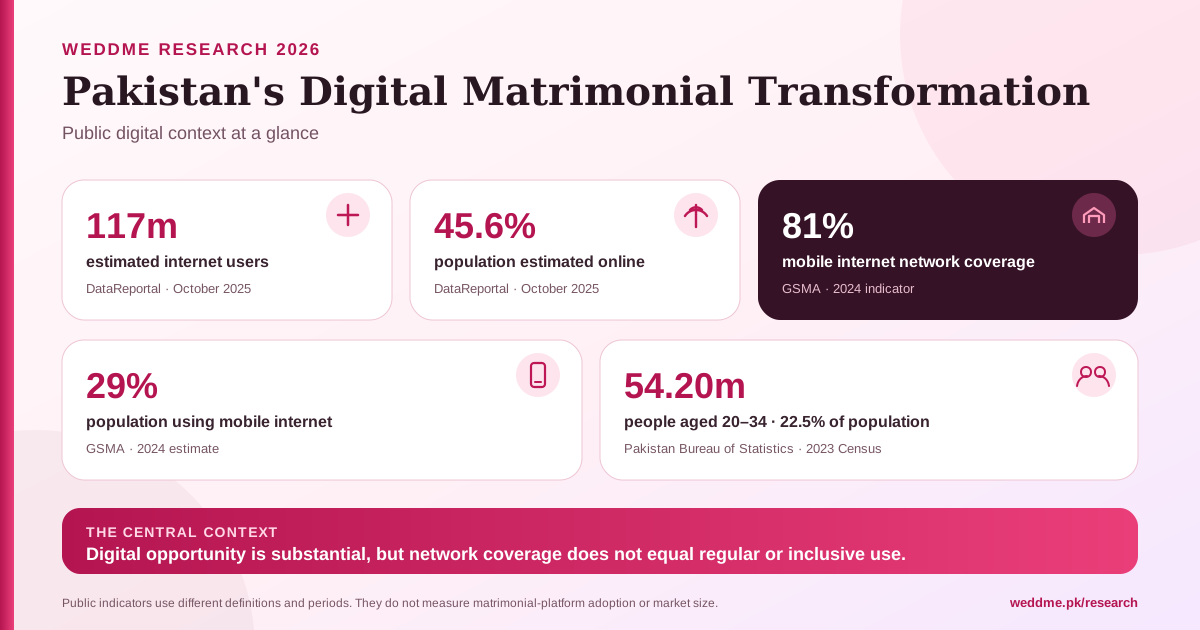
Five public indicators that frame the report
Sources use different definitions and reference periods. They provide national context and must not be combined into a matrimonial-service adoption or market-size estimate.
Scope and methodology in brief
This report describes profiles and activity represented on Weddme and places them within Pakistan's wider digital context. It is not a nationally representative study of Pakistan, and it does not measure successful matches, engagements, or marriages.
Readers looking for practical guidance can also review how Weddme works, the safety and privacy guide, and the wider Weddme Research library.
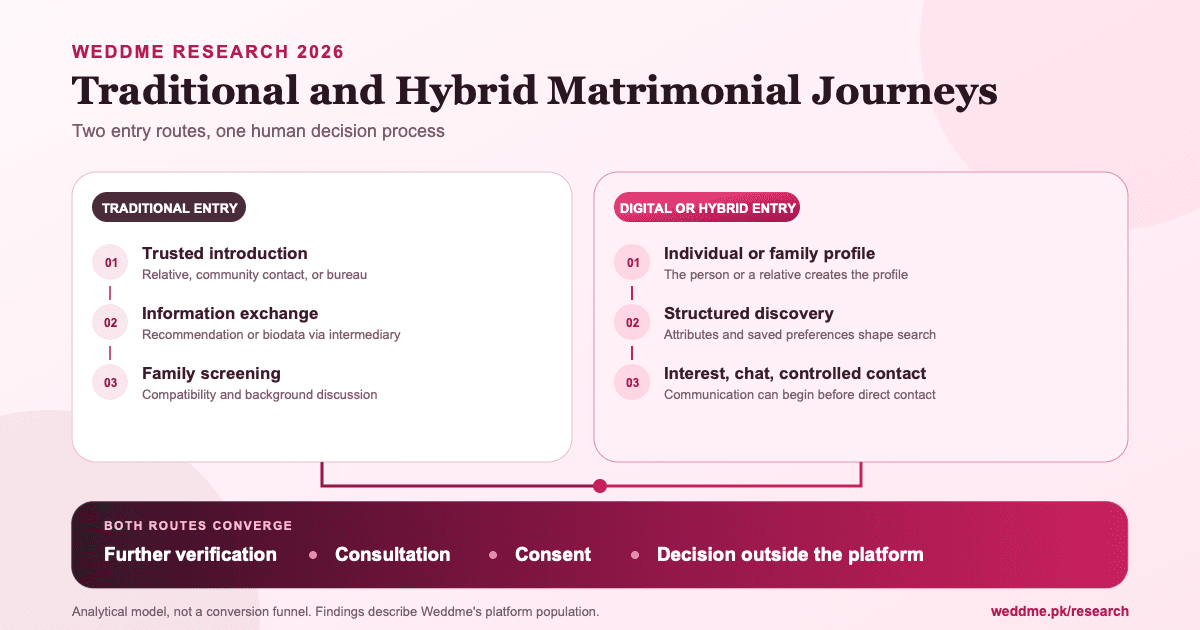
Traditional and hybrid matrimonial journeys
Digital search creates another route into the rishta process. Both routes still converge around verification, consultation, consent, and a decision outside the platform.
1. Executive Summary
Pakistan's matrimonial process has long depended on relatives, community networks, personal introductions, marriage bureaus, and meetings between families. Digital platforms are adding another route into that process. The central question is therefore not whether technology has replaced the traditional rishta journey. The more useful question is how search, participation, privacy, and communication change when part of the journey moves online.
This report combines national digital indicators from the Pakistan Bureau of Statistics, ITU, GSMA, DataReportal, and the World Bank with an analysis of how digital matrimonial services structure discovery and communication. It also draws on Weddme's published research and product experience without disclosing current platform scale, member composition, acquisition, retention, engagement, or conversion metrics.
Five conclusions shape the report.
First, digital matrimony is best understood as a hybrid journey. Technology can widen discovery and organize information, while personal judgment, family consultation, independent verification, meetings, consent, and the final decision remain human and often offline.
Second, family participation does not disappear when rishta search moves online. A digital profile may be created or managed by the person represented, a parent, a sibling, or another trusted relative. Platforms should make that representation clear without assuming that a manager controls every decision.
Third, digital services separate stages that traditional introductions may combine. Profile discovery, saved criteria, an interest signal, in-platform communication, direct contact, family discussion, and offline meetings can happen at different times. This gives people more control over sequence, but also introduces new moments of friction and misunderstanding.
Fourth, privacy is layered rather than simply public or private. A person may be comfortable showing selected profile information while keeping photos or direct contact restricted. Product controls can support that choice, but they cannot prevent screenshots, copied information, voluntary disclosure, or risk after a conversation moves elsewhere.
Fifth, trust is a process rather than a badge. Email or phone checks can confirm control of a channel; they cannot prove every biographical claim, intention, family statement, or offline identity. Responsible platforms should combine proportionate checks with moderation, reporting, user education, clear representation, and reminders about independent due diligence.
Pakistan's connectivity has created room for digital matrimonial services, but access remains unequal. Affordability, digital skills, regular internet use, gender gaps, language, trust, and urban-rural differences all shape who can participate. Digital matrimony should therefore be described as an emerging option within Pakistan's wider rishta landscape, not as a universal replacement for traditional routes.
2. Introduction
The traditional rishta journey is not a single standardized process. It can begin with a relative, a family friend, a community introduction, a marriage bureau, or a prospective spouse. Information may pass through several people before two individuals speak directly. Families may verify education, employment, household background, or reputation through their own networks. Meetings, consultation, and consent take place offline. The sequence varies by household, city, community, and individual preference.
Digital platforms do not enter an empty space. They enter this existing system of relationships and expectations. Their first effect is often practical: information that once travelled through phone calls, handwritten profiles, personal visits, or informal messages can be represented in searchable fields. A member can discover profiles beyond an immediate circle, apply structured criteria, and communicate without beginning with a physical visit. A parent or sibling may also perform some of those actions.
That creates a hybrid rather than a clean replacement. A profile can be discovered online and discussed offline. A sibling can manage the first stage while the person represented participates later. A member can share selected profile details while withholding direct contact information. An online conversation can lead to family involvement, external verification, or no further action. The decisive steps still depend on people, not on the interface alone.
This report focuses on that transition. It asks what digital product design and public evidence reveal about discovery, family participation, communication, trust, and privacy. It does not publish Weddme's current operational performance or platform-composition metrics, and it does not measure successful matches, engagements, or marriages.
The analysis complements the earlier Pakistan Matrimonial Trends Report 2026, which documented a frozen platform cohort and stated partner preferences. This report has a different purpose: it explains the changing journey without turning commercially sensitive operating data into public benchmarks.
3. Why Digital Matrimony Matters
Matrimonial search is a consequential information problem. A family or individual may want to consider age, education, marital history, profession, location, family circumstances, and other factors while protecting sensitive information and avoiding inappropriate contact. Traditional networks can provide context and social accountability, but their reach is bounded by who knows whom. Digital systems can widen that reach and make comparison more structured, but they also introduce new questions about identity, privacy, representation, and safety.
Three forms of change matter.
The first is a change in reach. Digital discovery can expose a profile to people outside an immediate family or community network. That capability does not prove that every member encounters genuinely new possibilities, nor does it show that more exposure creates better outcomes.
The second is a change in information structure. A traditional introduction may arrive as a narrative, a short biodata document, or a recommendation. A digital profile converts parts of that narrative into standardized attributes and preferences. This can reduce repeated information exchange, but it can also make a person appear more reducible to filters than they really are.
The third is a change in control over sequence. Discovery, contact access, chat, family discussion, verification, and meetings do not have to occur at once. A member may browse first, later express interest, communicate within the platform, and disclose direct contact only when ready. This staged path can reduce some early friction. It can also create new points of abandonment, misunderstanding, or misuse.
Digital matrimony matters because it reorganizes these stages. The platform does not decide whom a member should marry. It changes how a possible match becomes visible, how information is filtered, who can participate at each step, and when communication moves beyond the platform.
4. Pakistan's Digital Landscape
Pakistan has a large connected population, but national connectivity statistics do not describe universal or equal use. DataReportal's Digital 2026: Pakistan estimated 117 million internet users in October 2025, equivalent to 45.6% of the population, while also estimating that 139 million people remained offline. The same source reported 79.9 million social media user identities, but correctly cautioned that such identities do not necessarily represent unique individuals. These figures establish scale, not readiness to use a matrimonial service.
The ITU Pakistan dashboard reported 55.1 active mobile-broadband subscriptions per 100 people in Pakistan in 2024 and 81% population coverage for both at least 3G and LTE/WiMAX networks. A subscription is not the same as a unique person, and network coverage is not the same as regular use.
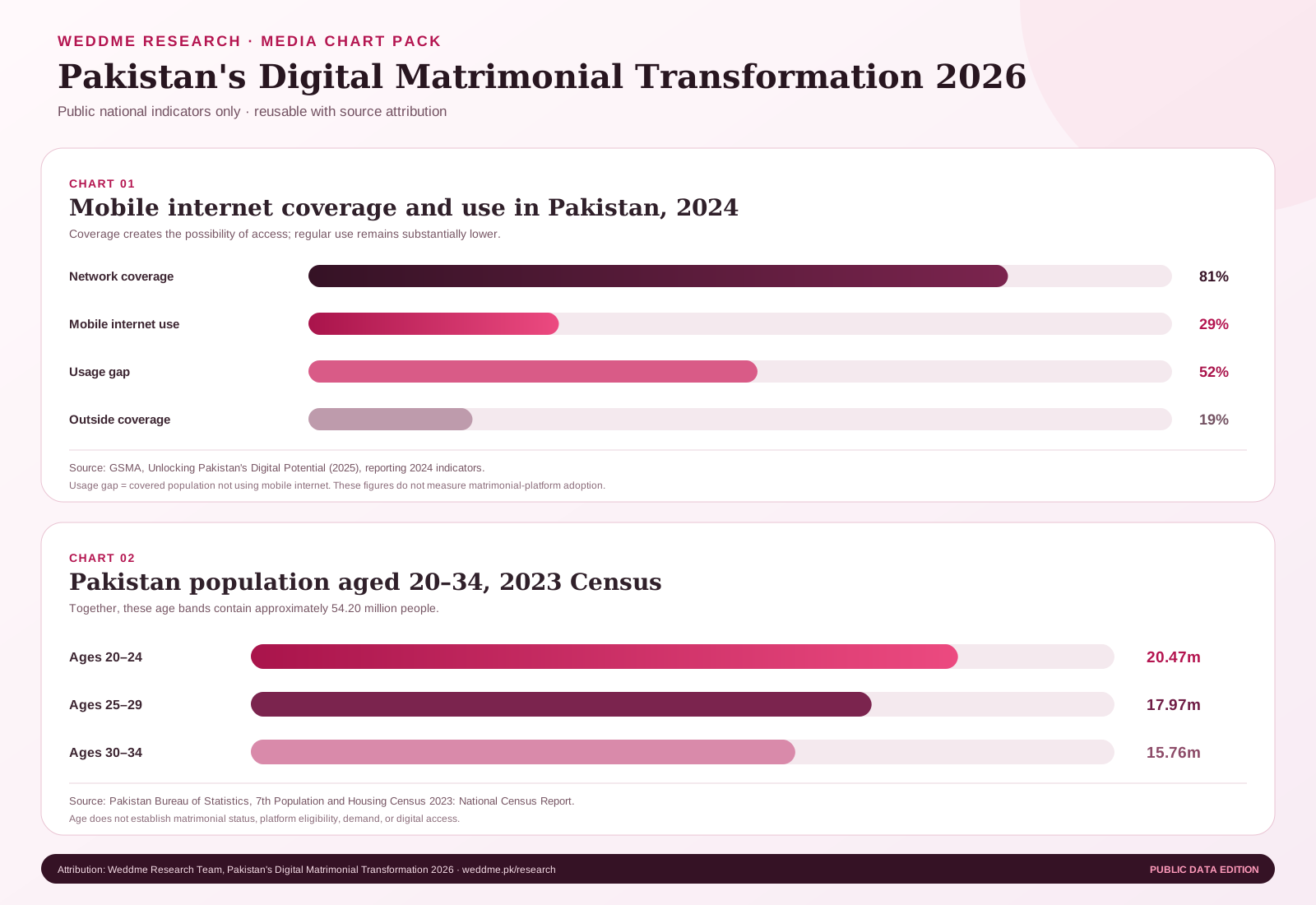
GSMA's 2025 Pakistan analysis makes that distinction explicit: it estimated that 29% of the total population used mobile internet in 2024, despite 81% coverage. Its analysis points to an important usage gap between the availability of a network and people's ability or willingness to use mobile internet regularly.
4.1 Coverage does not guarantee regular use
Mobile internet coverage and use in Pakistan, 2024
| Mobile internet measure | Share of population |
|---|---|
| Mobile internet network coverage | 81% |
| Mobile internet use | 29% |
| Usage gap within covered population | 52% |
| Population outside coverage | 19% |
External source note: GSMA, Unlocking Pakistan's Digital Potential (2025), reporting indicators for 2024. The usage gap is the difference between network coverage and mobile internet use; the coverage gap is the remaining population outside mobile internet coverage. These measures describe national digital access, not matrimonial-platform adoption.
The World Bank's April 2025 Pakistan Development Update similarly described a gap between access and use. Drawing on GSMA survey evidence, it reported higher mobile ownership and regular use in urban areas than rural areas. It also identified affordability, literacy, skills, and social norms as barriers, including substantial gender gaps in phone ownership and mobile internet adoption.
Pakistan also has a large young-adult population. The Pakistan Bureau of Statistics 2023 Census recorded approximately 20.47 million people aged 20 to 24, 17.97 million aged 25 to 29, and 15.76 million aged 30 to 34. Together, those age groups contained about 54.20 million people, or 22.5% of the census population. This does not establish demand for digital matrimony. It shows the demographic scale of life stages in which education, employment, family formation, and marriage decisions often become relevant.
4.2 The young-adult population provides demographic context
Pakistan population aged 20–34, 2023 Census
| Age group | Population (millions) |
|---|---|
| 20–24 | 20.47 |
| 25–29 | 17.97 |
| 30–34 | 15.76 |
External source note: Pakistan Bureau of Statistics, 7th Population and Housing Census 2023: National Census Report. The three age groups total approximately 54.20 million people. Age does not establish matrimonial status, platform eligibility, demand, or digital access.
The national context supports two measured conclusions. Pakistan has enough connectivity for large digital services to emerge, and access remains uneven enough that users of any one service will be selective rather than nationally representative. National connectivity figures cannot reveal how many Pakistanis use online matrimonial platforms, why they use them, or whether they prefer them to traditional routes.
External source note: DataReportal, Digital 2026: Pakistan (October 2025 indicators); ITU DataHub, Pakistan dashboard (2024 indicators); GSMA, Unlocking Pakistan's Digital Potential (2025 report using 2024 indicators); World Bank, Pakistan Development Update: Reimagining a Digital Pakistan (April 2025); Pakistan Bureau of Statistics, 7th Population and Housing Census 2023. Definitions and reference years differ and should not be combined into a single adoption rate.
5. The Traditional Rishta Journey
For this report, the traditional journey is treated as an analytical model, not a universal description of every Pakistani household. Its common stages can be represented as follows:
- A person or family signals that they are open to a proposal.
- Relatives, friends, community contacts, or a marriage bureau identify possibilities.
- Basic information is exchanged through a trusted intermediary.
- Families or individuals screen for broad compatibility.
- Background claims are checked through personal networks or documents.
- The people represented speak or meet, often with family knowledge or participation.
- Both sides consult, continue, or decline.
- A decision is made outside the discovery channel.
The strength of this system is contextual knowledge. A trusted intermediary may know a household, its reputation, or the history behind a short profile. Its limitation is bounded reach and inconsistent information. Different intermediaries may describe the same fact differently, and sensitive details may circulate without a clear record of who received them.
Traditional and family-arranged processes should not be confused with forced marriage. Peer-reviewed research on educated women from rural and low-income Pakistani communities has emphasized that family arrangement can coexist with individual consent and choice. The degree of participation and power still varies, which is why a digital system should make the person represented, the manager, and the communication pathway as clear as possible.
The traditional process also contains forms of verification that a platform cannot reproduce fully. A verification badge can confirm a platform event, such as control of an email address or phone number. It cannot verify every biographical statement, family claim, intention, or offline interaction. Digital verification therefore supplements rather than replaces personal due diligence.
6. The Emerging Digital Journey
The emerging journey retains many traditional stages but changes their order, scale, and interface.
Traditional and hybrid matrimonial journeys
Digital search adds a second route into a process that still relies on human judgment, consultation, consent, and offline verification.
Traditional entry
- Trusted introduction
Relative, community contact, or marriage bureau
- Information exchange
A recommendation or biodata moves through an intermediary
- Family screening
Broad compatibility and background are discussed
- Conversation or meeting
People and families decide whether to continue
Digital or hybrid entry
- Individual or family profile
The person represented or a relative creates the profile
- Structured discovery
Attributes and saved preferences organize the search
- Interest or in-platform chat
Communication can begin before contact details are shared
- Controlled contact
Visibility and contact access can be handled separately
The diagram is deliberately not a funnel. A family may create the profile at the beginning or become involved later. A member may communicate before revealing contact details. An introduction may start offline and use the platform only to exchange structured information. Some journeys stop after a profile view; others move between online and offline channels several times.
Technology changes search by making profiles retrievable beyond an immediate referral chain. It changes filtering by converting criteria into saved selections. It changes timing because discovery and initial communication can be asynchronous. It changes privacy by allowing different categories of information to have different visibility. It changes family participation by giving a relative a formal role. It changes communication by creating an in-platform stage before direct contact or a meeting.
What remains unchanged is equally important. A profile is still a representation, not a complete person. Compatibility remains interpretive. Identity and background require judgment beyond a database field. Families and individuals still negotiate expectations. Consent and the final decision remain outside the matching interface. No responsible analysis should describe a profile view, interest, chat, or reply as a successful matrimonial outcome.
7. How Platform Design Reflects This Transition
7.1 Structured discovery creates a new starting point
Digital profiles allow information to be presented consistently enough to search and compare. Age, location, education, profession, marital history, family details, and partner preferences can become part of a structured discovery process. This makes the starting point more legible, but does not establish compatibility or truth by itself.
A good product should explain what each field means, avoid presenting sensitive categories as measures of popularity, and remind members that filters are screening aids rather than judgments of human worth. Optional context and profile narratives remain important because structured fields cannot capture priorities, personality, family circumstances, or willingness to compromise.
7.2 Participation can move between web, mobile, and offline settings
A matrimonial journey may begin on a website, continue on a mobile application, move to an in-platform conversation, and later continue through family calls or meetings. Supporting more than one digital surface can improve convenience, but product availability does not establish equal access. Device cost, connectivity, language, digital confidence, disability, household norms, and privacy at home can all affect participation.
Platforms should therefore design for continuity and clarity rather than assuming that every member follows one channel. Safety information, account controls, profile status, and representation labels should remain understandable wherever the member participates.
7.3 Communication introduces possibility, not reciprocity
Digital communication can create an earlier direct-contact stage, but reach does not guarantee attention or mutual interest. A member may receive no reply for many ordinary reasons. A reply may be a question, a decline, a safety concern, or the start of a substantive conversation. Message counts alone cannot distinguish these outcomes.
This has design implications. Platforms should discourage bulk or repetitive outreach, make respectful decline possible, provide blocking and reporting tools, and avoid framing every interaction as progress toward a match. Members should also be prepared for non-response without treating it as proof of wrongdoing.
7.4 The platform's visibility ends before the human outcome
A digital service can observe activity that happens within its own interfaces. It may not know whether members continued on another channel, met safely, involved their families, ended contact, became engaged, or married. Any claim about successful outcomes requires a separate, consent-based method rather than an inference from clicks or chats.
That boundary is essential. Product analytics can improve an interface, but they should not be confused with evidence about relationship quality, consent, compatibility, or long-term success.
8. Family Participation in Digital Matrimony
Family participation has not disappeared from digital rishta search. It has entered the profile itself.
Weddme Research, 2026
Family participation is one of the clearest points of continuity between traditional and digital matrimonial search. Weddme's account model allows a profile to distinguish the person represented from a parent, sibling, guardian, or other manager. The earlier Pakistan Matrimonial Trends Report 2026 documented family-managed profiles within its frozen research cohort; this report does not republish or update those counts.
A manager relationship should be interpreted carefully. It identifies who is recorded as managing the digital profile. It does not establish who completes every action, who controls decisions, whether the represented person has less autonomy, or whether family participation is absent from a self-managed profile.
The important transformation is institutional. Traditional family participation can be represented inside the account structure rather than existing only as an invisible offline arrangement. This creates responsibilities for platforms:
- identify the person represented and the manager relationship clearly;
- make changes of manager or account control understandable;
- avoid assuming consent from the existence of a profile;
- provide safety and reporting guidance for both individual and family users;
- ensure that the represented person's wishes remain central; and
- make the transition from family-managed discovery to direct participation explicit when appropriate.
Family involvement can provide context, practical help, and continuity with familiar social processes. It can also create ambiguity about who is speaking. Good design should support collaboration while making representation and consent more—not less—visible.
9. Trust, Privacy, and Verification
Trust in digital matrimony is a sequence of checks and human decisions, not a single badge.
Weddme Research, 2026
Trust in a matrimonial process has several layers. A member may ask whether a profile is genuine, whether biographical claims are accurate, whether contact details will remain controlled, whether a conversation is safe, and whether the other side is serious. No single platform field answers all of those questions.
9.1 Privacy should be staged and understandable
Profile information does not have to be either entirely public or entirely hidden. A service can separate basic profile visibility, photo access, direct contact details, and communication permissions. This allows discovery to begin without requiring every sensitive detail to be disclosed at the same time.
Settings should use plain language and make their audience clear. Defaults should be conservative, especially for photos and contact details. Members should be able to review and change their choices, understand when information becomes visible, and receive warnings before moving a conversation outside platform controls.
Privacy settings do not remove risk. Publicly visible information can be copied or misrepresented. Restricted information can be shared voluntarily. Screenshots and external messages can move data beyond the platform. Controls work best when paired with reporting tools, moderation, user education, clear manager labels, and offline caution.
9.2 Verification confirms an event, not a whole person
Email and phone verification can establish that someone controlled a particular channel at a particular time. Stronger identity checks may establish more, but they also create tradeoffs involving privacy, document access, false rejection, data retention, and security.
A platform should describe each verification level precisely. It should not let a channel check imply that education, employment, marital history, family background, intentions, or all profile details have been independently confirmed. Members must still verify important claims personally and involve trusted people where appropriate.
9.3 Trust is a sequence, not a badge
The digital matrimonial trust sequence contains several distinct tasks:
- Platform legitimacy: Is the service functioning, moderated, and understandable?
- Account legitimacy: Has the member completed the checks the platform actually offers?
- Representation clarity: Is the profile self-managed or managed by a relative?
- Information assessment: Are claims complete enough to evaluate and verify?
- Communication safety: Can the parties speak without premature exposure of contact details?
- External due diligence: Can identities, families, circumstances, and intentions be checked outside the platform?
- Consent and decision: Do the people represented freely choose whether to continue?
A digital platform can support the first five and provide guidance for the sixth. It cannot substitute for the seventh.
10. Urban Adoption Patterns
National evidence consistently shows that digital access and regular use differ between urban and rural Pakistan. Connectivity, affordability, smartphone access, literacy, language, privacy within the household, and social norms can all influence whether a person can use an online matrimonial service.
Platform activity should not be used to compare matrimonial demand between cities. A service's geographic footprint can reflect launch choices, marketing, referrals, moderation coverage, language, connectivity, and product awareness as much as underlying interest. Low representation in an area is not evidence that people there reject digital matrimony.
Responsible geographic research should compare platform evidence with population and connectivity benchmarks, use stable observation periods, suppress small groups, and distinguish a service's reach from a city's demand. Until those conditions are met, national and regional public sources provide more appropriate context than a current operational city breakdown.
The practical product lesson is inclusion. Services should test lower-bandwidth experiences, accessible language, clear guidance, flexible verification pathways, and support that does not assume high digital confidence. Expansion should be evaluated by who can participate safely, not only by where accounts appear.
11. Benefits and Remaining Challenges
11.1 Potential benefits
Wider discovery. Searchable profiles can extend consideration beyond an immediate referral network. Wider availability does not guarantee suitability or better outcomes.
More structured comparison. Standardized fields can reduce repeated information exchange and make criteria explicit. They can also encourage overly mechanical screening if context is lost.
A formal place for family collaboration. Manager roles can bring parents, siblings, guardians, and others into the platform transparently rather than leaving their participation invisible.
Staged privacy. Separate controls for profile information, photos, contact details, and communication can give members intermediate steps before direct disclosure.
In-platform communication. An internal conversation can postpone the need to move immediately to a phone number or external service. It does not guarantee safety, seriousness, or reciprocity.
Access through more than one surface. Web and mobile interfaces can accommodate different circumstances, provided that key safety and account controls remain consistent.
11.2 Remaining challenges
Unequal digital access. Pakistan's coverage, ownership, affordability, and usage gaps exclude many people before profile creation begins. Gender and urban-rural differences are especially relevant.
Trust cannot be fully automated. Technical checks are useful but limited. Stronger identity processes can reduce some risks while creating cost, privacy, access, and error tradeoffs.
The person and manager may differ. Family collaboration can be appropriate and desired, but representation should remain clear and consent should never be assumed.
Attention is uneven. Greater reach can make non-response, rejection, and repeated outreach more visible. Interface design should discourage spam-like behavior while allowing respectful choice.
Information can become reductive. A person cannot be fully represented by age bands, education levels, locations, professions, or community fields.
Privacy controls have limits. Screenshots, copied text, external messages, and offline disclosure can move information beyond platform controls.
Use is not an outcome. Registration, profile activity, interest, and chat do not establish that a suitable relationship, engagement, marriage, or safe outcome followed.
12. Future Outlook
A platform can widen discovery and structure the first conversation. It cannot make the final decision.
Weddme Research, 2026
The future of digital matrimony in Pakistan is likely to remain hybrid. Connectivity can expand and product design can improve, but family structures and offline decision-making will not disappear simply because profiles become searchable. Development and research should support transitions between stages rather than assume a fully individual, app-only journey.
Several areas deserve careful investigation.
Clearer collaborative roles. Platforms can distinguish the person represented from a parent, sibling, guardian, or other manager and make handoffs explicit. Future research could examine whether manager transparency affects trust or safety without exposing individual identities or proprietary performance metrics.
Verification with proportionality. Stronger checks may improve confidence, but a system should collect only what is necessary, protect it carefully, and offer accessible alternatives when a member lacks a particular document or device.
Privacy-preserving communication. Controlled contact exchange, in-platform calling, abuse reporting, and limits on bulk outreach may make early communication safer. Safety interventions should be evaluated for actual harm reduction and unintended exclusion.
AI-assisted quality and safety. AI may help detect duplicate content, suspicious patterns, abusive messages, or incomplete profiles. It should not make unreviewable judgments about marital suitability or infer sensitive traits. Human review, appeal pathways, privacy safeguards, bias testing, and clear disclosure are necessary.
Outcome-aware research. The most important missing evidence concerns what happens after platform interaction. Voluntary, privacy-preserving follow-up could distinguish no response, respectful decline, continuing conversation, family meeting, engagement, marriage, and safety incidents. Such work requires explicit consent and careful retention limits.
Better geographic inclusion. Future work should investigate language, device, disability, affordability, and digital-literacy barriers rather than reading low representation as low interest.
Longitudinal evidence. Public benchmarks should use stable definitions over time and separate product instrumentation changes from genuine behavioral change. Commercially sensitive operational measures can remain internal while carefully selected, privacy-preserving research findings are published when mature.
13. Limitations
-
This is not a national survey. The report synthesizes public national indicators and an analytical model of digital matrimonial design. It does not estimate the share of Pakistanis using matrimonial platforms or generalize one service's users to the country.
-
No platform performance benchmark is published. Current Weddme scale, composition, acquisition, retention, engagement, communication, verification-rate, city-distribution, and conversion figures are intentionally outside the public scope.
-
Product capability is not user behavior. Describing a search, privacy, manager, verification, or communication feature does not show how often members use it or why they make a particular choice.
-
No causal design. The report does not estimate the causal effect of technology on marriage practices, trust, family participation, safety, or outcomes.
-
No message-content analysis. The report does not read, classify, or quote private member communications.
-
No offline outcome data. The analysis does not measure meetings, family approval, engagement, marriage, relationship quality, or safety after people leave the platform.
-
Manager does not equal authority. A recorded manager relationship cannot establish who controls decisions or whether family participation also occurs around a self-managed profile.
-
External indicators differ. Internet users, mobile-internet users, network coverage, subscriptions, social-media identities, and population age groups have different definitions and reference years.
-
Traditional journeys vary. The journey model is illustrative. Household, community, regional, and individual processes may follow a different order or use different intermediaries.
-
Technology changes. Product features, public infrastructure, and patterns of use evolve. This report describes principles and current public context rather than a permanent market state.
14. Methodology
14.1 Research objective
The report asks how Pakistan's traditional matrimonial process may change when digital platforms become part of discovery and communication. The analysis identifies mechanisms, design choices, benefits, risks, and evidence gaps. It does not estimate market size, platform growth, or business performance.
14.2 Evidence used
The public quantitative context comes from the Pakistan Bureau of Statistics, ITU, GSMA, DataReportal, and the World Bank. The report also uses peer-reviewed research on family arrangement and consent, Weddme's documented product model, and the previously published Pakistan Matrimonial Trends Report 2026.
Internal aggregate analysis informed the editorial questions considered during development, but current operational figures are excluded from this public edition. No public statistical claim depends on an undisclosed internal denominator.
14.3 Analytical framework
The report compares two illustrative entry routes: a traditional route through relatives, community contacts, or bureaus, and a digital or hybrid route through an individual- or family-managed profile. Both routes converge around further verification, consultation, consent, and a decision outside the discovery service.
The framework evaluates six dimensions:
- discovery reach;
- information structure;
- family participation and representation;
- privacy and sequence control;
- communication and reciprocity; and
- the boundary between platform activity and offline outcomes.
14.4 Privacy and commercial safeguards
The public edition contains no names, contact details, biographies, messages, account identifiers, individual records, small-group breakdowns, or current operational dashboards. It also withholds business-sensitive measures that could reveal platform scale, acquisition patterns, retention, engagement, communication performance, verification rates, demographic balance, or geographic concentration.
These exclusions are not presented as redacted findings. The report avoids quantitative claims that would require the withheld values and instead limits its conclusions to public evidence, product mechanisms, prior published research, and clearly labeled analytical interpretation.
14.5 Source handling
External indicators were checked against their publication date, reference year, and definition. Figures from different sources are not combined into a single adoption or market-size estimate. National connectivity evidence is used for context, not as a proxy for matrimonial-platform demand.
14.6 Revision policy
Material factual corrections, source changes, or methodology revisions will be dated on this page. Future editions may add carefully selected platform findings when the evidence is mature, the definitions are stable, privacy risk is low, and publication does not expose commercially sensitive operating information.
15. References
Weddme Research
- Weddme Research Team. (2026). Pakistan Matrimonial Trends Report 2026.
- Weddme Research. Product and safety documentation reviewed for this report, including How Weddme Works and Safety Guidance.
External references
- DataReportal. (2026). Digital 2026: Pakistan. Published with indicators primarily referring to October 2025.
- GSMA. (2025). Unlocking Pakistan's Digital Potential: Reform, Trust, and Opportunity.
- International Telecommunication Union. Pakistan Digital Development Dashboard. Indicators cited for 2024.
- Pakistan Bureau of Statistics. (2025 release). 7th Population and Housing Census 2023: National Census Report.
- World Bank. (2025). Pakistan Development Update: Reimagining a Digital Pakistan.
- Zubair, S. (2020). “Love marriage or arranged marriage? Choice, rights, and empowerment for educated Muslim women from rural and low-income Pakistani communities.” Compare: A Journal of Comparative and International Education, 50(1), 90-106.
Suggested citation
Weddme Research Team. (2026). Pakistan's Digital Matrimonial Transformation 2026: How Technology Is Reshaping Pakistan's Traditional Rishta Journey. Weddme Research & Insights. https://weddme.pk/research/pakistan-digital-matrimonial-transformation-2026
Describe this publication as an evidence-and-design report, not as a national survey, market-size estimate, or disclosure of Weddme's current operating performance.
Reporting resources
Journalists, editors, and researchers can download the public summary or request methodology clarification and an attributed comment. Please include the topic and publication deadline.