How to Run a Rishta Search on Weddme: A Family-to-Family Guide
Weddme rishta search guide: build a trustworthy profile, shortlist with filters, compare candidates, and reach a first family conversation, no middleman.
The bureau's office smelled of stale tea and old files. My father had just handed over another PKR 5,000 advance, the third that month, and the proposals that came back were still wrong: wrong city, wrong sect, a boy who had never even seen the profile we wrote.
That afternoon I stopped counting what we had spent across five bureaus and started counting what we had actually received: mismatched callbacks and a growing pile of receipts, somewhere in the PKR 75,000 to 150,000 range before a single serious conversation.
The method was broken, not the search.
- Weddme is a direct, family-to-family platform: no middleman, no marriage commission, and the final decision always stays with the families.
- A trustworthy, complete profile is the single biggest factor in getting serious, relevant proposals rather than being ignored or filtered out.
- Shortlisting is a skill: use filters and comparison deliberately, and involve parents and guardians in the decision, not just the individual.
- Safety is a process, not a setting: control photos and personal details, verify information independently, and move to contact only when both families are comfortable.
- Weddme gives your family a clear, private, organized way to find and evaluate the right candidates yourselves.
This guide walks your family through the entire Weddme process in order: building a profile that earns trust, shortlisting with discipline, comparing candidates side by side, and safely reaching a first family conversation. No middleman. No advance fee. No success commission. Weddme charges none of these; families discover and message each other directly, and the decision stays where it belongs, with you.
By the end, you will know how to run a rishta search the way a careful family should: deliberately, privately, and without paying a middleman for the privilege.
The next section explains what Weddme actually is and why its model differs from the bureau you already know.
What Weddme Is and Why It Works Differently
The frustration described in the introduction has a structural cause: the bureau model. Here is what Weddme replaces it with.
Weddme is a direct family-to-family matrimonial platform, and its purpose is to give families a private space to run their own search. No broker, no bureau, no middleman. Families discover and message each other directly, and Weddme charges no pre-marriage fee, no post-marriage fee, and no success commission.
The traditional bureau model quietly adds up. Weddme's published comparison puts the cost at PKR 75,000 to 150,000 or more, built from advance search fees and a commission after the match. Weddme starts free and has no outcome-based payment. That is the no-commission difference.
Time works differently too. A bureau search often means 6 to 18 months of follow-ups. On Weddme, families can start shortlisting the same day. Family decisions still take time, but the waiting for callbacks disappears.
| Traditional bureau flow | Weddme flow |
| Pay advance search fee | Create a profile |
| Wait for bureau callbacks | Search and filter profiles yourself |
| Pay commission after match | Message families directly |
| Middleman controls the pace | No commission, family controls the pace |
Removing the broker doesn't remove the waiting. We assumed the no-commission model would speed everything up, but the real bottleneck turned out to be our own family conversations. The platform let us shortlist the same day, yet each candidate still needed a week of discussion before anyone would agree to message. The design choice is honest: Weddme removes the middleman and the fees, not the deliberation. That is exactly why the method in this guide matters more than the platform's speed.
Now that the model is clear, walk through the actual search flow step by step.
How the Weddme Search Works, Step by Step
With the model clear, here is the whole journey in order, so you can see where each later section fits.
- Sign up. Create the family account. It takes minutes and costs nothing.
- Build the profile. This is where seriousness shows. A complete profile gets read; a thin one gets skipped.
- Search and filter. See candidates immediately and compare them side by side. Why does a bureau search drag on for months? Because every follow-up waits on a callback. On Weddme the comparison sits in front of you the same afternoon, and a family can start shortlisting the same day instead of waiting through six to eighteen months of bureau follow-ups. That speed changes how a family works: you compare first, then decide.
- Shortlist. A deliberate, filtered set. Only profiles the family has actually discussed and agreed to pursue.
- Message. Only after a profile is worth pursuing. No mass outreach, no scattergun requests.
- Family conversation. Both families verify each other, then decide together. This step still takes time, and it should.
The first and most important step is the profile. The next two sections cover it in depth, and the full walkthrough from signup to shortlisting is covered in how Weddme works.
Building a Profile That Earns Trust
The search flow starts with the profile, and the profile is where most families either earn trust or get skipped. A thin profile reads as a family that is not ready to engage. Serious families skip it without a second thought. A complete profile does the opposite: it signals that you have thought through what you want and are prepared to move forward.
Weddme asks for nine fields: age, city, education, profession, marital status, sect, caste or tribe, family background, and lifestyle preferences. Each one answers a question the other family will ask anyway. Filling all of them removes guesswork. The step-by-step guide to creating a complete Weddme profile walks through each field, but the principle is simple: leave nothing blank that you would expect the other family to tell you.
Honesty about sect, caste, and family background matters more than clever wording. These are the fields families verify first, and any exaggeration damages trust the moment it is discovered. A mismatch here is a filter. It saves both sides from an awkward conversation later.
Lifestyle preferences are where many profiles stay vague, and that vagueness costs time. If you have a clear expectation about living arrangements, city, or work after marriage, say so. Nine fields, and I left lifestyle preferences blank on my first attempt. The proposals that came back made me redo it the same evening. A specific answer filters out proposals that do not match. You do not have to clarify each one individually.
Writing a Profile That Represents You Well
A complete profile earns trust; a well-written one earns the right kind of attention. Here is how each side writes it well.
For Men: Profession, Stability, and Family Grounding
A groom-side profile lives or dies on three things: what he does, how settled he is, and where he comes from. Families reading these profiles look for evidence that their daughter will be secure and respected.
State the profession plainly. "Software engineer at a Lahore firm" tells a family more than "works in IT" ever will. Name the sector, the city, and whether the work is permanent or contractual. If he runs a family business, say so and name it.
Stability matters more than income, and families read stability through specifics: how long he has been in the role, whether he owns or rents, whether his parents live nearby.
Family background carries real weight. Mention the father's profession, the mother's role, siblings and what they do. A profile that says "father retired from WAPDA, two brothers, one in Canada" gives a family something to anchor on. One that says "good family" gives them nothing.
I expected the groom-side profiles to be the easy ones, a job title and a photo and done. Seven years of helping families write these has taught me the opposite. The profiles that get serious replies are the ones where the family sat together and wrote the father's posting history, the mother's family name, the brother's degree, the flat in Gulberg. The ones that get skipped are the ones that read like a CV with the family cropped out. That gap, between what I assumed would matter and what actually moves a family to reply, is the whole craft of this section.
Avoid vague claims. "Good family" is the most common phrase on Pakistani rishta profiles and the least informative. Replace it with a concrete detail: "family from Sialkot, father ran a textile unit, mother teaches at a government school." That is a family a reader can picture.
The same goes for "well-settled." Say what that means: owns a home, has a car, has been in the same job for six years. For a fuller treatment of what a groom-side profile should emphasize and the mistakes that sink it, our guide to creating a trustworthy male rishta profile walks through each field.
For Women: Education, Values, and Dignity
A bride-side profile has a different job. It must signal seriousness and character while protecting the family's privacy and the woman's dignity. The balance is delicate, and most families get it wrong in one of two directions: too little, which reads as disinterest, or too much, which reads as desperation.
Education belongs on the profile, stated plainly. "BSc from Kinnaird, currently teaching at a private school" is enough. Values come through in how the family describes her: her role in the household, her relationship with her parents, her involvement in community or religious life. A line like "helps her mother run the home, teaches Quran to younger cousins" tells a family more about her character than any adjective.
Safety and dignity are non-negotiable. Keep the phone number off the profile. Leave the home address off. Post only photos the family would be comfortable sharing beyond the platform. The profile should invite a family conversation through the platform, not around it. A family that respects its own daughter's privacy signals that it will respect a daughter-in-law's too.
The bride-side profiles took me longer to understand. I kept seeing families write "simple girl, good character" and then wonder why serious proposals never came. The families that got replies wrote differently. They named the degree, the city, the father's job, the fact that she prays and teaches her younger siblings. They kept the phone number off and the dignity on. After enough years of watching both versions, the pattern is unmistakable: specificity invites trust, and vagueness invites silence.
For the full picture of what a bride-side profile should include and how to keep it safe and dignified, our guide to creating a safe and complete female rishta profile covers each element in turn.
What Makes a Profile Feel Real
The difference between a profile that gets a family conversation and one that gets skipped is texture, not facts. A real profile has uneven edges: a father's posting in Quetta, a brother studying in Karachi, a mother's family from Peshawar. A generic profile is smooth and empty, full of phrases that could belong to anyone.
Replace "simple girl" with what she actually does. Name the family instead of saying "good family." Describe what "well-settled" looks like. One concrete detail is worth ten adjectives.
With the profile in place, the search itself begins, and filters are the first tool.
Searching and Shortlisting with Filters
The profile is done. Now the family turns to the search itself, and the filters are where discipline starts.
Start with city and age range, then narrow by education, profession, sect, caste, community, and marital status. The discipline of using Weddme search filters for better shortlisting is simple: each filter should remove profiles the family would not seriously consider. The goal is a relevant shortlist, not the largest list.
During the Lahore expansion push last spring, I reviewed roughly forty profiles a month. Families who started with city and age, then layered on sect and education, ended with eight or ten serious candidates. Families who applied every filter at once often ended with two or three, and half of those had incomplete profiles a looser first pass would have caught.
Over-filtering too early hides good candidates. Under-filtering drowns the family in irrelevant proposals.
One filter deserves its own decision: geography. The next section covers it.
Choosing the Right City: Local or Nearby
Filters narrow the list, but one filter, city, shapes everything downstream, from first meetings to family visits. Same-city search keeps first meetings and family visits simple. You can meet a family for tea the same week, and relatives can visit without a long drive. The trade-off is a smaller candidate pool.
Nearby-city search widens the pool while keeping travel manageable. Agree on a travel radius before searching. A two-hour drive is reasonable for most families. A six-hour drive is too far. Treat nearby cities as a deliberate second ring, not an afterthought.
Weddme's city-wise search covers major cities like Lahore, Karachi, Islamabad, Faisalabad, Multan, and Rawalpindi, plus overseas Pakistani families. We were mid-scroll through Karachi profiles when we noticed the city filter also listed overseas Pakistani families, a detail the marketing never mentions.
That inclusion matters for families with relatives abroad or those open to a match from the diaspora. The local-versus-nearby decision is worth thinking through carefully, and the city-wise rishta search guide covers the same trade-offs.
Once the shortlist takes shape, the family decision-making begins, and parents belong at the center of it.
Involving Parents and Guardians in Shortlisting
A shortlist is only as good as the judgment applied to it, and in a rishta search that judgment is a family matter. Parents and guardians are not bystanders watching a profile feed scroll by. They are the ones who know which family histories hold up under scrutiny, which professions fit the household's rhythm, and which small details in a profile signal seriousness rather than casual browsing.
A parent reviewing profiles on a platform works differently from sitting across from a bureau agent who has already decided which three families you should meet. The bureau route hands you a filtered list and asks you to trust the filter. The platform route hands you the raw material and asks you to apply your own method. I watched a father work through a shortlist of twelve profiles one evening. What impressed me was his discipline. He read the family background section first, every time, before he even looked at the photograph. That order of attention is a method, and it is one no middleman can impose on you.
What should a parent look for beyond sect, caste, and family background? Those three fields matter, but they are only a starting point. A profile that matches on all three can still be a poor fit if the family's stated expectations about living arrangements, career plans, or the pace of the process are vague.
Look for specificity. A profile that says "family-oriented" tells you little. One that says the candidate plans to stay in Lahore after marriage and expects the couple to live with the parents for the first year tells you a great deal. Specificity is the difference between a profile written to attract everyone and a profile written to be understood by the right family.
Questions a parent should ask before adding a candidate to the shortlist are different from the questions that belong in the family conversation. Before shortlisting, ask questions you can answer from the profile itself: Is the family's location workable for visits? Does the education and profession align with what your household values? Is the family background described in enough detail to suggest they are serious?
Hold the deeper questions for the family conversation: how the two families would handle disagreements, what the candidate's own plans are, how finances would be arranged. Those belong in the family conversation. Asking them too early, before both families have verified each other, puts the cart before the horse.
Balancing parental authority with the individual's own preferences is where most families stumble. The decision should be family-led. That means the parent's role is to narrow the field with judgment, then bring the individual into the shortlisting conversation before the list is final.
A parent who shortlists alone and presents a finished list has made the decision alone. One who shortlists to a working set of five or six, then sits with the individual to review those profiles together, has kept the decision in the family while respecting that the person who will live the marriage has a voice. The individual may reject a profile the parent liked, and that rejection should be heard and respected.
Respectful shortlisting means reviewing deliberately rather than dismissing on a single field. A profile that is strong on family background but lists a profession your household does not usually consider deserves a second look before it is set aside. One with a photograph that does not impress deserves a read of the written sections before it is dismissed.
Discipline means applying the same standard to every profile. You do not let one field, seen in isolation, end a candidate's chances before the rest of the profile has been read. The families who shortlist well are the ones who can explain, for every profile they rejected, which combination of factors led to the decision.
For parents and guardians who want a fuller treatment of this role, a parent and guardian guide to shortlisting profiles walks through the review priorities in more detail.
With parents involved, the next step is comparing the shortlisted candidates fairly. The section that follows gives a method for weighing education, profession, and family background side by side, so the comparison is structured rather than a gut reaction to whichever profile was opened last.
a parent and guardian guide to covers this in more depth.
Comparing Candidates: Education, Profession, and Family Background
Parents are involved and the shortlist is set. Now the family needs a fair way to compare two or three strong candidates.
Before comparing, write down what your family cannot compromise on: education level, profession stability, family reputation, and values alignment.
Why do families keep circling back to the same candidate? Usually because they compared one dimension at a time. A family I worked with nearly chose a doctor on profession alone, until the comparison sheet showed a values mismatch on how they handle extended family. That one row changed the decision.
Compare all dimensions at once, not one at a time. The trap is comparing only profession, or only education, and letting that single dimension decide. When you weigh comparing education, profession, and family background side by side on a comparison sheet, the choice becomes deliberate rather than impressionistic.
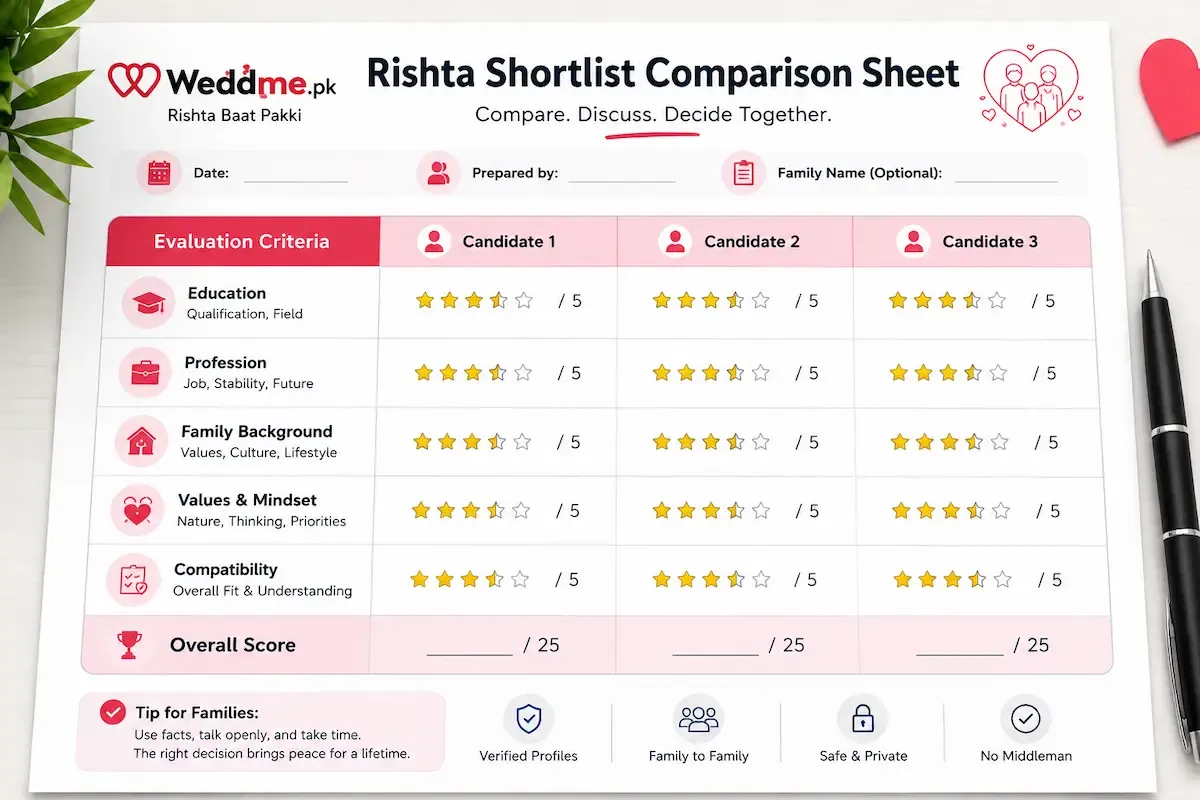
| Candidate | Education | Profession | Family Background | Values/Lifestyle | Notes |
| Candidate 1 | MBBS, reputable medical college | Doctor, stable government post | Known family, good reputation in community | Conservative, family-oriented | Strong on paper; verify values alignment |
| Candidate 2 | MBA, private university | Bank manager, private sector | Family known through mutual contacts | Moderate, open to working wife | Profession stable but values need discussion |
| Candidate 3 | BSc Engineering | Engineer, overseas | Family less known, need verification | Unclear, need more conversation | Strong profession; family background needs checking |
Weigh family background and values as heavily as education and profession. Rishta compatibility is family-to-family, not just person-to-person.
Before any contact happens, the family must handle photos and personal details safely. The next section covers the rules.
Photo and Picture Safety
Comparison done. Before any message is sent, the family must agree on how photos and personal details are handled. This is where trust is protected or lost.
Use a clear, recent photo that shows the face. Nothing in the background should reveal a home address, a school name, or any other identifying detail. Two families, three weeks of back-and-forth, and one photo shared too early taught me the cost of skipping this rule. The photo and picture sharing safety rules on Weddme are simple: keep everything inside the platform until both families have verified each other.
Moving from Shortlist to First Family Conversation
Safety rules are set and the shortlist is final. Now comes the handoff: the search becomes a real conversation between two families.
Send the first message only after both families have completed profiles and appear on each other's shortlist. Ask first about the basics that matter: sect, caste, location, education, family background. Personal details come later.
With safety rules agreed, the family is ready for the step everything has been building toward: the first conversation.
Moving from Shortlist to First Family Conversation
Safety rules are set and the shortlist is final. Now comes the handoff: the search becomes a real conversation between two families.
Send the first message only after both families have completed profiles and appear on each other's shortlist. Ask first about the basics that matter: sect, caste, location, education, family background. Personal details come later.
Keep the exchange respectful. One family speaks at a time. There is no pressure for immediate replies, and no contact information changes hands until both sides agree.
I expected education and sect to drive my shortlist, but location and how a family described their background mattered more in practice. A profile that named the father's profession and the neighborhood told me more than the degree column ever did.
Share contact information only after the initial exchange confirms mutual interest and both families are ready for a phone call or meeting.
The platform supports the search. The final judgment, verification, meetings, and family discussions remain with the people involved.
Even careful families make avoidable mistakes. The next section names the most common ones and how to fix them.
Common Mistakes That Waste a Family's Time
The process is clear, but even well-intentioned families slip. Here are the mistakes that quietly waste weeks.
An incomplete profile is the first one. A family sees a half-filled form and moves on, because they cannot tell who you are or what you want. Complete every field before going live. It is the difference between being shortlisted and being skipped.
Over-filtering is the second. Families set the criteria so tight that only three profiles survive, and none of them fit. Widen the criteria, and weigh family fit alongside education or caste. A good match is rarely the one that ticks every box.
Comparing on one dimension only is the third. Education alone, or caste alone, tells you almost nothing about how two families will actually get along. Put the dimensions side by side before you decide.
Sharing photos too early is the fourth. We sat with a family who sent photos in the first message, then spent two weeks wondering why the other side went quiet. The fix was simple: verify the family first, then share. That one change turned the conversation around, and it cost nothing but patience. Photos are the last step, not the first.
Rushing to contact is the fifth. A profile looks good, so the message goes out the same evening, before anyone else in the family has seen it. Shortlist first, consult the family, then message. One deliberate step beats five hasty ones.
Treating the platform like a bureau is the sixth, and the most common. Families wait for Weddme to bring them a rishta, the way a broker would. It will not, because that is not what it is. Run the method yourself. Weddme is the venue, not the matchmaker.
Unique Content Element
A "before you message" checklist: profile complete, filters set, shortlist compared, family consulted, safety rules agreed.
A few practical questions remain. The FAQ answers them directly.
Conclusion
A family I know spent heavily across five bureaus and still had no shortlist. They moved to Weddme, built one complete profile, and the first family conversation came from their own filtering, not a broker's callback. No commission followed.
The method is simple: complete profile, disciplined shortlisting, structured comparison, verified handoff. No middleman, no success commission.
Create a complete, honest profile first. That step makes every other step work.
Your family's judgment, not a middleman, finds the right match.
Frequently asked questions
Is Weddme free to use?
You start free with a profile and search. Fuller access comes through clear paid plans. Weddme charges no pre-marriage fee, no post-marriage fee, and no success commission.
How do I keep photos and personal details private?
Use the platform's privacy controls. Keep sensitive details inside the platform until both families verify each other. Agree on one trusted point of contact.
Should I search only in my own city or include nearby cities?
It depends on your priorities. Agree on a travel radius first. Treat nearby cities as a deliberate second ring.
What should parents and guardians focus on when shortlisting?
Look beyond the obvious fields to family background, values, and lifestyle preferences. Shortlisting is a family decision that respects the individual's preferences.
How do I compare two or three strong candidates fairly?
Compare on the same dimensions every time: education, profession, family background, values, lifestyle. Avoid weighing only one dimension. A simple comparison sheet keeps the decision deliberate. The answers point back to one starting action. The conclusion names it.
Compare profiles when your family is ready.
Use Weddme search filters to review profiles with clearer context before starting a serious conversation.