Divorce Rate Increase in Pakistan: What the Data Shows and What It Does Not
Is divorce in Pakistan really quadrupling? Headline statistics often lack context, omitting years, denominators, and measurement methods. This guide examines what the 2023 census data actually tells us about marital status in Pakistan, debunks unverified claims of rising divorce rates, and breaks down the main legal routes for dissolution. Whether you are evaluating headline trends or seeking practical advice, explore our guides on Online Rishta Safety and Nikah Law & Legal Documents to make informed, family-first decisions. For more insights on relationships, family life, and navigating major transitions, explore our guides on Planning Your Engagement or browse our expert advice on Wedding Planning Tips. If you are dealing with immediate safety concerns, relationship stress, or need guidance on legal rights, always prioritize verified local support and professional legal counsel before relying on generalized social media claims.
Introduction
You have probably seen the headline: divorce in Pakistan has “quadrupled.” It lands in a family group chat or a social feed, it sounds definitive, and it leaves people arguing about marriage, morals and modern life.
Now look at the claim again. Which years? Quadrupled by what measure? Out of how many people, or how many marriages? When a source gives none of these, the number cannot be checked. It can only be believed or doubted, and neither helps anyone.
This matters beyond statistics. A confident claim about “rising divorce” shapes how relatives talk about a cousin’s separation, how journalists frame a story, and how students cite a figure. Without a denominator, even a true-sounding number can mislead.
This guide offers a clearer reading. You will learn:
- how four different “divorce statistics” differ, and why they should never be swapped;
- what the 2023 census figure (as reported by a secondary source) shows, and what it does not;
- why the “quadrupled” claim should be treated as unverified;
- the main legal routes in plain language, and why individual legal advice matters;
- separate next steps for evidence questions, relationship support, safety concerns and legal advice.
By the end, you should be able to check any divorce-rate claim yourself and decide what kind of help fits your situation. Use the evidence check before you share a headline. And if you, or someone you know, may be in danger, go straight to the safety section below. Safety comes before everything else in this guide.
What a “divorce rate” can mean
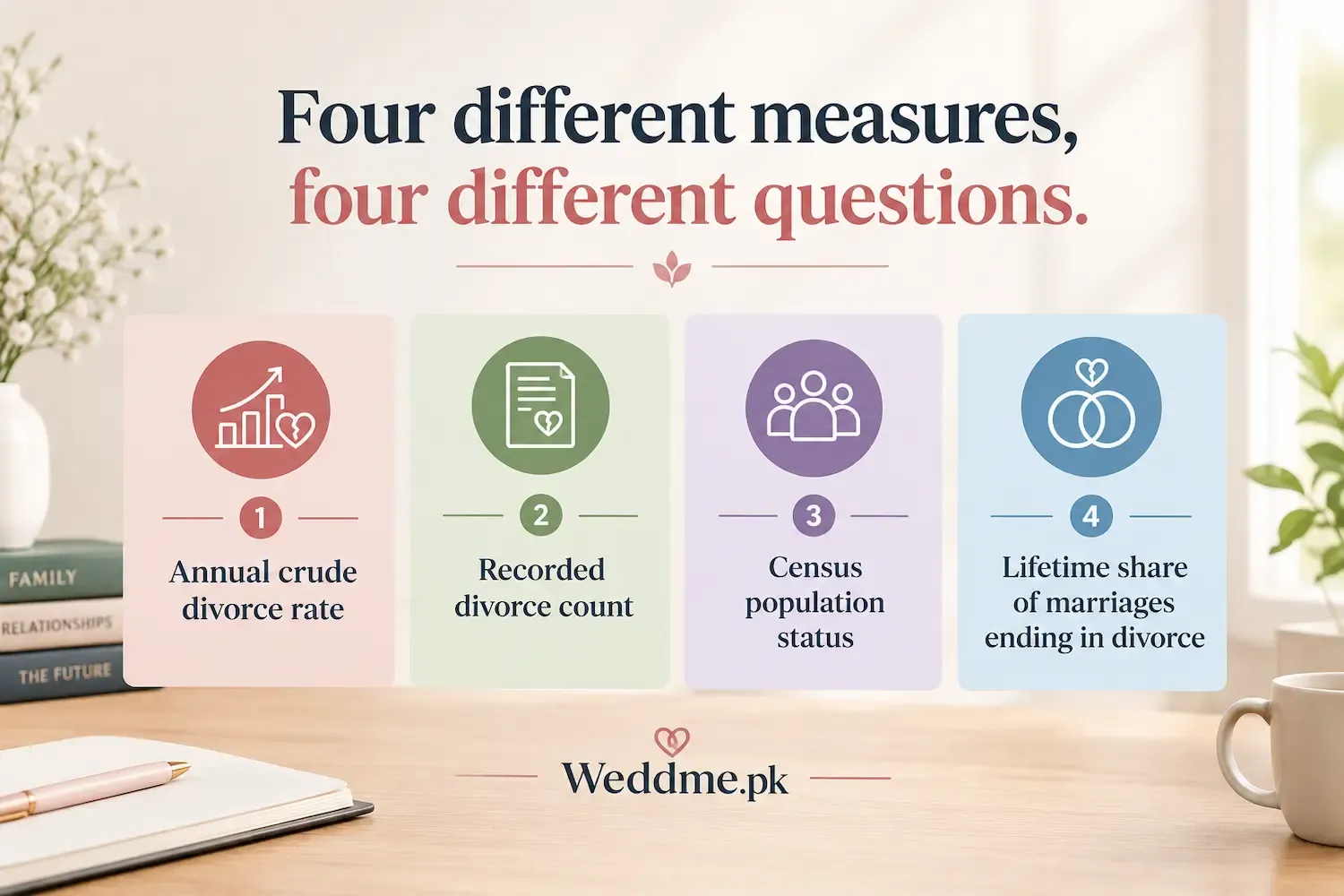
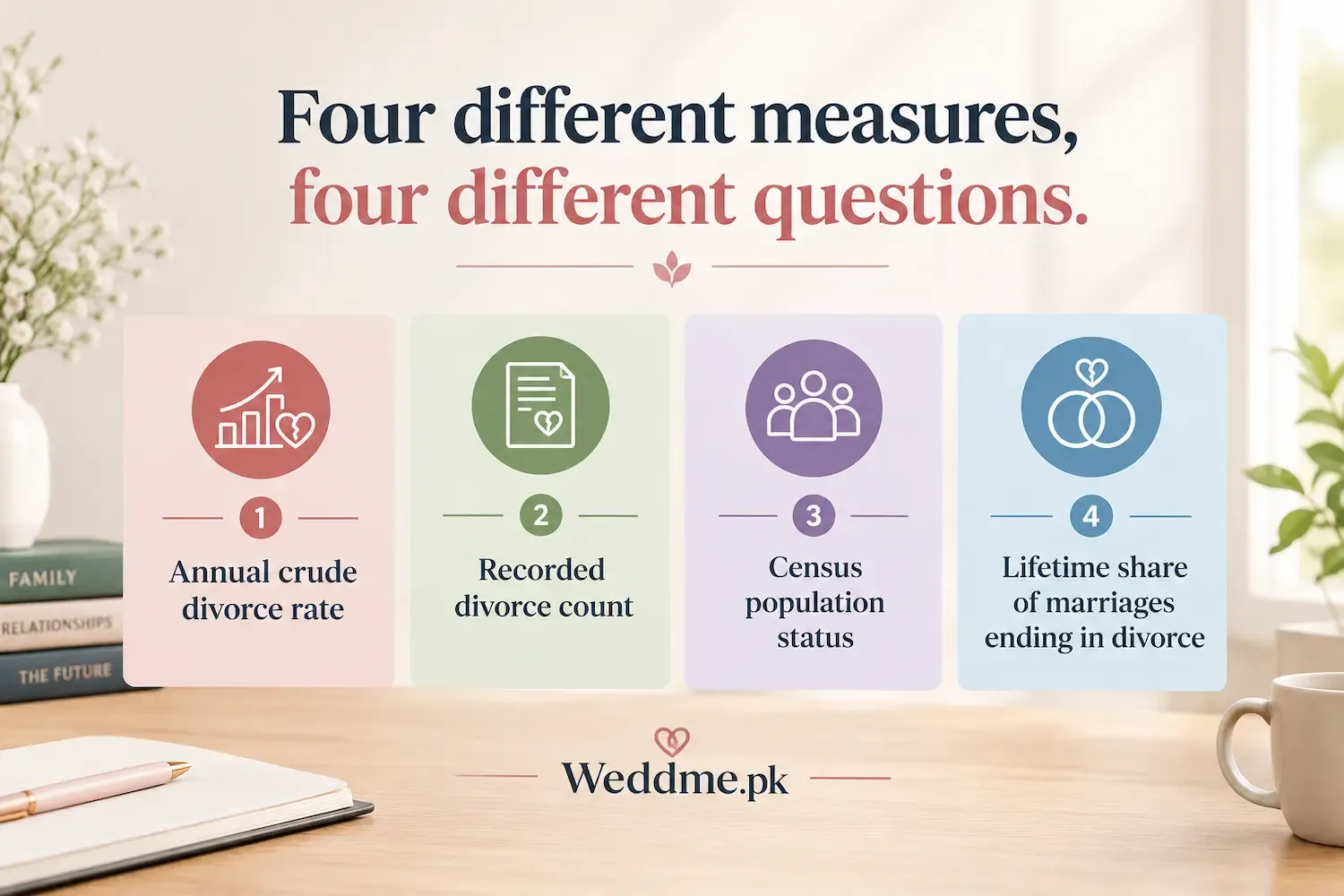
People use “divorce rate” to describe at least four different things. Each answers a different question, which is why a figure from one cannot stand in for another.
Four measures that should not be treated as interchangeable
| Measure | In plain language | The question it answers | What it cannot tell you |
| Annual crude divorce rate | Divorces recorded in a period, relative to the population (usually per 1,000 people) | “How common were recorded divorces this year, given the size of the population?” | Anything about a lifetime outcome, or about a single marriage |
| Recorded divorce count | The number of divorces registered or reported in a period, with no adjustment for population | “How many cases were recorded?” | Whether the likelihood of divorce changed, since population may have grown |
| Census population status | The number or share of people classified as divorced on census day | “What share of people are currently in this status?” | How many divorces happened that year |
| Lifetime share of marriages ending in divorce | An estimate of how many marriages eventually end | “How likely is a marriage to end in divorce over time?” | It cannot be worked out from a census share of people currently divorced |
A few points are worth keeping in mind:
Annual crude divorce rate. Always state the denominator. “4 per 1,000 people” and “4 per 1,000 marriages” are very different statements.
- Recorded divorce count. “Recorded” depends on what is registered or reported, and registration practices can differ between places and over time.
- Census population status. This is a snapshot. A person who divorced years ago and has not remarried may still be counted as divorced, and a person who remarried will not.
- Lifetime share. This needs marriage-cohort and outcome data that follow marriages over time. A snapshot of people currently divorced cannot be turned into this figure.
Definitions, coverage, registration practices and data-collection methods can all change how figures compare over time. A change in how cases are recorded can look like a change in behaviour.
What the reported 2023 census snapshot can, and cannot, tell us
Here is the figure, reported accurately. A secondary-source search-result summary gives the following for the 2023 census, for people aged 15 or older:
| Status | People | Out of | Share |
| Divorced | 499,017 | 142,924,350 | 0.35% |
| Separated | 210,895 | 142,924,350 | 0.15% |
The same summary says separation was newly identified in 2023 and was included in the married category for headline classification.
What do these numbers describe? Population status as reported in a summary. On census day, about 0.35% of people aged 15 or older were classified as divorced, and about 0.15% as separated.
What do they not describe? Three things:
- They are not an annual divorce rate. The 0.35% is a share of people at one moment. It does not say how many divorces occurred in 2023.
- They are not a count of divorces in a year. Nobody can read “499,017” as “499,017 divorces.”
- They are not a lifetime outcome. They do not say what share of marriages eventually end.
A source limitation you should know about
This figure came from a secondary-source search-result summary attributed to Weddme. The underlying Pakistan Bureau of Statistics census table was not available in the material gathered for this article. Until that table is checked, treat the figures as reported, not as independently confirmed. The classification of separated people in particular needs checking against the original table.
Keep the figures attached to the population aged 15 or older, and do not recast 0.35% as an annual rate.
What the available evidence says about an increase
The “quadrupled” claim and its limits
The supplied Dil Ka Rishta article says Pakistan’s divorce rate has quadrupled over the past decade. In the same piece, it says exact numbers are difficult to obtain.
That second point matters. The excerpt gives no underlying dataset, no start and end years, no denominator, no geographic coverage and no calculation. So the multiplier is an unverified claim. It is not an established national trend in the evidence gathered here.
There is a useful distinction between reporting a claim and confirming it. A source can raise a question without supplying the data needed to answer it. The question (“Is divorce rising?”) is fair. The answer (“It quadrupled”) is not yet supported by anything we can check.
The article also proposes possible pressures and interventions. But the excerpt does not establish measured causes, and it does not show that its proposed interventions have reduced divorce.
Evidence audit: what each source can support
The table below is a source-and-measure check. It separates an attributed claim, a secondary-source summary, a primary-law resource and a statistical agency’s general role.
| Source or claim | Measure and population | Period or scope | Reported value or statement | Interpretation and limitation |
| 2023 census figures reported in a Weddme search-result summary | People aged 15 or older classified as divorced or separated | 2023 census snapshot, as described in the summary | Divorced: 499,017 of 142,924,350 (0.35%). Separated: 210,895 (0.15%) | A population-status snapshot, not an annual divorce rate or a lifetime share. The underlying Pakistan Bureau of Statistics table still needs checking |
| Dil Ka Rishta article’s “quadrupled” statement | The excerpt calls it a divorce-rate increase but defines no measure or population | “Over the past decade”; exact years not stated in the excerpt | Claims the rate quadrupled; calculation not supplied | Treat as unverified. No dataset, denominator, years or method to confirm the multiplier |
| United Nations Statistics Division description | Official marriage and divorce statistics reported by national statistical offices, including crude marriage and divorce rates | Demographic Yearbook data-collection and dissemination role | Describes how official statistics and rate indicators are collected and shared | Helps explain what comparable official indicators are. It does not establish a Pakistan-specific trend or figure |
| Pakistan Code, Ministry of Law and Justice | Official legislation resource; not a divorce-trend measure | Muslim Family Laws Ordinance, 1961 record and linked complete-law PDF | Identifies the Ordinance and gives access to the law | Useful for checking the legal framework, not for establishing a trend. The page says its content is informational and points users to the relevant Gazette notification if in doubt |
This is not a complete national data review. It covers only the sources gathered for this article.
Why case counts can rise while a rate stays level
Counts and rates answer different questions. A larger population can produce more recorded cases even when the rate per person does not change.
Here is a worked example. All inputs are illustrative. They are not Pakistan data.
| Period A | Period B | |
| Recorded cases | 8,000 | 10,000 |
| Population | 2,000,000 | 2,500,000 |
| Crude rate per 1,000 people | 8,000 ÷ 2,000,000 × 1,000 = 4 | 10,000 ÷ 2,500,000 × 1,000 = 4 |
Count change: (10,000 − 8,000) ÷ 8,000 × 100 = 25% increase.
So the count rose by 25%, yet the crude rate stayed level at 4 per 1,000 people. A rising count alone does not show that any individual marriage became more likely to end.
The reverse can happen too. A rate can rise while a count looks flat, if the population shrinks or the denominator changes. That is why one number is never enough.
The headline-to-rate check
Think of this as a small calculator card you can run on any claim:
- Inputs: cases and population for two periods.
- Outputs: the count change, each period’s crude rate per 1,000 people, and a plain-language reading.
Example reading (illustrative): “Cases rose 25%, but the rate per 1,000 people did not change. The increase reflects a bigger population, not a higher likelihood.”
Five questions to ask before sharing a trend claim
Use these as a repeatable check:
- Who collected the data? Is it an official statistical source, a secondary summary, a case-service provider or an unattributed post?
- What is being counted? Registered divorces, court filings, Union Council records, census status or something else?
- What is the denominator? Total population, people of a particular age, marriages, or nothing at all?
- Which places and years are covered? Pakistan nationally, a province, a city or a single institution?
- Was the same definition used throughout? Changes in collection or classification can affect comparisons.
Possible pressures and context, without claiming proven causes
What the cited article raises, and what it does not prove
The Dil Ka Rishta excerpt points to four possible pressures: unequal rights, strain associated with arranged marriages, financial difficulties and domestic violence.
There is an important difference between a possible contributing pressure and evidence that measures how common it is or how much it contributes to a national trend. The excerpt raises the first. It does not supply the second.
For each proposed cause, a careful reader should ask: has Pakistan-specific research measured this? If yes, cite it. If not, treat it as a possibility raised by a source, not a proven explanation.
A few cautions apply:
- Arranged marriage is not inherently harmful. If you discuss family involvement or relationship expectations, describe the specific mechanism, such as pressure to marry without consent or limited say in a decision, and avoid generalising about all families or couples.
- Changing expectations or wider access to support can be part of a conversation about divorce. But the gathered excerpts do not establish what role, if any, they play in a national increase, so this guide does not claim one.
- Divorce is a legal and personal outcome, not proof of moral failure. There is no single universal cause, and treating it as a verdict on character helps no one.
Legal routes and why individual advice matters
Understanding the main routes in plain language
The supplied legal-service material describes several routes. This is a general orientation. It does not decide anyone’s legal status.
- Talaq: a husband-initiated route, discussed in the supplied legal-service excerpts in connection with Section 7 of the Muslim Family Laws Ordinance, 1961.
- Delegated talaq: a route involving authority delegated to a wife. Whether that authority exists, and how far it goes, depends on the relevant facts and documents.
- Khula: a route the supplied legal-service material describes as a wife seeking dissolution through the court.
- Mutual dissolution: a route the Zafar & Associates excerpt discusses as a mutually agreed way of ending the marriage.
- Judicial dissolution: dissolution through a court decree, as described in the Zafar & Associates excerpt.
Route, procedure, notice, jurisdiction, timing and legal effect all depend on the circumstances and the applicable law. A short description like this cannot tell you that a particular marriage has legally ended, or has not.
Section 7 summaries: what the supplied legal-service excerpts say
Treat what follows as source accounts, not a settled legal determination.
- Khadija Law Associates describes written notice to a Union Council Chairman, a reconciliation process, a 90-day period and a divorce certificate. Its excerpt also makes claims about pronouncements, witnesses, stamp paper, delegated authority and procedural penalties. This guide does not repeat those claims, because they need review by a qualified practitioner.
- Zafar & Associates describes notice to the Chairman and the wife, formation of an Arbitration Council within 30 days, a 90-day period subject to stated conditions, pregnancy-related timing, and Union Council jurisdiction tied to residence.
The two excerpts differ in procedural detail, and the material gathered here does not resolve the differences. That is a good reason not to treat either as a step-by-step instruction.
For the law itself, use the Pakistan Code, Ministry of Law and Justice record for the Muslim Family Laws Ordinance, 1961. It identifies the Ordinance and links to a complete-law PDF. The page notes that its content is informational, and advises anyone in doubt to refer to the relevant Gazette notification.
For your own case, speak to a qualified local family lawyer, and confirm forms, jurisdiction and administrative procedure with the relevant Union Council or local authority.
A two-lane path for support
People arrive at this topic in very different situations. So instead of a single path, think of two starting lanes. Both can lead to legal advice when you need it.
- Safety lane. If there is violence, coercion, fear or immediate danger, put safety first. Make private contact with a locally verified specialist or an emergency service. Do not make joint counselling or reconciliation the first step.
- Voluntary relationship-support lane. If there is no safety concern, and both partners freely want to work on non-abusive conflict, consider structured communication or a licensed mental-health professional or reputable counselling service.
- Legal-support connection. Either lane leads to qualified legal advice when you need help with legal status, rights, children, notice, separation or jurisdiction.
Here is what the map might say to a reader in the first lane: “You’ve said you fear going home. Start with private, specialist safety support, not pressure to reconcile. If you need advice about your legal position or children, also speak with a qualified family lawyer.”
Counselling is voluntary support. It is not a substitute for legal advice, and it is not a safe response to abuse. No article can diagnose a relationship or promise reconciliation, and this one does not try.
When a relationship or family member needs practical support
If you are helping someone else, a short sequence can help you choose a next step without treating every situation alike:
- Ask whether anyone is in immediate danger, or being pressured or controlled.
- If yes, focus on safety and private access to locally verified specialist support. Do not pressure the person to meet or reconcile.
- If there is no immediate safety concern, ask whether both partners freely want help with the relationship.
- If both do, consider a qualified counsellor or a structured conversation.
- For legal status, rights, children, finances, notice or procedure, seek individual advice from a qualified Pakistani family lawyer.
If you are a supportive relative, listen without deciding the outcome for the person affected, and do not spread private details.
An illustrative scene: checking a claim while listening to a person
This is an illustrative draft, not a reported case.
“A cousin sent a family group chat a post saying divorce had quadrupled. I looked for the years and denominator, but the post gave neither, so I stopped short of forwarding it as fact. Later, my sibling said they were afraid to go home. I put the argument about the headline aside and helped them look for private contact with a local support service and a family lawyer. The post could wait; the safety concern could not.”
The scene has one purpose: to keep statistical uncertainty separate from a person’s real circumstances, and to show why safety should come before family pressure to reconcile.
The evidence needed to establish a national trend
What a stronger comparison would require
A credible assessment of a national trend would need comparable data across multiple periods, with clear definitions and consistent coverage. In practice, that means:
- the number of divorces recorded, and what “recorded” means;
- the relevant population denominator, and the rate calculation;
- the years, geographic coverage, and age or other population scope;
- whether the same categories and collection methods were used across periods
- how missing, late or changed registrations are handled.
The United Nations Statistics Division is relevant here. Its Demographic Yearbook work collects official marriage and divorce statistics from national statistical offices and shares indicators, including crude rates. That helps explain what comparable indicators look like. The material gathered for this article does not, however, establish a Pakistan-specific trend or figure.
This guide should also not be read as a complete national data review. It covers the sources listed in the evidence audit, as of 24 October 2026, and each statistic is tied to the period and scope stated beside it. Where an item is a researched finding, an attributed claim or an illustrative calculation, the text says so.
Conclusion: what can responsibly be said
A direct answer and useful next steps
So, is the divorce rate in Pakistan increasing? The sources gathered here do not establish a verified national annual increase, or its size.
The reported 2023 census figure is a share of people aged 15 or older classified as divorced, as summarised by a secondary source. It is not an annual rate or a lifetime marriage outcome, and the underlying census table still needs checking.
What you do next depends on what you need:
- For a statistic: check its source, measure, denominator, period, geography and definition.
- For a relationship concern: consider voluntary counselling only when both partners freely choose it and there is no safety concern.
- For danger or coercion: prioritise safety and locally verified specialist help, not reconciliation pressure.
- For legal rights or procedure: consult a qualified Pakistani family lawyer and the relevant local authority.
Divorce is not a social verdict. Better evidence helps explain a trend. It does not tell any individual or family what they should do.
Frequently asked questions
Has the divorce rate in Pakistan quadrupled?
That claim appears in a Dil Ka Rishta article, which also says exact numbers are hard to obtain. The excerpt gives no years, denominator or calculation, so it should be treated as unverified.
What does the 2023 census say about divorce in Pakistan?
As reported by a secondary source, 499,017 of 142,924,350 people aged 15 or older (0.35%) were classified as divorced, and 210,895 (0.15%) as separated. This is a status snapshot, not an annual divorce rate, and the underlying table should be checked.
What is the difference between a divorce count and a divorce rate?
A count is the number of recorded cases. A rate compares cases with a population or number of marriages. A count can rise while the rate stays level if the population grows.
What are the main ways a marriage can be dissolved in Pakistan?
Supplied legal-service material describes talaq, delegated talaq, khula, mutual dissolution and judicial dissolution. Procedure and legal effect depend on the circumstances, so speak to a qualified family lawyer.
Where can I find the law on talaq?
The Muslim Family Laws Ordinance, 1961 is available through the Pakistan Code, Ministry of Law and Justice. The page is informational, so check the relevant Gazette notification if in doubt.
Compare profiles when your family is ready.
Use Weddme search filters to review profiles with clearer context before starting a serious conversation.