Overseas Pakistani Rishta Guide 2026: A Complete NRI Proposal Process, Verification, and Safety Checklist
How do you know an overseas Pakistani rishta proposal is genuine before your family invests time, trust, and reputation? Whether you are coordinating from London, Toronto, or Dubai, cross-border matchmaking requires a verification-first mindset. This comprehensive 2026 guide walks you through document verification, NADRA checks, video call protocols, red flag detection, and safe family coordination without relying on costly intermediaries.
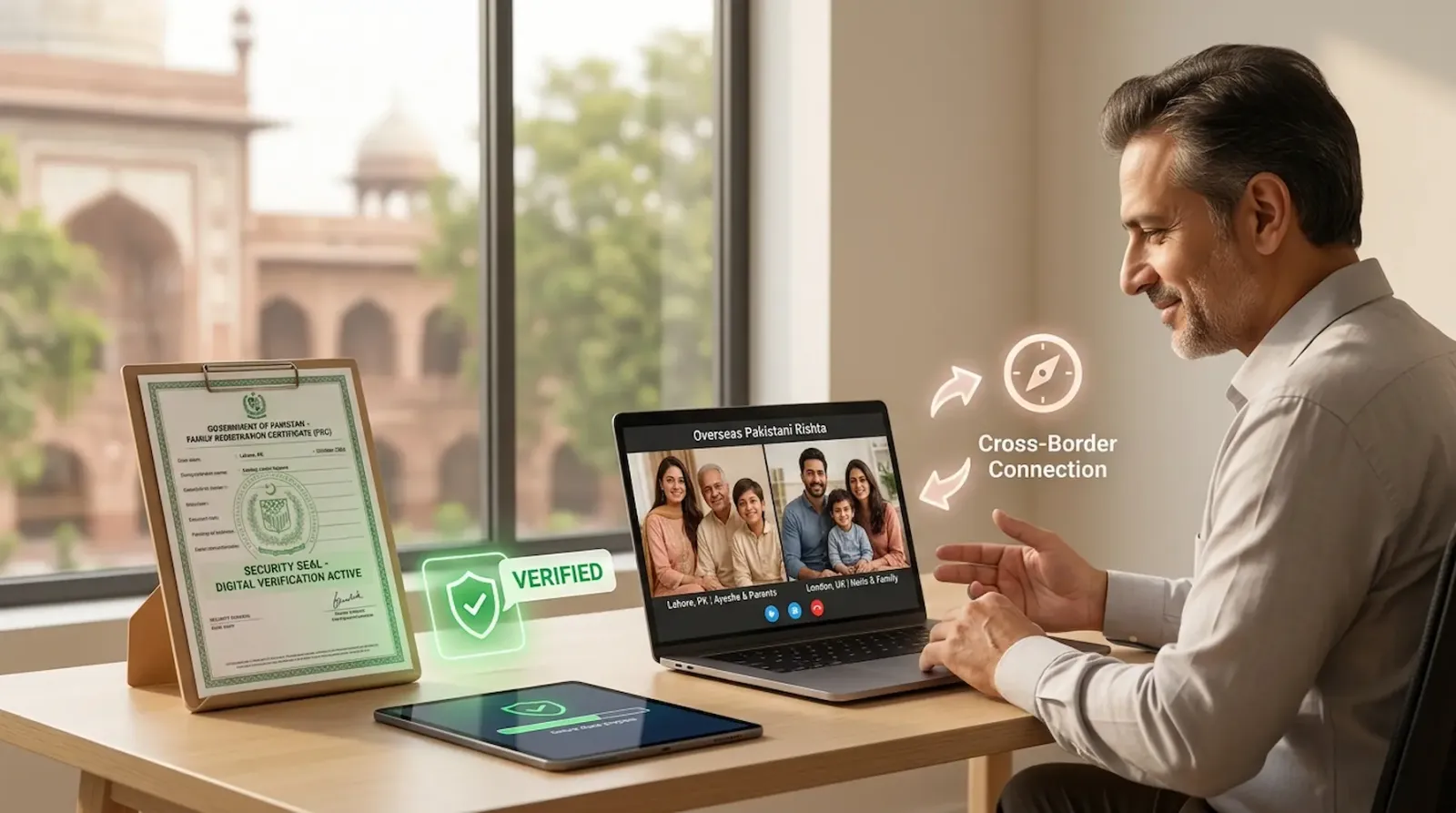
Introduction
How do you know an overseas Pakistani rishta proposal is genuine before your family invests time, trust, and reputation?
If you are a family living in Toronto, London, or Dubai, you have likely received a promising rishta proposal from Pakistan. Within days, the excitement gives way to a quiet, nagging anxiety: you have no reliable, independent way to confirm the person's background, family standing, or actual intentions.
The overseas rishta process feels fragmented across time zones and borders. Families worry about fraud, hidden expectations, and balancing modern professional lives with traditional values. Existing guidance is often overly promotional, pushing a specific app, matchmaking bureau, or paid consultation while leaving out the concrete steps required for verification and safety.
One wrong step—sharing private family details, sending money for "emergency visa fees," or rushing a nikah under pressure—can lead to financial loss, emotional harm, and lasting damage to your family's reputation. The fear is real, and the information gap makes it worse.
This guide provides a vendor-neutral, step-by-step process from profile creation to nikah. It equips you with a rigorous verification and background check checklist, actionable red flag identification, fraud prevention scripts, myth-busting insights, and structured long-distance communication protocols.
By the end of this guide, you will know exactly what documents to request, how to independently cross-check them, when to pause or stop, and how to involve family across borders with absolute confidence. Treat every proposal as unverified until independently checked. Let’s build your verification-first search.
Understanding the Overseas and NRI Rishta Landscape
Who Seeks Overseas Pakistani Rishtas?
- Overseas Pakistani professionals and established families residing in the UK, USA, Canada, Australia, UAE, and GCC.
- Second-generation diaspora youth who want cultural and religious compatibility alongside modern professional ambitions.
- Parents living in Pakistan who are coordinating search efforts on behalf of their children abroad.
- Non-Resident Pakistani (NRI) grooms and brides seeking proposals that match their education, career trajectory, and religious values.
Why Families Pursue Cross-Border Matches
- Access to a wider, more diverse pool of proposals sharing core Pakistani cultural and religious values.
- Established family connections and community networks spanning multiple countries and continents.
- The desire to balance a global professional career with traditional family expectations.
- Preference for verified, reputable families rather than unknown local options.
How Overseas Proposals Differ from Domestic Rishtas
| Aspect | Domestic Rishta | Overseas/NRI Rishta | Key Implication |
| Verification | Easier through local networks, neighborhood inquiries, and short visits. | Requires remote checks, documentation, and on-the-ground contacts. | Families must treat every proposal as unverified until independently checked. |
| Communication | In-person meetings common from early stages. | Video calls across time zones and physical distance. | Structured protocols and scheduling are essential. |
| Legal/Immigration | Usually straightforward within domestic jurisdictions. | Visa status, attestation, and cross-border steps apply. | Documented proof and cross-checking are mandatory. |
| Family Involvement | Parents are often directly involved and present. | Parents may be scattered across different countries. | Clear roles and shared expectations prevent confusion. |
The Verification-First Mindset
Treat every proposal as unverified until independently checked, no matter how impressive the profile or how warm the initial conversations feel. Prioritize verification before emotional investment, family introductions, or any financial commitment.
Expert Tip: Always conduct family-to-family video calls before any commitment, and treat repeated refusal of video calls as a serious red flag. Build your entire search around the principle: verify first, trust later.
Step-by-Step Rishta Process from Profile Creation to Nikah
Preparing a Strong, Honest Profile
- Include accurate, verifiable details: education, career history, family background, religious practice, and lifestyle expectations.
- Avoid exaggeration or omissions; inconsistencies discovered later destroy trust permanently.
- Prepare supporting documents early: CNIC, educational degrees, employment letters, and passport bio pages.
- State non-negotiables clearly, such as religious compatibility, career plans, and living arrangements.
Shortlisting and Initial Screening
- Compare incoming proposals against your family's agreed criteria: education, career, religious practice, and family reputation.
- Look for profile inconsistencies, vague employment details, or pressure to move quickly.
- Use reverse image search tools such as Google Images and TinEye to check profile photos for theft, stock imagery, or reuse.
- Request basic verification documents before investing significant personal time.
Family Meetings and Video Call Protocols
- Schedule calls at times that work across time zones, rotating meeting times to share inconvenience fairly.
- Include parents and key family members from the start; do not allow private one-on-one calls to replace family oversight.
- Prepare questions in advance: family background, education, career, religious practice, expectations for mahr and living arrangements.
- Observe how the other family responds to verification requests and whether they include elders. Use reliable platforms like WhatsApp, Zoom, and Google Meet for structured family meetings.
Verification and Background Checks
- Follow the detailed verification checklist in the next section before any commitment.
- Request and cross-check documents; involve a trusted relative or family friend on the ground in Pakistan.
- Do not skip verification even if the proposal comes through a known contact or reputable platform.
Engagement and Nikah Planning
- Only proceed to engagement after verification is complete and both families are aligned on key terms.
- Discuss mahr, finances, living arrangements, and career expectations openly early in the process.
- Plan the nikah with realistic timelines that allow for documentation, family meetings, and legal steps. Keep records of all communications and agreements.
Verification and Background Check Checklist
Identity and Family Relationship Verification
- Request CNIC copies from both the candidate and their parents.
- Ask for the NADRA Family Registration Certificate (FRC) to confirm claimed family relationships and detect inconsistencies.
- Cross-check names, parentage, and family structure against the CNIC and FRC.
Product Recommendation: Use NADRA Family Registration Certificate (FRC) and CNIC verification for family relationships; use reverse image search tools such as Google Images and TinEye for profile photos; use video call platforms like WhatsApp, Zoom, and Google Meet for family meetings; and use matrimonial platforms with verified identity badges and reporting flows, such as QuickRishta, Shaadi.org.pk, and established family networks.
If any family relationship cannot be confirmed, pause and ask for clarification.
Education and Employment Verification
- Request copies of educational degrees and certificates.
- Verify degrees through the issuing institution or official attestation channels (such as HEC in Pakistan).
- Independently verify educational and employment credentials through professional networks like LinkedIn, a company email address, or the employer directly.
- For employment, request an official letter or contract and verify by contacting the employer directly or checking the company email domain. Be cautious of self-reported income or vague job titles without supporting evidence.
Visa and Immigration Status Verification
- Request the passport bio page and any visa or immigration status documents.
- Cross-check the visa status with the issuing authority rather than accepting verbal claims.
- Understand the implications of the person's status for a future spouse visa or relocation. If the person is unwilling to share documented proof, treat that as a red flag.
Community and On-the-Ground Checks
- Involve a trusted relative or family friend on the ground in Pakistan to conduct local background and neighborhood checks.
- Contact mosque imams, family elders, and neighborhood contacts for character and family standing references. Ask specific questions about the family's reputation, behavior, and any known issues.
E-E-A-T Consideration: Cite authoritative sources such as NADRA, the FIA Cybercrime Wing, and reputable matrimonial safety resources for verification and fraud reporting. Include first-hand practitioner insights on typical documentation issues and cultural nuances. Where relevant, incorporate guidance from Islamic scholars on mahr, family involvement, and religious compatibility. This guide is periodically reviewed to keep immigration rules, platform features, and scam tactics current.
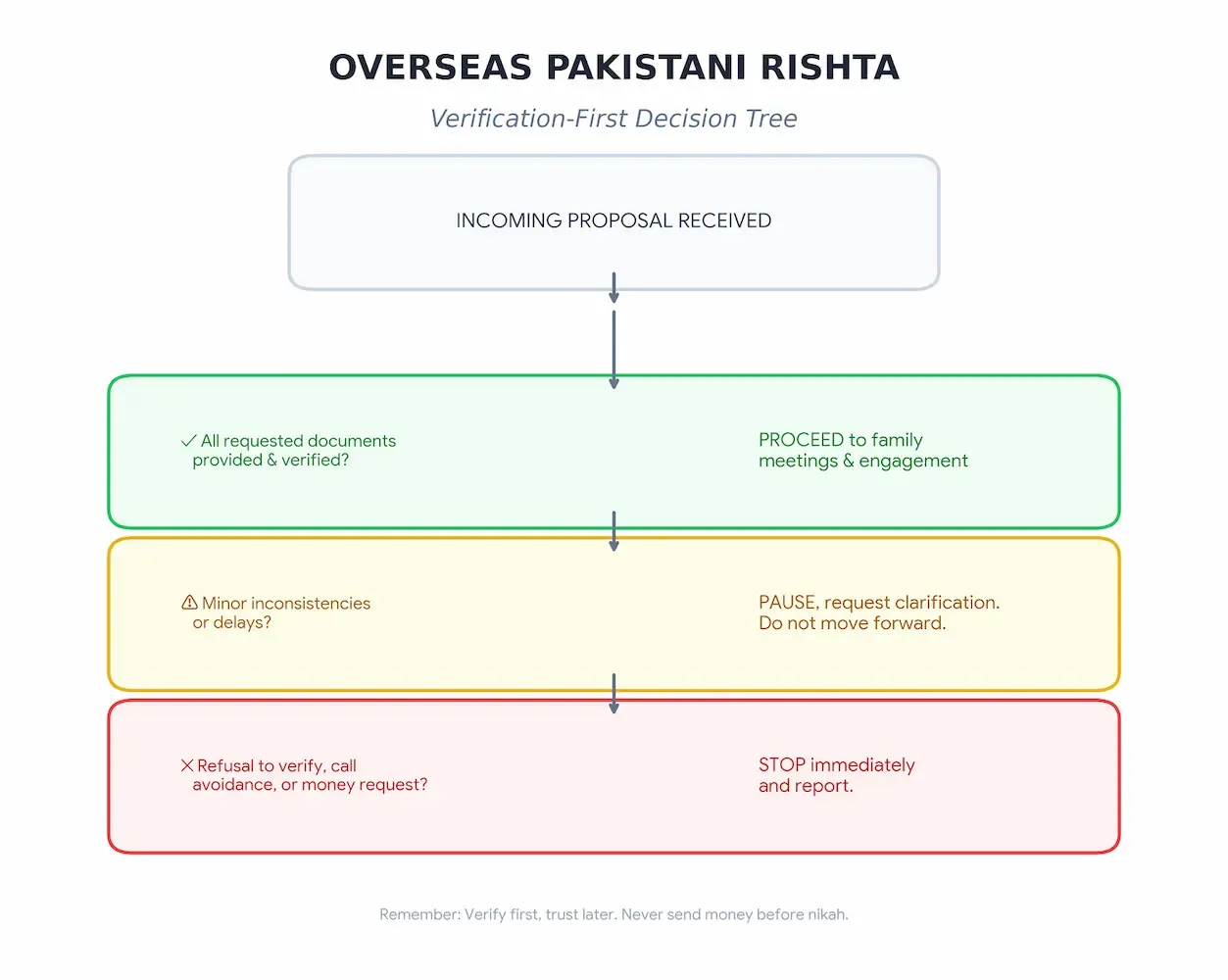
Verification-First Decision Tree
Real-World Scenario Examples
- Scenario 1 (The Rushed Proposal): A proposal pushes for a quick nikah after only two video calls and avoids sharing the FRC. Correct action: Pause, request official documents, and involve a trusted local relative.
- Scenario 2 (The Financial Scam): A proposal asks for money to cover visa processing or ticket costs before meeting in person. Correct action: Stop contact immediately, screenshot all evidence, and report the profile to the platform and the FIA Cybercrime Wing.
Documentation Checklist Table
| DocumentWhat it ConfirmsHow to VerifyWho Should Request | |||
| NADRA Family Registration Certificate (FRC) | Family relationships, parentage, and family structure | Request a certified copy and cross-check names against CNIC; verify through NADRA official channels | Parents / Senior Family Member |
| CNIC (Both Sides) | Identity, age, and family details | Verify through NADRA CNIC verification service or physical inspection | Parents / Senior Family Member |
| Educational Degrees & Certificates | Claimed qualifications | Contact the issuing institution or use official HEC attestation channels | Candidate / Family |
| Employment Letter or Contract | Job title, employer, and income | Contact the employer directly or verify through a company email domain | Candidate / Family |
| Passport Bio Page & Visa/Immigration Status | Identity, nationality, and legal status overseas | Cross-check with the issuing authority or immigration records | Candidate / Family |
| Divorce or Death Certificate (If Applicable) | Marital history | Verify with the union council or relevant legal authority | Parents / Senior Family Member |
| Character References (Mosque Imam / Elders) | Community standing and character | Contact references directly and ask specific questions | Trusted Local Relative |
Red Flags and Fraud Prevention
Profile and Photo Red Flags
- Stolen or stock photos; run reverse image searches on all profile pictures.
- Inconsistent details between the profile and submitted documents.
- Too-good-to-be-true claims about extreme wealth, high political status, or influential connections.
- Reluctance or outright refusal to share basic identity documents.
Conversation and Behavior Red Flags
- Repeated refusal of family-to-family video calls.
- Pressure to rush the nikah, engagement, or make quick financial decisions.
- Evasive answers about family background, employment history, or visa status.
- Love bombing or excessive flattery early in the conversation.
- Attempts to isolate the individual from family oversight.
Money Scam Scripts and Financial Red Flags
- Requests for money before the nikah under any framing: plane tickets, customs clearance fees, visa processing, or medical emergencies.
- Disguised dowry or jahez demands framed as cultural expectations.
- Requests for private photos or sensitive financial information early in the process.
- Never send money to a rishta contact before the nikah, no matter how convincing the story.
What to Do When a Red Flag Appears
- Screenshot all evidence and save communications securely.
- Report suspicious profiles to the platform first.
- Escalate to the FIA Cybercrime Wing if money demands or private photos are involved.
- Cease contact and inform family members immediately.
- Do not confront the person alone; involve trusted relatives.
Myth Busting on Overseas Pakistani Rishtas
- Myth: All Overseas Proposals Are Wealthy.
- Reality: Overseas Pakistanis have diverse income levels; many are middle-class professionals managing student loans or high living costs abroad. Do not assume wealth based on location; verify employment and financial standing independently.
- Myth: Green Card Motives Are Always Present.
- Reality: Many overseas Pakistanis seek genuine cultural and religious compatibility, not immigration benefits. However, motives should be discussed openly and verified through family references.
- Myth: Long-Distance Matches Are Unworkable.
- Reality: With structured communication, family involvement, and clear expectations, long-distance matches succeed regularly. Distance alone is not a reason to reject a proposal.
- Myth: Dowry or Jahez Is Always Expected.
- Reality: Disguised dowry or jahez demands are red flags, not cultural norms to accept. Discuss mahr and finances openly early to avoid hidden demands.
- Myth: Overseas-Raised Youth Are Less Traditional.
- Reality: Many second-generation diaspora youth value religious and cultural compatibility strongly. Generational gaps exist but are bridged easily with clear communication.
Long-Distance Communication and Courtship Best Practices
- Managing Time Zones: Use shared calendars to find mutually convenient times. Rotate meeting times so one family is not always inconvenienced, and respect prayer times and daily routines.
- Family-to-Family Video Call Protocols: Set an agenda before the call: introductions, key questions, and verification requests. Include parents and elders from both sides. Follow up with a written summary of what was discussed and agreed.
- First-Meeting Safety: Meet first in a public or family-hosted venue. Keep your own transport and never rely on the other party for travel arrangements. Inform a trusted friend or relative of the meeting details and expected return time.
- Balancing Modern Courtship with Traditional Values: Respect family involvement while maintaining healthy personal boundaries. Discuss expectations for communication frequency and privacy early.
Legal, Immigration, and Financial Considerations
- Visa and Immigration Status: Request documented proof of visa or immigration status and cross-check it rather than accepting verbal claims. Consult official immigration sources for current requirements.
- Mahr Transparency: Discuss the mahr amount and form early in the process. Document the agreement in writing to avoid later disputes. Be alert to disguised dowry or jahez demands.
- Cross-Border Legal Steps: Understand nikah registration requirements in both Pakistan and your country of residence. Plan for marriage certificate attestation and embassy requirements. Keep organized records of all legal documents.
- Protecting Yourself from Financial Fraud: Never send money before the nikah under any circumstances. Report suspicious requests to the platform and the FIA Cybercrime Wing immediately.
Family Involvement and Cultural Expectations
- Roles of Parents and Extended Family: Parents in Pakistan coordinate on-the-ground checks and community references. Overseas parents and siblings help with scheduling, documentation, and emotional support. Clarify responsibilities early.
- Bridging Generational Gaps: Have open conversations about preferences for education, career, and lifestyle. Find common ground on non-negotiables and flexibles.
- Handling Disagreements and Pressure: Avoid coercive pressure to rush the nikah. Involve a trusted mediator, such as a family elder or religious scholar, if disagreements arise. Remember that a rushed decision often conceals something.
Conclusion: Your Verification-First Path Forward
- Verify first, trust later. This is your golden rule.
- Use the documentation checklist and verification steps before making any commitments.
- Treat every red flag seriously and report suspicious activity without hesitation.
- Involve family across borders with clear roles and open communication.
- Save or print this guide and share it with relatives coordinating the search.
- If you encounter fraud, screenshot evidence, report it to the platform first, and escalate to the FIA Cybercrime Wing.
Compare profiles when your family is ready.
Use Weddme search filters to review profiles with clearer context before starting a serious conversation.